

crafting a link to deep time from ancient river red gum
- Written by Billy Griffiths, Lecturer, Deakin University
With a mischievous smile, Damien Wright gives the exhibit an unceremonious kick. The enormous, curved slab of river red gum rocks back and forth on the gallery floor, casting a wavering shadow over the “Do Not Touch” sign at its base.
A couple of anxious visitors shuffle over to investigate as Damien tells me how he made this wobbling wooden bowl, and why he chooses to work with the hardest, most challenging timbers.
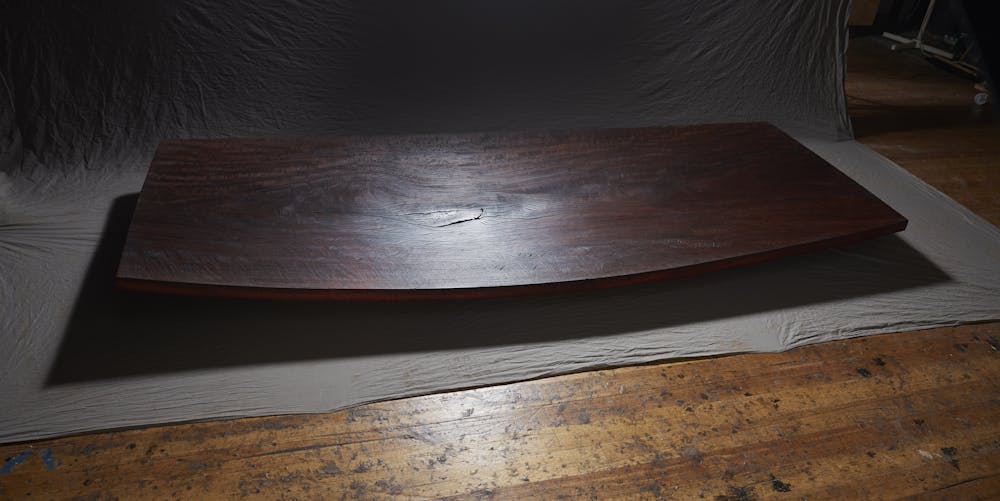 Damien Wright, ‘Food Bowl’, 2017. Recovered Red Gum, 2800 x 1300 x 250mm.
Fred Kroh
Damien Wright, ‘Food Bowl’, 2017. Recovered Red Gum, 2800 x 1300 x 250mm.
Fred Kroh
The river red gum (Eucalyptus camaldulensis) once grew on the banks of the Murray River. Damien discovered the thick slab in a miller’s yard in Wodonga, where it had lain exposed to the elements for years, slowly warping in the heat. What others had dismissed as damaged wood, Damien saw as creative possibility: he relished the opportunity to work with wood that had been “cooked, cured and crazed by the sun”.
In his workshop in Northcote, Melbourne, he worked to accentuate the warp in the wood by curving the edges of the slab, creating a long, bowing channel, almost three metres in length and over a metre wide. Like all his work, this object is an argument he has made with his hands.
The rough, red, cracking grain of the wood runs lengthways across the piece, like gullies and rivulets spreading across a parched, burnt land. Damien encourages this comparison with his title, which is a pointed commentary on the mistreatment of the waterways on which the tree grew.
“It’s called Food Bowl”, he tells me. And then, gesturing to a knot in the centre, “It drains in the middle”.
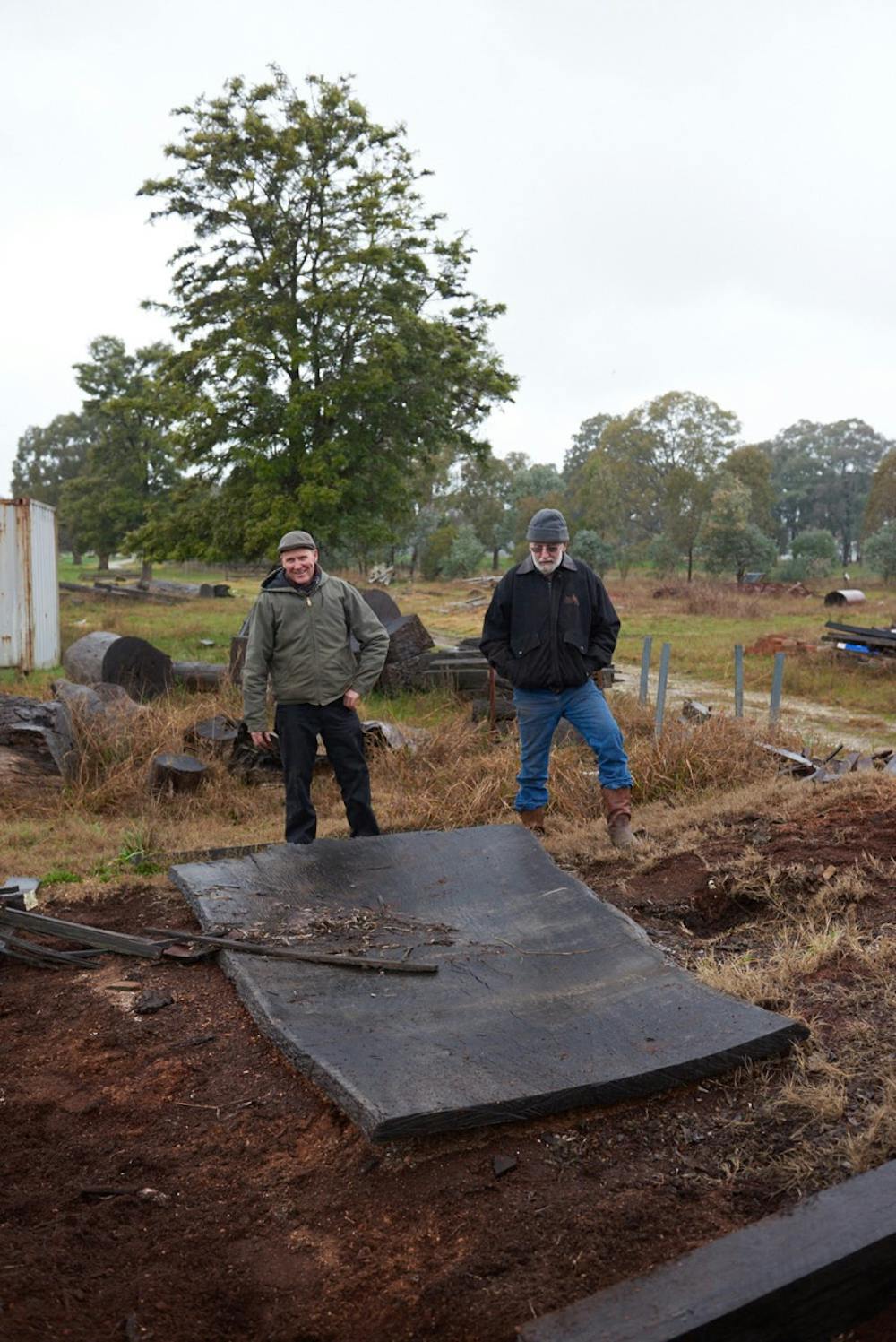 Damien Wright, left, and miller Kelvin Barton with the slab that became Food Bowl, Wodonga, 2017.
Fred Kroh
Damien Wright, left, and miller Kelvin Barton with the slab that became Food Bowl, Wodonga, 2017.
Fred Kroh
For Damien, wood is a way of thinking about place and time — even deep time. A river red gum may grow for anywhere between 400 and 1,000 years before it falls. And as it decomposes over centuries it becomes a home for new life. Murray cod lay their eggs in drowned red gums.
To work with wood is to think beyond a human lifespan. When you look at something like the Murray-Darling system from the perspective of a grand old red gum, you see the fragility and inter-connectedness of the waterway, and how rapidly it has degraded with recent human interventions.
“And if you have that conversation about deep time in this country”, says Damien, “you have to talk about Indigenous people and this continent as an occupied and cultural space, not just a physical place”.
Read more: Friday essay: when did Australia’s human history begin?
River red gums were a part of Australia’s environment long before people arrived here. They grew beside the Murray River when it was a wide, cold, fast-flowing stream; they witnessed its transformation in the late Pleistocene into a narrow, sinuous, seasonal river; and they have remained, over the past 13,000 years, as the water has slowed and warmed, forming swamps, low sand dunes and small lakes along the channel, and seasonal wetlands in the wider riverine plain.
These mighty trees have also been absorbed into the social and cultural worlds of Indigenous Australians. Their roots have been dug and hollowed out to create bowls, their bark cut to craft canoes, and their limbs burned to warm camps and cook food. In recent millennia, they presided over the most densely populated areas of the continent.
 A red gum along the Wagirra Trail in Albury, 2017. Before European settlement, wooden canoes were cut from the trees and used by the Wiradjuri people on the Murray River.
Sarah McPhee/AAP
A red gum along the Wagirra Trail in Albury, 2017. Before European settlement, wooden canoes were cut from the trees and used by the Wiradjuri people on the Murray River.
Sarah McPhee/AAP
Read more: The ring trees of Victoria's Watti Watti people are an extraordinary part of our heritage
Damien tells me how he seeks to evoke this deep history through his craft as he shows me two of his other pieces: a striking lantern (Black Lighthouse) he made in collaboration with Yolngu craftsman Bonhula Yunupingu, which glows like a fire through thin, black wood; and an elegant reading chair and angular side table called Ned — a riff on Sidney Nolan’s Ned Kelly helmet, which it closely resembles.
Each piece of furniture has been made from red gum in a stage preliminary to fossilisation. The wood is black and almost as hard as stone. It is known as ancient red gum.
While other native timbers enable Damien to explore relationships with the Australian environment, the ancient red gum opens a conversation about deep time on this continent.
Geomorphologist Jim Bowler was the first to identify the material as red gum; he used radiocarbon dating to place its age at about 8,000 or perhaps 10,000 years old. Later I call him and, over the phone, he sketches out the wood’s journey from the banks of the Murray River to the workshops of inquisitive artisans like Damien.
The tree would have seeded after the end of the last ice age, at a time when sea levels were rising and the climate was warming.
The rapid snowmelt in the Victorian Alps caused the mountains to shed huge amounts of gravel, which was then swept into the Murray River. As red gums fell into an ancient channel they were covered by this new gravel, which sealed them in the riverbank.
Preserved from decay by the acidity of the water, the entombed wood slowly absorbed enormous amounts of iron and silica. This oxidising and ebonising process is what makes it black through to the centre and hard, much harder than other red gum.
Jim first became aware of the red gum when he received some samples at the Melbourne Museum in 1990. The damp and fibrous wood had been unearthed in a quarry on Yorta Yorta land in Wodonga, where it was regarded as a nuisance by those more interested in the gravel around it.
Jim and his wife Joan Bowler recognised the significance of the timber and were eager to see it preserved and used. They helped arrange for the director of the museum to provide “authentications” for woodworkers to make it into furniture, and Joan and her friend Annetine Forell travelled the country over the following two decades, drawing the remarkable material to the attention of millers and craftspeople.
The late Kelvin Barton, a miller, woodworker and seventh-generation farmer, became a crucial intermediary. He collected the ancient red gum in Wodonga, reducing its water content in his ersatz kiln to turn it into workable timber. This was how Damien, a long-term friend and collaborator, came to encounter the ancient red gum — indeed it was in Kelvin’s yard that he found the much younger slab that became Food Bowl.
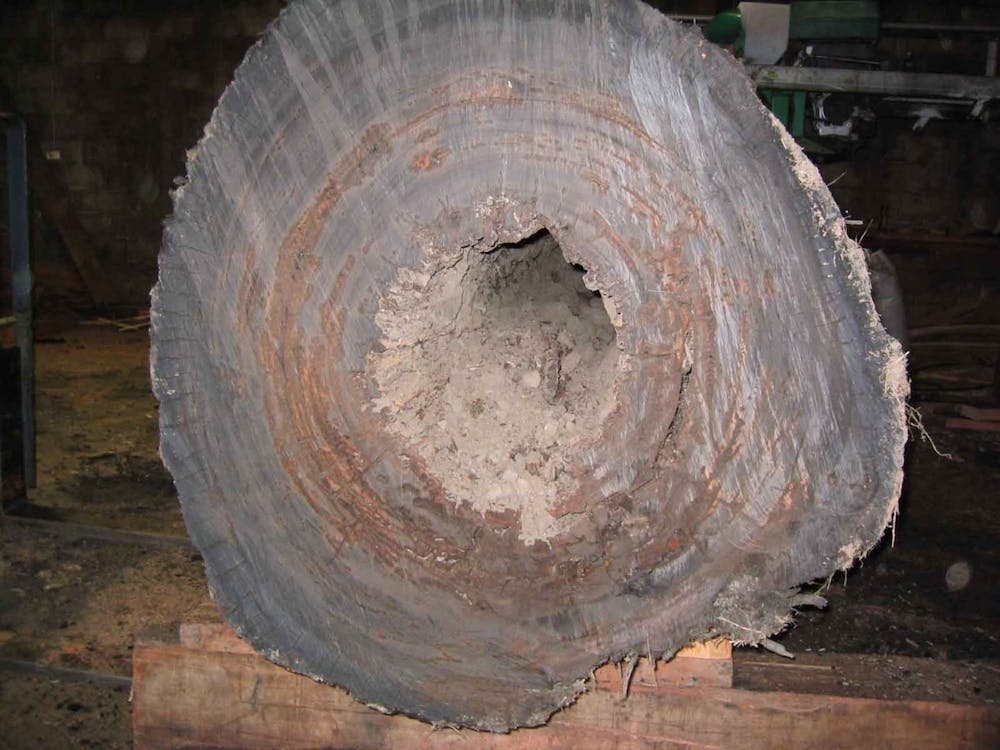 Ancient red gum, Wodonga, 2004.
Damien Wright
Ancient red gum, Wodonga, 2004.
Damien Wright
Damien uses the ancient red gum to articulate his vision for Australia. He sees craftsmanship as a language: a practice that is refined over time to communicate knowledge, beauty and ideas.
He considers his furniture — in its functionality as well as its elegance — as an embodiment of this philosophy. Objects tell stories. They become part of our everyday lives and express everyday futures:
My argument is that to take a material that is ten thousand years old and to articulate that in a beautiful and passionate way and to make that a relevant thing to our lives or to peoples’ lives is a way of articulating a future for this continent. It’s a way of understanding our place in time. It’s a way of dealing with people. It’s a way of projecting forward.
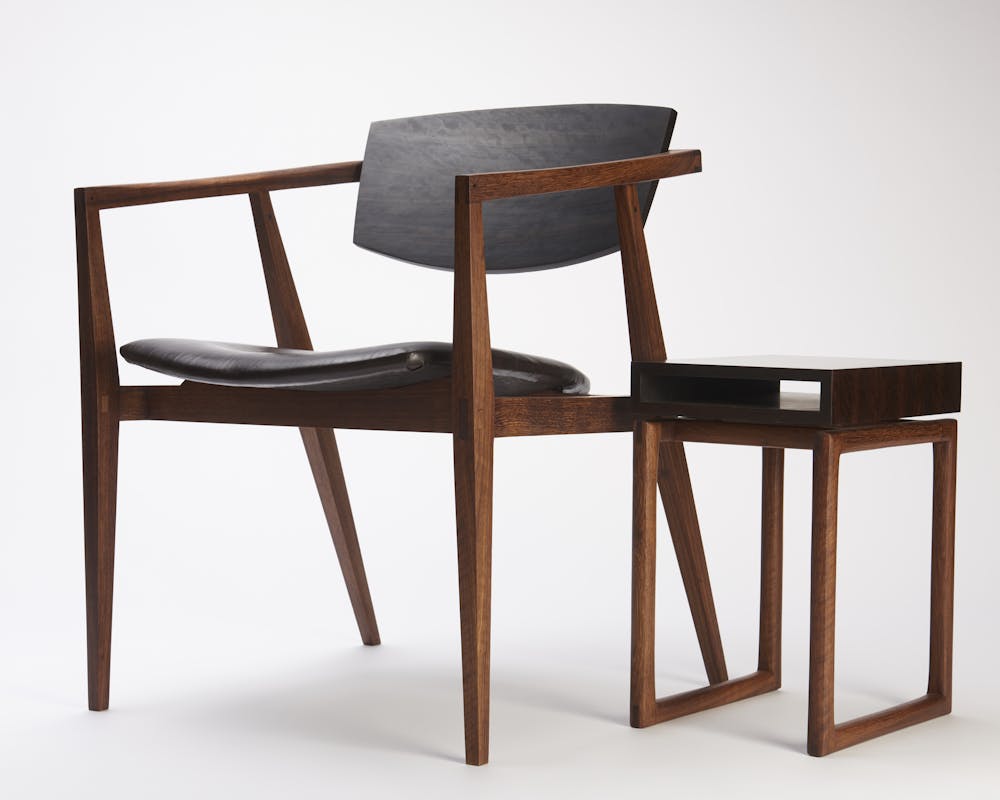 Damien Wright, Reading Chair and Ned, 2017. Ancient red gum and recovered black bean.
Fred Kroh
Damien Wright, Reading Chair and Ned, 2017. Ancient red gum and recovered black bean.
Fred Kroh
Joan Bowler shares this vision for the ancient timber. In 2008, her company Australian Ancient Redgum donated a six-metre “Fossil Tree” to the Children’s Garden at the Royal Botanic Gardens Victoria, so that “children can sit under this ancient tree and look up through the hollowed out centre and dream of what was and what might be”.
Trees that were seeded after the end of the last ice age, that survived the ruptures of invasion and industry, have reemerged to offer a deep-time perspective of the continent.
It is a scale that reveals the long-term costs of short-term exploitation, and renders processes like the degradation of the Murray-Darling river system into sudden events.
Ancient red gum also invites a longer view of Australian history. And in the hands of Joan and Damien, it calls for the acknowledgement of cultures and histories that for so long have gone unrecognised.
This is an extract from Living with the Anthropocene, Love, Loss and Hope in the Face of Environmental Crisis, edited by Cameron Muir, Kirsten Wehner & Jenny Newell (New South Books).
Authors: Billy Griffiths, Lecturer, Deakin University

















