

With a mandate to govern New Zealand alone, Labour must now decide what it really stands for
- Written by David Hall, Senior Researcher in Politics, Auckland University of Technology
A pandemic can change the foundations of a society. But if this happens in New Zealand over the next three years, it will be for reasons beyond the control of the sixth Labour government. When it comes to the fundamental structure of state and economy, Labour is broadly committed to the status quo.
This was confirmed on election night when Prime Minister Jacinda Ardern, wearing a Labour red dress before a National blue background, declared: “We will be a party that governs for every New Zealander.”
In times of upset, people yearn for normality — and Ardern’s Labour Party was awarded a landslide for achieving something close to this. The risk of a further COVID-19 outbreak is ever present, as today’s announcement of a community transmission case in Auckland reminded us.
Nevertheless, international spectators view our pandemic response with a wistful gaze. At a time when many nations went sour on liberal democracy and rolled the populist dice, New Zealand appears on the world stage like a tribute act to third-way politics, a nostalgic throwback to the relative sanity and stability of the long 1990s.
Yet for many people who live in Aotearoa New Zealand, the status quo isn’t working, and hasn’t for some time. These tensions are only intensifying.
Housing unaffordability is on the rise again, with implications for wealth inequality and deprivation. This is compounded further by the cascading economic effects of the global pandemic and unconventional manoeuvres in monetary policy that are pushing house prices higher.
Without remedial action, this inequality will leave New Zealand society more exposed to future shocks, not only from COVID-19, but also the multiplying risks of climate change, biodiversity collapse, digital disruption and international instability. Inequality ensures uneven impacts, a recipe for further discontent and conflict.
 The headline says it all: but what will Labour do with that power?
GettyImages
The headline says it all: but what will Labour do with that power?
GettyImages
No party for ideologues
Even from a purely electoral perspective, the Labour Party can’t afford inaction. It is easy to forget how precarious the prime minister’s position was at the beginning of the year. She could boast enough policy wins to stack an early campaign video, yet hadn’t pulled a fiscal lever large enough to convince the public that her government was truly “transformational”.
Entering a second term, her policy agenda is more recognisable by what she won’t do than what she will — no capital gains tax, no wealth tax, indeed no new taxes at all beyond a tweak for the highest earners.
This leaves us with the longstanding conundrum of what the Labour Party is and what it really stands for these days. Ardern and her colleagues are not ideologues, but no politics is without ideology — a system of ideas, values and beliefs that orients its efforts.
Read more: New Zealand's new parliament turns red: the 2020 election results at a glance
I’ve argued in the past that Ardern’s government has a spirit of civic republicanism. This has met with reasonable scepticism, yet in the midst of the pandemic it feels more relevant than ever. With borders drastically restricted, and old allies going wayward, there is a renewed sense of separateness, of independence in the world.
Might the pandemic seal New Zealand’s fate as the Commonwealth of Oceana, as a 21st century version of 17th century English republican John Harrington’s utopian island?
Kindness as a political virtue
The first symptom of republicanism belongs to Ardern herself. She is the active citizen par excellence. She embodies civic commitment and public-spiritedness, along with a good dose of humility. Even in emergencies, she remains one of us: primus inter pares, “first among equals”.
Analysts of Ardern’s political leadership emphasise her openness, honesty, self-discipline, empathy and, above all, her authenticity. For civic republicans, the exercise of such virtues is the lifeblood of public life. Indeed, insofar as Ardern has a distinctive political agenda, it is centred on the virtue of kindness.
Arguably, this has displaced the more principled commitments that might guide substantive structural reform. But kindness also provided vital emotional leadership in the raw moments following the Christchurch mosque attacks and the outset of the pandemic.
Read more: Jacinda Ardern and Labour returned in a landslide — 5 experts on a historic New Zealand election
As the 18th century philosopher Montesquieu said, “Virtue in a republic is a most simple thing: it is a love of the republic.” Few could doubt Ardern’s devotion to the nation. But for the Labour Party, as for republicans, this has an exclusionary aspect.
Given the emphasis on citizens, republicans have tended to prioritise “us” over “them”. In the Athenian republic, only citizens could participate in democracy, and only wealthy men could be citizens — not women, not slaves, not foreigners.
Similarly, in New Zealand’s “team of five million”, only citizens have the full spectrum of rights and entitlements. For more than 300,000 temporary visa holders, whose compliance with pandemic restrictions was vital for containing the outbreak, there was minimal solidarity from government.
Many were frozen out of jobs during lockdown, unable to relocate due to visa conditions, and excluded from social welfare support. Others were stuck outside the country until very recently, unable to re-enter. From a liberal or internationalist perspective, this is hard to swallow. But there is a nativist strain within the Labour Party which will relish these harder borders.
None of this is to say that Labour’s politics aren’t liberal or social democratic. Ideologies can be mixed in the same way that economies can be. It is to say, more modestly, that some of the qualities that characterise the Ardern government align with civic republicanism.
And this helps to resist the lazy analysis that this government is nothing more than a continuation of what came before, another phase in an undifferentiable centrist blob.
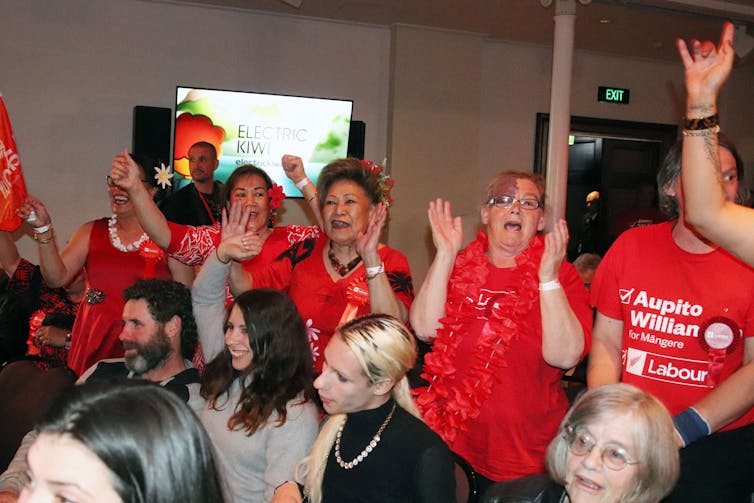 Pasifika Labour Party supporters celebrate as results roll in. The challenge is now to deliver for New Zealand’s least well-off communities.
GettyImages
Pasifika Labour Party supporters celebrate as results roll in. The challenge is now to deliver for New Zealand’s least well-off communities.
GettyImages
Neither socialist nor purely liberal
But where to next? Firstly, this is not a government of pure socialist intentions. Accusations of this kind come from a place of confusion, delusion, or plain mischief. Socialism, simply put, involves collective ownership of the means of production.
This government already relinquished an unprecedented opportunity to socialise the economy when it implemented its wage subsidy scheme at the outset of the pandemic.
Public debt is growing precisely to keep private businesses in private hands. Labour’s resistance to substantive tax reform, even to reduce the debt it insists it must pay back, reveals its abandonment of redistribution as a practicable tool for social change.
Read more: NZ election 2020: Jacinda Ardern promised transformation — instead, the times transformed her
Secondly, this is not a government of purely liberal intentions. It is ambivalent about the free flow of people and capital. Attorney-General David Parker, in particular, has prioritised citizens through restrictions on overseas buyers of housing and the “national interest” test for foreign investment.
It is notable that former National prime minister John Key, guided by a vision of global liberalism that is increasingly endangered, is still railing against this.
Ardern’s government is also unembarrassed about a more active role for the state. Its approach for housing is illustrative — not just its boost to state-owned housing, but especially its embrace of the state’s potential as a developer providing houses directly to market.
Liberals see this as mere interference, but republicans tolerate government intervention wherever it improves the lives of citizens. In the wake of the pandemic, voters will be prone to agree.
The danger of losing trust
This touches on the defining feature of civic republicanism: its commitment to freedom from domination. Republicans accept the kinds of intervention that liberals fear, as long as they free people from situations of oppression and subjugation.
Domination should also be broadly understood to include regulations, poverty, sexism, racism, environmental degradation, employment relations — anything that thwarts our cherished projects.
This is where the republican spirit mostly clearly intersects with the sixth Labour government’s interest in well-being. The purpose of worrying about well-being is to improve people’s capabilities to live the kinds of lives they most value.
Because the aforementioned forms of oppression curtail such freedoms, we have a duty to overturn them, through intervention if necessary. Well-being economics isn’t merely about measurement; it is an emancipatory project.
Ardern’s government is most vulnerable to criticism when it falls short of this ideal — for example, the oppressive practices of Oranga Tamariki or ineffective infrastructure development. If voters won’t punish Ardern for not being socialist or liberal enough, they might still penalise her for failing to make real these republican impulses.
It is said that, in politics, what lifts you up is what will eventually drag you down. When the virtues of openness fail to strengthen transparency, when state intervention fails to deliver outcomes competently or effectively, when appeals to “the people” paper over vital differences, when the politics of kindness fail to prevent suffering — this is where trust will be lost.
The danger of electoral dominance is becoming your own worst enemy.
Authors: David Hall, Senior Researcher in Politics, Auckland University of Technology

















