

We can no longer ignore the threats facing the Pacific — we need to support more migration to Australia
- Written by Jane McAdam, Scientia Professor and Director of the Kaldor Centre for International Refugee Law, UNSW
The effects of a warming planet are no longer far away in time or distance. We are witnessing transformed landscapes, mass extinctions and people on the move, whether by force or choice.
Across the globe, the adverse effects of disasters and climate change are already prompting millions of people to move. More people are now displaced within their countries each year by disasters than by conflict.
The Asia-Pacific region has been the hardest hit by these disasters.
In the Pacific islands, king tides, cyclones, droughts and flooding displace people on a regular basis. Countries like Kiribati and Tuvalu are now facing existential questions about their capacity to sustain their populations into the future.
‘Burying our heads in the sand’
There are potential consequences for Australia, too, which may disrupt many of our foreign and domestic policy agendas – including energy, environment, foreign aid, national security, labour and migration.
This is why Pacific governments, including Australia, are currently engaged in talks about how migration could alleviate pressure on threatened Pacific island nations and become a climate change adaptation strategy.
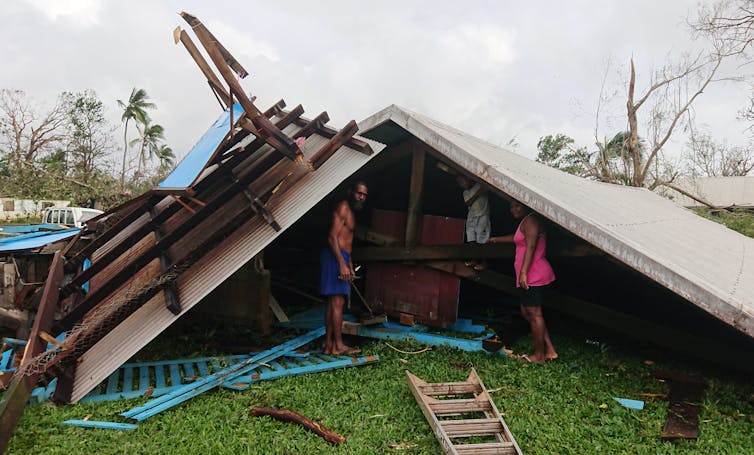 Cyclone Harold badly damaged Vanuatu in April of this year.
JULIAN BLUETT/PR handout
Cyclone Harold badly damaged Vanuatu in April of this year.
JULIAN BLUETT/PR handout
Most Pacific Islanders want to remain in their homes. Policies designed to reduce their exposure to disaster risks, improve their adaptation to climate change and bolster their development can all help.
But at the same time, Pacific communities acknowledge
that the movement of people needs to be discussed … [and] failing to do so will be like burying our heads in the sand.
Most displacement in the Pacific is temporary and internal, but it is occurring with increasing regularity.
Some Pacific governments have already developed guidelines on internal displacement and planned relocations in the context of climate change and disasters. Fiji has established a trust fund to support relocations. (New Zealand has contributed A$3 million to the fund).
How Australia can expand visas for Pacific islanders
Australia could play a much bigger role in this effort, too.
A new Kaldor Centre policy brief argues that smarter Australian migration policies could give Pacific peoples more choice to take control of their own lives.
By creating more temporary and long-term visa opportunities, Australia could provide a release valve for Pacific islanders at risk of displacement.
If only 1% of the Pacific’s population was permitted to work permanently in Australia, this would bring more benefits to the region than Australia’s annual aid contribution. Migration can enhance the resilience of those who move, as well as those who stay behind.
Australia already has targeted Pacific work schemes: the short-term Seasonal Worker Programme and the longer-term Pacific Labour Scheme.
These could be expanded and complemented by additional initiatives, such as
special educational or training visas
preferential access to existing labour, education or family visas
humanitarian visas to assist those displaced by disasters, or those already in Australia when a disaster strikes and who cannot safely return home.
Australia should also create a visa category similar to New Zealand’s longstanding “Pacific Access Category”.
This enables 650 Pacific Islanders from specific countries (plus their families) to become permanent residents of New Zealand annually. The Samoan quota resident visa allows 1,100 Samoans to come, as well.
The New Zealand schemes are based on a ballot that prevents “cherry picking” based on people’s skills, going some way to alleviate concerns about a brain drain resulting in Pacific nations.
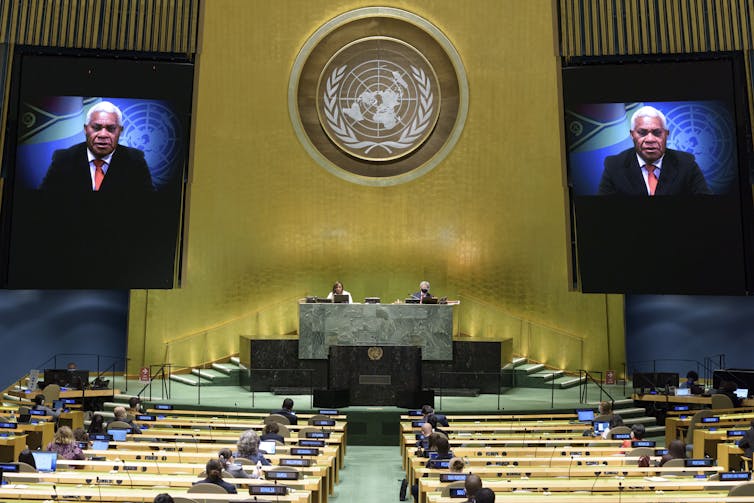 At the UN General Assembly last month, Vanuatu’s prime minister stressed the need for increased funding to combat climate change.
Manuel Elías/AP
At the UN General Assembly last month, Vanuatu’s prime minister stressed the need for increased funding to combat climate change.
Manuel Elías/AP
Migration can be a win-win
The lockdown of borders in response to COVID-19 has wrought unprecedented damage to the already vulnerable economies of the Pacific.
Dame Meg Taylor, secretary general of the Pacific Islands Forum, powerfully observes that the pandemic’s
humanitarian and economic fallout offers us a glimpse of what the global climate change emergency can become – if it is left unchecked and if we do not act now.
As Australia reshapes its Pacific policies in response to COVID-19, dignified migration should be front and centre.
The pandemic itself has revealed just how reliant Australian horticulture is on Pacific seasonal workers; likewise, seasonal employment is a lifeline for many Pacific families.
Increased migration could thus be a win–win strategy in the face of climate change, as well.
Read more: Pacific nations aren't cash-hungry, minister, they just want action on climate change
Authors: Jane McAdam, Scientia Professor and Director of the Kaldor Centre for International Refugee Law, UNSW

















