Heading back to the playground? 10 tips to keep your family and others COVID-safe
- Written by Thea van de Mortel, Professor, Nursing and Deputy Head (Learning & Teaching), School of Nursing and Midwifery, Griffith University
In some Australian states, kids have been back on slides, swings and monkey bars for months. But in Victoria, many families are only now getting back to playgrounds, after they were closed for much of the second lockdown.
With lots of kids running around, and parents looking on, how can you ensure your trip to the playground is COVID-safe for you, your children and others?
A good place to start is to understand how COVID-19 spreads, and what you can do to interrupt it.
Droplets big and small
According to the US Centers for Disease Control and Prevention, the main way SARS-CoV-2 (the virus that causes COVID-19) spreads is by droplet transmission.
Droplets containing virus particles are released from the mouth or nose when someone who is infectious coughs, sneezes, laughs, talks or even breathes. The more vigorous the activity, the greater the volume of droplets and spread (so, for example, laughing releases more droplets than breathing).
Larger droplets fall to the ground relatively quickly and within a short distance of where they were released. But you can inhale them if you’re standing close to an infected person.
Smaller droplets, or aerosols, can travel further and hang around for longer in the air. Scientists are still working to understand the importance of this form of transmission — commonly termed airborne transmission — in the spread of COVID-19.
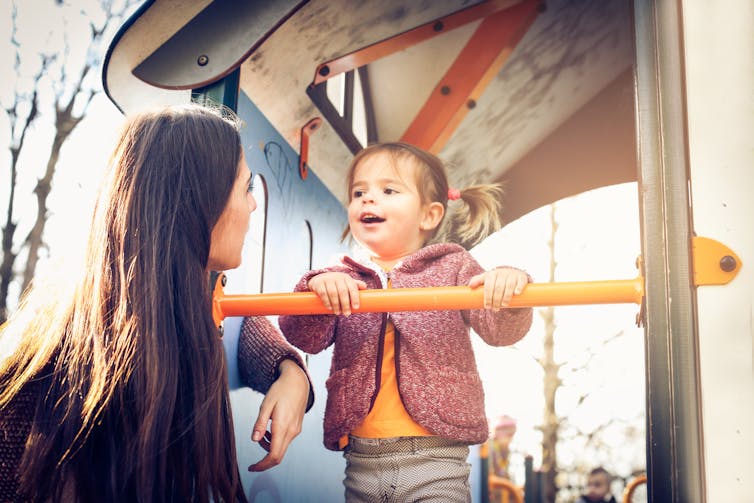 COVID-19 meant playgrounds were closed for a while.
Shutterstock
COVID-19 meant playgrounds were closed for a while.
Shutterstock
Another possible route of transmission is contact with contaminated surfaces. This happens when infectious droplets fall onto surfaces, or contaminated hands touch surfaces. If an uninfected person touches the contaminated surface and then touches their face or food, they may ingest virus particles and become infected.
A recent laboratory study found SARS-CoV-2 particles can remain both detectable and viable (able to cause infection) on surfaces for many days, particularly if the surfaces are smooth, such as metal or plastic. As with airborne transmission, scientists are still figuring out how common this mode of transmission is for COVID-19.
Read more: That public playground is good for your kids and your wallet
Playgrounds are outdoors, so that’s a plus
The good news about playgrounds is they’re generally outdoors in parks. The risk of inhaling infectious droplets is reduced because the large volume of air has a dilution effect, compared with being in a confined space indoors with other people. Outdoor breezes can also disperse particles.
The temperature also appears to influence the risk. Warmer temperatures have been shown to reduce the viability of SARS-CoV-2 more quickly than cooler temperatures, while sunlight may also help inactivate the virus. In Australia, of course, we’re now heading into the warmer and sunnier summer period.
On the other side of the coin, public playground equipment may not be cleaned regularly. So there could be some risk of transmission via contaminated surfaces.
And while warmer weather and particularly being outdoors may protect us to a degree, as with anything during the pandemic, a small level of risk remains.
Read more: 'Stupid coronavirus!' In uncertain times, we can help children through mindfulness and play
10 tips to stay COVID-safe at the playground
Check the restrictions and requirements in your state around mask wearing, how far you can travel, and the number of people permitted in a space before heading to a playground.
Don’t go to the playground if you or your child is sick or has any COVID-19 symptoms (fever, cough, sniffles, upset tummy).
Keep your distance (at least 1.5 metres) from anyone not in your household. While it’s tempting to socialise with other parents, avoid congregating closely with others.
Take disinfectant wipes or wet wipes with you and wipe down areas little hands frequently touch (such as swing chains) before your kids use the equipment, particularly if they’re too young to understand instructions.
Take hand sanitiser with you (minimum 60% alcohol). Ensure your children sanitise their hands before getting on the equipment, after playing, before eating and before leaving the playground. Supervise young children when they use alcohol-based hand sanitiser. Parents should regularly sanitise too.
Avoid using shared taps or water fountains; instead, bring bottled drinks. Frequently touched surfaces such as taps are more likely to be contaminated.
Remind children to avoid touching their face while using the play equipment.
Avoid physical contact between your kids and other kids in the area.
Avoid sharing toys with other children. If you bring toys, make sure they’re washable.
Use the playground outside of peak use periods to reduce the amount of contact with others.
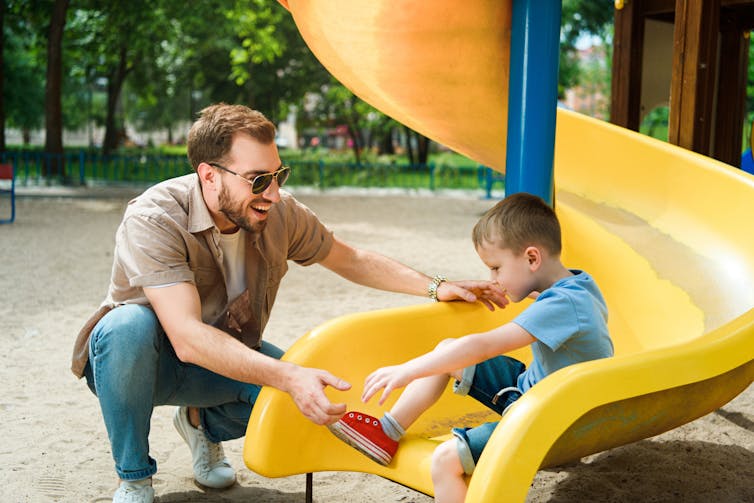 If possible, it’s good to visit the playground at a time it might be quieter.
Shutterstock
If possible, it’s good to visit the playground at a time it might be quieter.
Shutterstock
While younger children may not understand or follow instructions well about keeping away from other children or touching their face, fortunately, they appear to have a lower risk of being diagnosed with COVID-19, and of developing severe disease if they are infected.
The focus with young children should be on frequent hand hygiene and preventing physical contact with non-family members as much as possible.
With little COVID-19 transmission in Australia now, and most playgrounds being outdoors, a trip to the playground is fairly low-risk, and we know physical activity carries many benefits for children and adults alike. But we can all do our part to minimise any risk of transmission.
Authors: Thea van de Mortel, Professor, Nursing and Deputy Head (Learning & Teaching), School of Nursing and Midwifery, Griffith University