Research shows whipping horses doesn't make them run faster, straighter or safer — let’s cut it out
- Written by Kirrilly Thompson, Adjunt Senior Research Fellow, University of South Australia
The Melbourne Cup is upon us. This year will be different due to COVID-19 — but one thing we don’t expect to change is concern about horses’ welfare, which seems to resurface each year.
Just days before the Cup, Victoria’s parliament has heard allegations that unwanted thoroughbreds continue to be slaughtered in knackeries and abattoirs in New South Wales, The Guardian reports.
Billionaire executive chair of Harvey Norman Gerry Harvey reportedly apologised after one of his ex-racehorses was sent to a pet food factory for slaughter, despite the state’s racing industry announcing rules against this in 2017. It’s not the first time we’ve heard of such gruesome cases.
Read more: Who's responsible for the slaughtered ex-racehorses, and what can be done?
Beyond this, there are persisting concerns about how racehorses have been ridden for more than a century. In particular, the use of the whip to “encourage” horses to run faster and straighter has been shown to potentially be both painful and dangerous.
For our research, published yesterday in the journal Animals, we analysed more than 100 race reports to determine exactly how whip use influences the dynamics of a race.
We found whips make no difference to horse steering, jockey safety, or even a horse’s speed. Our study offers scientific findings that support Racing Victoria’s recently announced plan to gradually phase out whip use until whips are only being used when absolutely necessary.
Justifications from the racing industry
Advocates of whip use, such as Racing Australia and the British Horseracing Authority, claim it’s necessary for horse and rider safety. They argue it facilitates the steering necessary to reduce interference between horses on the course.
Another justification given is that whipping makes horses run faster. This is considered fundamental to racing integrity. In a billion-dollar industry that relies on gambling, all parties — including punters, trainers, breeders and owners — want to know the horse they’ve backed will be given every opportunity to win.
For many racing aficionados, breaches of “integrity” and the thought of a horse not being fully “ridden out” on its merits is just as corrupt as the horse being doped, or a race being fixed by some other means.
 Last year’s Melbourne Cup first prize winner received A$4,400,000 in prize money.
Vince Caligiuri/AAP
Last year’s Melbourne Cup first prize winner received A$4,400,000 in prize money.
Vince Caligiuri/AAP
The growing importance of racehorse welfare
But animal welfare is also important to racing integrity, according to the International Federation of Horseracing Authorities and other racing bodies.
Racing stewards are in the unenviable position of enforcing horse welfare during races, while also having to ensure whips are used to give each horse full opportunity to win.
For all official races in Australia, there are detailed regulations for the number and style of whip strikes allowed at the different points of a course.
Research over past decades has concentrated on jockeys’ accuracy, compliance with whip rules, the link between whip use and catastrophic falls that can injure or kill horses or jockeys and simply whether or not whipping hurts.
But until now, few have stopped to ask whether whips actually work. That’s simply because there hasn’t been a way to scientifically test the culturally entrenched assumption they do.
Read more: Whips hurt horses – if my leg's anything to go by
Racing without using the whip
However, since 1999, a form of whipping-free racing has been conducted in Great Britain via the “hands and heels” racing series for apprentice jockeys. In this form of racing, jockeys are permitted to carry whips but can’t use them unless under exceptional circumstances, such as trying to avert a collision.
After races, stewards produce an official report noting any unusual or unorthodox jockey behaviour (which may or may not have affected race placings), jockey infringements, horse movement on the course, interference between horses, and veterinary issues.
We analysed reports for 126 races involving a total of 1,178 starters (horses and jockeys). These included all 67 hands and heels “whipping-free” races in the period starting January 2017 and ending December 2019. For these, we were able to case-match 59 traditional “whipping-permitted” races.
Thus, we were able to compare the performance of racehorses under both “whipping-free” and “whipping-permitted” conditions in real racing environments, to figure out whether whipping makes horses easier to steer, safer to ride and/or more likely to win.
Our results indicated no significant differences between horse movement on the course, interference on the course, the frequency of incidents related to jockey behaviour, or average race finishing times.
Put simply, whip use had no impact on steering, safety or speed. Contrary to longstanding beliefs, whipping racehorses just doesn’t work.
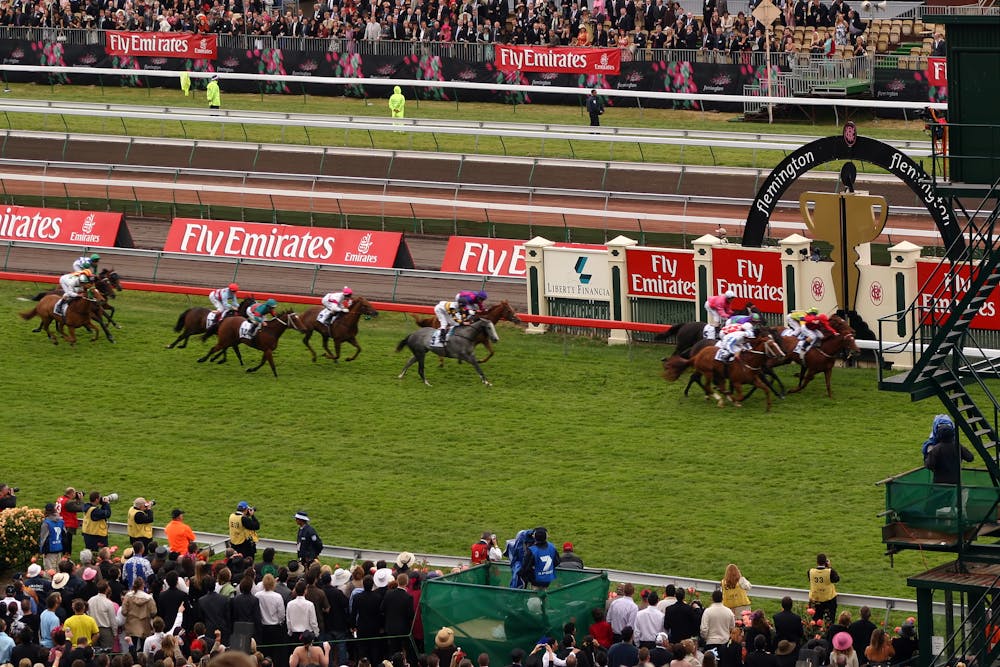 The Melbourne cup has been running for more than 150 years, with the first official cup trophy awarded in 1865.
Shutterstock
The Melbourne cup has been running for more than 150 years, with the first official cup trophy awarded in 1865.
Shutterstock
The way forward
Our findings reinforce the need for more support for whipping-free races. Importantly, they indicate whip use could potentially be banned without any adverse effect on horses, riders or racing integrity.
“Whipping-free” races are not the same as “whip-free” races. While some might argue for races with no whips at all, an agreeable compromise would be to let jockeys carry whips, but only use them if their safety is jeopardised.
This approach has already been adopted in Norway, where whipping-free races have been held for more than 30 years with no apparent negative consequences.
Given evolving social values, we believe transitioning to a whipping-free approach is essential for the future of an industry that relies on a social licence to operate.
Read more: Dressing up for Melbourne Cup Day, from a racehorse point of view
Authors: Kirrilly Thompson, Adjunt Senior Research Fellow, University of South Australia