

Can New Zealand's most diverse ever cabinet improve representation of women and minorities in general?
- Written by Jennifer Curtin, Professor of Politics and Policy, University of Auckland
Two weeks after Labour’s landslide election win, Prime Minister Jacinda Ardern announced a ministry that is more diverse than any seen before in New Zealand.
Of those inside cabinet, 40% are women, 25% are Māori (two in five of those are women), 15% are Pasifika (two in three are women), and 15% are LGBTQI — one of whom is Deputy Prime Minister Grant Robertson.
Beyond the 20 cabinet ministers, there are four ministers outside cabinet and two undersecretaries. Of these six, three are women, two are Māori, one is Pasifika and one is Indian. Green Party co-leaders Marama Davidson and James Shaw are also associate ministers outside cabinet. The diversity of Ardern’s new government runs deep.
There remain important voices missing from cabinet, however. As Jonny Wilkinson of disability support network Tiaho Trust noted, disabled people are the largest minority group in New Zealand but they lack representation in parliament and cabinet.
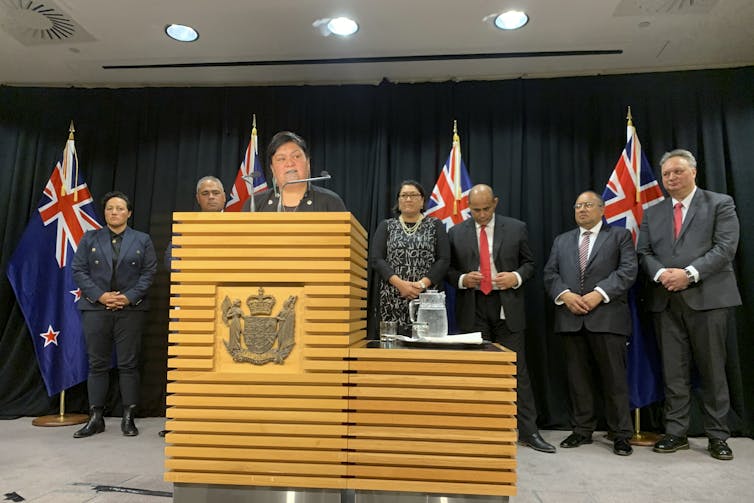 Race and gender diverse: new foreign minister Nanaia Mahuta, flanked by other senior Māori ministers.
Greater diversity over time
In 2017 Ardern set herself a target of a gender balanced cabinet. She missed achieving this in 2020 despite demands for, and achievement of, increased gender parity in government executive branches globally in recent years.
As the proportion of women in parliament increases, it is argued, so too does the pool of eligible candidates from which the prime minister can select women ministers.
Some leaders have ignored this, including former Australian prime minister Tony Abbott, who claimed there were insufficient women parliamentarians with the experience needed for cabinet. That position has become increasingly untenable over time.
Read more: Her cabinet appointed, Jacinda Ardern now leads one of the most powerful governments NZ has seen
While large scale comparative studies suggest women leaders are no more likely than their male counterparts to select women ministers, in New Zealand we know that it was Labour’s Helen Clark who substantially increased the proportion of women promoted to cabinet (from 11% in 1996 to 35% in 1999).
National Party Prime Minister John Key followed her example, ensuring his cabinets comprised at least 30% women. Ardern has moved the bar higher by selecting 40% women.
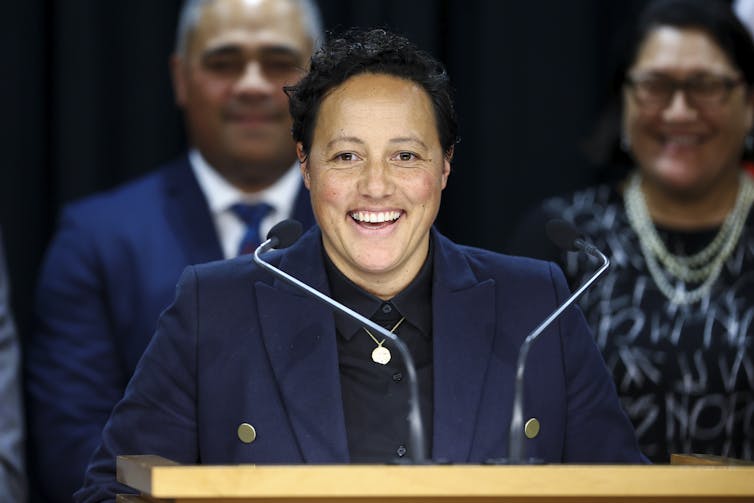 New to cabinet: Kiri Allan will be minister of conservation, minister of emergency management, associate minister for arts, culture and heritage, and associate minister for the environment.
GettyImages
New to cabinet: Kiri Allan will be minister of conservation, minister of emergency management, associate minister for arts, culture and heritage, and associate minister for the environment.
GettyImages
The gender quota debate
That we have yet to reach gender parity may raise questions in New Zealand and elsewhere. However, our major parties have long resisted implementing strict gender quotas, meaning incremental progress is the norm. That said, our global gender ranking has gone from 50th equal to 26th equal.
This contrasts with Canada’s Justin Trudeau, who in 2015 made history when he selected his first gender parity cabinet. There had been criticism of the policy by pundits who argued diversity and merit could not co-exist, but Trudeau’s response was pithy: “Because it’s 2015.”
Read more: New MP Ibrahim Omer's election highlights the challenges refugees from Africa face in New Zealand
Five years on, Ardern may have anticipated similar resistance. Asked about the basis of her cabinet selection, she said it was based on “merit, talent and diversity”. Gender balance was the byproduct, in other words.
We also know that not all ministries are created equal. Globally it is finance, foreign affairs, defence and other highly resourced portfolios that are most prized. These usually make up the leader’s inner circle (remember former Labour Prime Minister David Lange’s all male “fish and chip brigade”).
However, the Interparliamentary Union’s annual maps of women in world politics reveal these ministries continue to be allocated more often to men than women.
Women inside the inner circle
This is not the case in Labour’s new cabinet. Ardern’s inner circle (or top five if the photos are anything to go by) includes two women. The top ten positions in cabinet are shared equally between the sexes, with the portfolios alternating between women and men in order of seniority.
New Zealand’s first female foreign affairs minister is Nanaia Mahuta, former associate minister of trade and a senior member of Labour’s Māori caucus. Fourth ranked Megan Woods, who holds a number of big-budget portfolios, has been made associate minister of finance.
Read more: Why equal health access and outcomes should be a priority for Ardern's new government
There are four new women ministers (one of whom has come straight into cabinet from outside parliament), who have portfolios of their own but who are also associate ministers working with other senior ministers. This is an important strategy — if those senior ministers take their roles seriously, it will ensure these more junior women are likelier to succeed.
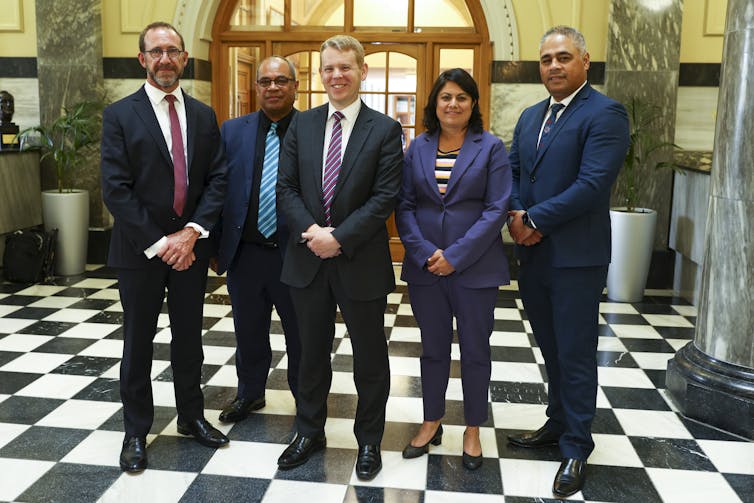 The new Labour health team: from left, Andrew Little, Aupito William Sio, Chris Hipkins, Ayesha Verrall and Peeni Henare.
GettyImages
The new Labour health team: from left, Andrew Little, Aupito William Sio, Chris Hipkins, Ayesha Verrall and Peeni Henare.
GettyImages
The challenge of wider diversity
One question that remains for women’s organisations, however, is whether this new-look ministry will enhance the substantive representation of women and other minorities.
Women workers (as well as the young, Māori and Pasifika) have borne the brunt of job losses during the COVID-19 pandemic, meaning we need gender and diversity analyses applied to all future economic recovery commitments.
Similarly, our family and sexual violence rates remain high, although the cross-portfolio policy responses continue to be led by talented ministers from both Labour and the Greens.
Whether this will be a feminist-focused cabinet remains to be seen. But the diversity of expertise, perspectives and lived experiences among the women around the cabinet table offers an opportunity to bring more diversity into policy deliberations and decisions. As it should — after all, it’s 2020.
Authors: Jennifer Curtin, Professor of Politics and Policy, University of Auckland

















