With house prices soaring again the government must get ahead of the market and become a 'customer of first resort'
- Written by John Tookey, Professor of Construction Management, Auckland University of Technology
House prices are spiking again, with “affordable homes” showing most growth. That’s no surprise really, with multiple factors in play.
Market instability due to COVID-19 is driving asset acquisition — property is the classic port in a storm for investors. Interest rates are at all-time lows and likely to stay that way. The pandemic has curtailed people’s spending, costly holidays are cancelled, socialising is limited and home working has reduced travel costs.
Overall, homeowners have more disposable income. This has led to an uptick in home improvements, renovations and real estate activity. Media coverage adds fuel to the fire by breathlessly reporting rapid price rises. First-time buyers panic that they will miss their chance.
Bottom line: the conditions are in place for a house price boom.
Into this febrile atmosphere stepped the Property Investors’ Federation CEO, claiming first-time buyers were causing recent price rises. The reasoning was that people moving out of a flat to buy a home — one that was previously a rental property — effectively reduce the available housing stock.
This is unfair at best. It shifts blame onto a younger, poorer demographic for reduced cost efficiency and return on investment. Those buyers may be looking to settle down and start a family. They are already largely locked out of the housing market by the depredations of property speculators and investors.
The rise of renting
For many years, property investment has been the main way in which New Zealanders have grown their wealth and provided for retirement. Developing a property portfolio is a tax-efficient, cost-efficient option for individuals with surplus wealth.
Capital growth in previous acquisitions leverages funding for further acquisitions, making the process self-sustaining. Better yet, investors can congratulate themselves for offering rental accommodation options that the state does not provide.
Government attempts to limit investment through capital gains taxes or some other mechanism have encountered substantial pushback. New Zealanders want the freedom to invest in property.
The result has been an ever-increasing proportion of the population in rental accommodation and an accompanying decline in the total number of owner occupiers. Over the past 40 years, owner occupancy has declined from 74% nationally to its current 62% (close to 50% in Auckland).
The market alone won’t fix it
House prices — irrespective of media narratives — are not driven by production costs. They are driven by the residual values of existing houses. Like any commodity, scarcity drives values up. Abundance forces values down. Investors and first-time buyers pursuing the same properties create artificial scarcity.
The issue, then, is how to rapidly generate enough housing to meet the demand, given house building is not a rapid process. Irrespective of how many new houses of a particular type are wanted, capacity is constrained.
At best, additional “emergency” housing stock will take several years to be built. New houses are generally commissioned and bought by individual customers, and each house is unique and distinct. To date, most of this type of development has involved large, standalone — not affordable — homes.
This is not a market set up to provide mass housing at short notice. It is certainly not a market to create the housing surplus that would force down values.
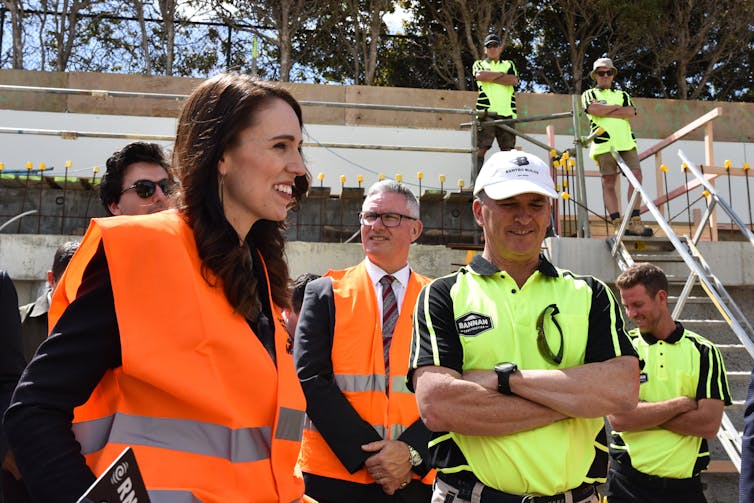 Prime Minister Jacinda Ardern visits a construction site to announce Labour’s housing policy during the 2020 election campaign.
AAP
Prime Minister Jacinda Ardern visits a construction site to announce Labour’s housing policy during the 2020 election campaign.
AAP
Governments should think like builders
The options are clear — moderation of supply and demand, with houses constructed ahead of the market.
But successive governments have failed to recognise builders will not do this of their own accord. So-called “special housing areas” failed because the market drove the development of standalone sections, not high-density plots.
KiwiBuild, the previous government’s ambitious house-building policy, failed utterly. Once again, it was because the government assumed builders would scale up their production and productivity without pre-existing commitment of funding and contracts.
Starting large development contracts without guaranteed customers is risky. Builders have limited resources and will not take on speculative builds.
On the other hand, housing scarcity leads to regular business and reasonable margins. In a volatile economy this is a good place to be. In a free society we can’t simply compel builders to build more. We can only encourage and incentivise them with large contracts.
This is where the government would need to provide the development capital to get ahead of the market — in other words, be the customer of first resort.
Read more: The housing boom propelled inequality, but a coronavirus housing bust will skyrocket it
Reining in property investors
This does create the secondary problem of the state stepping into a commercial space. Using public funds to favour certain projects and providers will certainly trigger outraged howls of “unfair competition” from those not favoured.
But the demand side could be dampened with various measures to limit property investors and meet the urgent need to wean New Zealanders off property investment by:
limiting the number of properties that individuals or household trusts can hold
limiting the number of trusts that individuals can hold
incentivising divestment of property holdings (in favour of selling to first-home buyers, for example).
The elephant in the room is a capital gains tax on secondary and rental properties — something the current government backed away from during its first term.
Ultimately, though, given a choice between helping first-home buyers into housing or limiting cost-effective property investment, a left-leaning government will likely side with social need over optimising capital formation. To do otherwise would be unacceptable to its voter base.
In the final analysis, the Property Investors’ Federation is likely to be sorely disappointed with future policy.
Authors: John Tookey, Professor of Construction Management, Auckland University of Technology