How life-cycle assessments can be (mis)used to justify more single-use plastic packaging
- Written by Trisia Farrelly, Senior Lecturer, Massey University
After banning plastic bags last year, New Zealand now proposes to regulate single-use plastic packaging and to ban various hard-to-recycle plastics and single-use plastic items.
These moves come in response to growing public concern about plastics, increasing volumes of plastic in the environment, mounting evidence of negative environmental and health impacts of plastic pollution and the role plastics play in the global climate crisis.
Addressing plastic packaging is key to reversing these negative trends. It accounts for 42% of all non-fibre plastics produced.
But the plastics industry is pushing back. Industry representatives claim efforts to regulate plastic packaging will have negative environmental consequences because plastic is a lightweight material with a lower carbon footprint than alternatives like glass, paper and metal.
These claims are based on what’s known as life-cycle assessment (LCA). It’s a tool used to measure and compare the environmental impact of materials throughout their life, from extraction to disposal.
Industry arguments to justify plastic packaging
LCA has been used to measure the impact of packaging ever since the Coca-Cola Company commissioned the first comprehensive assessment in 1969.
While independent LCA practitioners may adopt rigorous processes, the method is vulnerable to misuse. According to European waste management consultancy Eunomia, it is limited by the questions it seeks to answer:
Ask inappropriate, misleading, narrow or uninformed questions and the process will only provide answers in that vein.
Industry-commissioned life-cycle assessments often frame single-use plastic packaging positively. These claim plastic’s light weight offsets its harmful impacts on people, wildlife and ecosystems. Some studies are even used to justify the continued expansion of plastics production.
Read more: Cheap plastic is flooding developing countries – we’re making new biodegradable materials to help
But plastic can come out looking good when certain important factors are overlooked. In theory, LCA considers a product’s whole-of-life environmental impact. In practice, the scope varies as practitioners select system boundaries at their discretion.
Zero Waste Europe has highlighted that life-cycle assessment for food packaging often omits important considerations. These include the potential toxicity of different materials, or the impact of leakage into the environment. Excluding factors like this gives plastics an unjustified advantage.
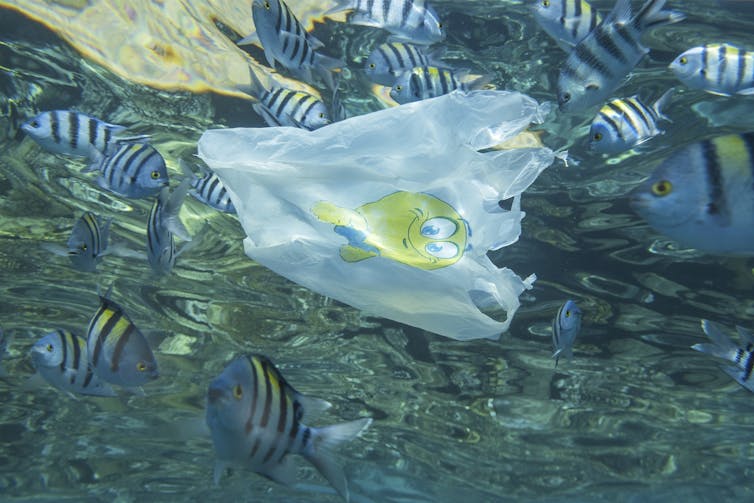 Life-cycle assessment of plastic packaging fails to account for marine pollution.
Andrey Nekrasov/Barcroft Media via Getty Images
Life-cycle assessment of plastic packaging fails to account for marine pollution.
Andrey Nekrasov/Barcroft Media via Getty Images
Researchers have acknowledged the method’s critical failure to account for marine pollution. This is now a priority for the research community, but not the plastics industry.
Even questionable LCA studies carry a veneer of authority in the public domain. The packaging industry capitalises on this to distract, delay and derail progressive plastics legislation. Rebutting industry studies that promote the environmental superiority of plastics is difficult because commissioning a robust LCA is costly and time-consuming.
Read more: Why the pandemic could slash the amount of plastic waste we recycle
Life-cycle assessment and packaging policy
LCA appeals to policymakers aspiring to develop evidence-based packaging policy. But if the limitations are not properly acknowledged or understood, policy can reinforce inaccurate industry narratives.
The Rethinking Plastics in Aotearoa New Zealand report, from the office of the prime minister’s chief science adviser, has been influential in plastics policy in New Zealand.
The report dedicates an entire chapter to LCA. It includes case studies that do not actually take a full life-cycle approach from extraction to disposal. It concedes only on the last page that LCA does not account for the environmental, economic or health impacts of plastics that leak into the environment.
The report also erroneously suggests LCA is “an alternative approach” to the zero-waste hierarchy. In fact, the two tools work best together.
The zero-waste hierarchy prioritises strategies to prevent, reduce and reuse packaging. That’s based on the presumption that these approaches have lower life-cycle impacts than recycling and landfilling.
 New Zealand has a growing number of zero-waste grocers.
Shutterstock/Ugis Riba
New Zealand has a growing number of zero-waste grocers.
Shutterstock/Ugis Riba
One of LCA’s limitations is that practitioners tend to compare materials already available on the predominantly single-use packaging market. However, an LCA guided by the waste hierarchy would include zero-packaging or reusable packaging systems in the mix. Such an assessment would contribute to sustainable packaging policy.
New Zealand already has growing numbers of zero-waste grocers, supplied by local businesses delivering their products in reusable bulk packaging. We have various reuse schemes for takeaways.
New Zealand is also a voluntary signatory to the New Plastics Economy Global Commitment, which includes commitments by businesses and government to increase reusable packaging by 2025.
Prominent organisations, including the Ellen MacArthur Foundation and the Pew Charitable Trusts, estimate reusables could replace 30% of single-use plastic packaging by 2040. The Pew report states:
A reduction of plastic production — through elimination, the expansion of consumer reuse options, or new delivery models — is the most attractive solution from environmental, economic and social perspectives.
The plastics industry has misused LCA to argue that attempts to reduce plastic pollution will result in bad climate outcomes. But increasingly, life-cycle assessments that compare packaging types across the waste hierarchy are revealing that this trade-off is mostly a single-use packaging problem.
Policymakers should take life-cycle assessment beyond its industry-imposed straitjacket and allow it to inform zero-packaging and reusable packaging system design. Doing so could help New Zealand reduce plastic pollution, negative health impacts and greenhouse gas emissions.
Authors: Trisia Farrelly, Senior Lecturer, Massey University