A third of our waste comes from buildings. This one's designed for reuse and cuts emissions by 88%
- Written by Roberto Minunno, Research Fellow in Sustainability Buildings, Curtin University
Designing buildings so they can easily be taken apart and the materials reused provides a feasible and commercial pathway for minimising waste and greenhouse gas emissions. Our research shows one such Curtin University building, the Legacy Living Lab in Fremantle, reduces construction waste and cuts emissions to almost a tenth of what a conventional building process would produce.
The modular, circular economy building produces benefits in all six environmental indicators we assessed. It’s part of our vision for the decarbonisation of buildings.
The Legacy Living Lab is proof that designing buildings for disassembly and reuse greatly reduces their environmental impacts.Learning from nature
Natural biogeochemical cycles create little or no waste. These circular cycles eventually transform used material into a new resource. For example, through the nutrient cycle a fallen leaf provides the building blocks for future leaves.
It’s simple and beautiful. The opposite of a linear model of “take, make, dispose”. It’s complex and ugly.
Unfortunately, this is the model industrialised society has adopted. And not only for our coffee pods, which mostly end up in landfill, but also for most commercial and residential buildings.
The building industry consumes about 50% of mineral resources and produces about 35% of waste. It’s a major source of global greenhouse gas emissions. What, then, can be done?
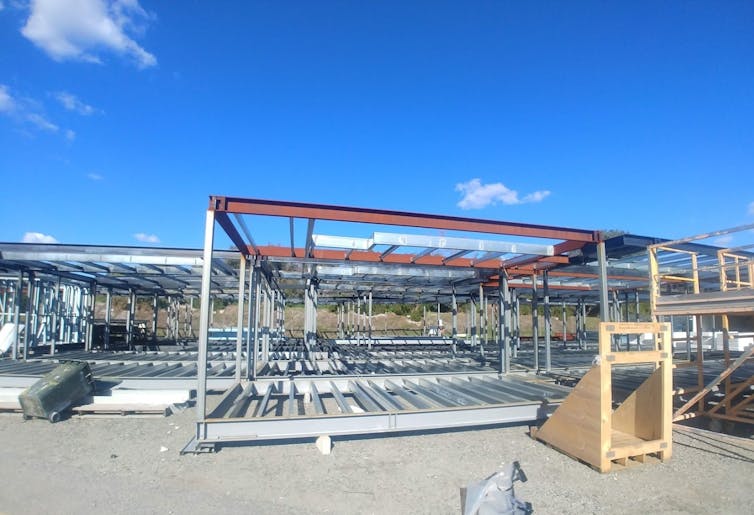 The reuse of steel frames for building saves costs and reduces resource consumption and emissions.
Author provided
The reuse of steel frames for building saves costs and reduces resource consumption and emissions.
Author provided
Read more: We create 20m tons of construction industry waste each year. Here's how to stop it going to landfill
Rethinking ‘downward spiral’ recycling
The answer lies in revisiting the basics of our recycling practices. Since the late 1990s, recycling has been considered an environmental solution, with recycling bins popping up everywhere. However, researchers and consumers alike have begun to realise recycling often comes down to mere “wishcycling”. Less than 10% of plastics is actually being recycled.
Reprocessing is considered the best way to keep materials in use, particularly for artefacts like coffee cups or microchips. However, for many other products, such as building materials, recycling often translates into less than helpful down-cycling.
Even seemingly environmentally benign material, such as timber, often cannot be recycled. Rather, it is remanufactured into products of lower economic value and quality. The material is in a downward spiral that only delays its disposal to landfill.
Clearly, it is much better for the environment if we can find ways to reuse products. Indeed, there are “reusable alternatives for almost everything: beeswax or silicone food wraps, reusable coffee pods, shampoo and conditioner bars, reusable safety razors and bars of soap, rather than liquid soap”.
Read more: With the right tools, we can mine cities
Applying reuse principles to buildings
Can this reuse practice be adopted for buildings too? After all, a building is a sophisticated and complex product compared to coffee pods or cling wrap.
Researchers from Curtin University Sustainability Policy (CUSP) Institute put this question to the test by building a modular, reusable laboratory. It’s a place where researchers, builders and citizens alike can meet to prototype and study new products.
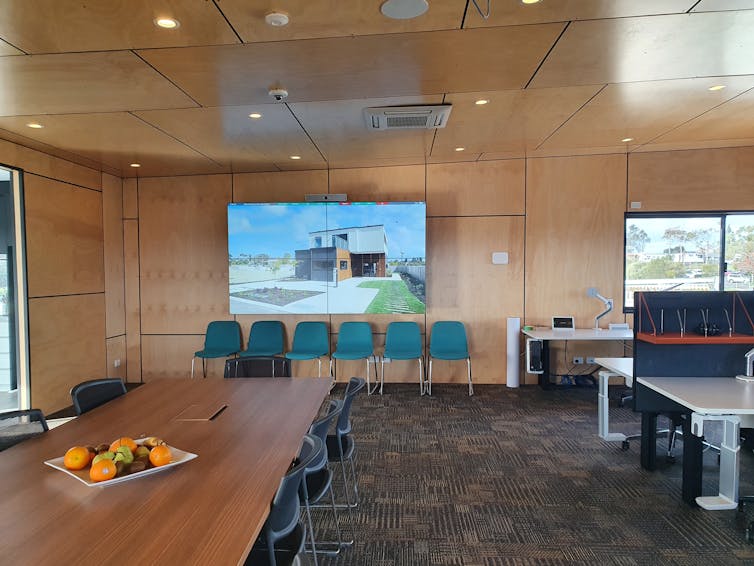 The Legacy Living Lab is a highly functional building that can be taken apart and reused elsewhere within a matter of days.
Author provided
The Legacy Living Lab is a highly functional building that can be taken apart and reused elsewhere within a matter of days.
Author provided
The Legacy Living Lab (L3) is a highly functional, state-of-the-art building with offices and space for collaboration. Yet it can be taken apart – deconstructed or disassembled – moved and reused anywhere within weeks.
Findings from studying the environmental impact of this facility point towards a resounding yes to the question of whether reuse practices can be adopted for buildings. The in-built reuse practices of the L3 save 18 tonnes of construction materials from disposal compared to common building industry practices. This leads to an 88% decrease in greenhouse gas emissions.
So how was this done? Simply, by choosing reused steel frames, opting for steel foundations instead of concrete, and designing internal wall cladding that’s easily disassembled. This makes it almost as easy to take the building apart as your average Lego spaceship.
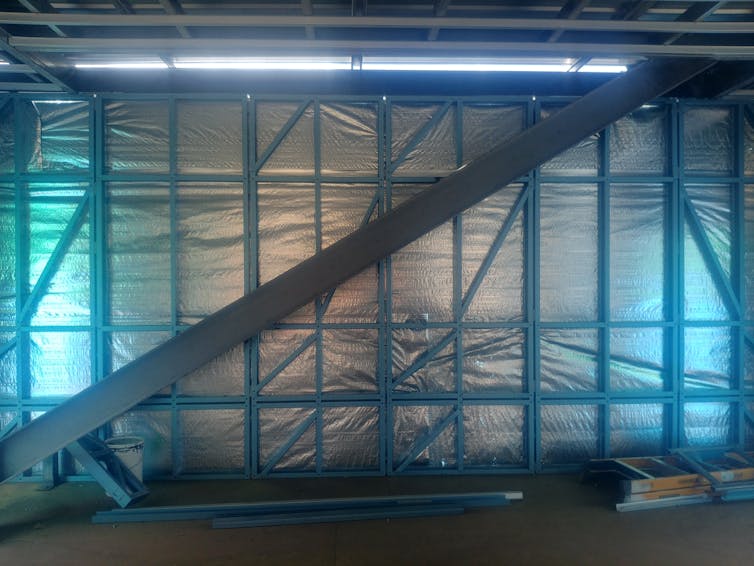 The internal wall cladding is designed to be easily taken apart.
Author provided
The internal wall cladding is designed to be easily taken apart.
Author provided
Read more: Green cement a step closer to being a game-changer for construction emissions
When the time comes to decommission the building, it can be deconstructed as eight modules. These can be moved to the next site for reuse rather than being demolished.
Modular buildings are made of box-shaped structures, built off-site and delivered on-site in a matter of hours. This has the added benefit of minimum disruption for our cities compared to traditional construction sites.
Modular buildings come in all shapes and dimensions, from tiny houses to skyscrapers and factories. They are often more cost-effective to produce than traditional double-brick constructions.
Thus, as well as a minimal environmental footprint, the advantages of modular buildings include flexibility, speed and cost.
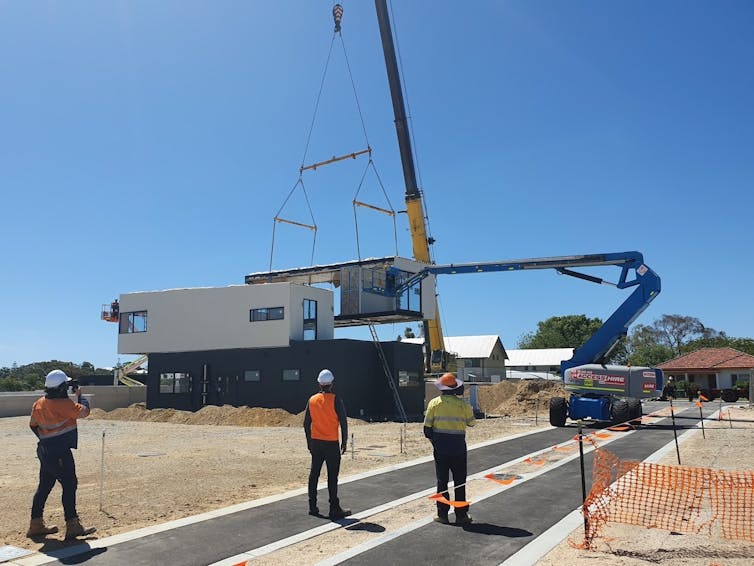 The building’s eight modules were built off-site and then rapidly put together on site.
Author provided
The building’s eight modules were built off-site and then rapidly put together on site.
Author provided
Creating a new building materials market
By adopting easily disassembled modular buildings, we can create a whole new market for reusable building materials. Design-for-disassembly and closed-loop supply chains can keep building components in the material loop as they are – without the need for wishy-washy and wasteful recycling procedures.
Similar to the way nature operates, the team at CUSP created a building whose byproducts from one process remain in the loop as inputs for the next, keeping waste to a minimum. In this way, disassembly becomes much safer and cleaner, which benefits our cities and their residents.
Read more: Unbuilding cities as high-rises reach their use-by date
All that does not mean recycling building waste isn’t beneficial. It all depends on the project. Timber can at least be chipped into garden mulch, bricks and concrete crushed into road base, and so forth.
But this approach is not nearly as neat as nature’s way of handling waste. Design for disassembly and modularity comes closer to that. It can lead the way towards a marketplace where it is common practice to retain material in the supply chain.
If our goal is to create products and processes that “solve our greatest design challenges sustainably and in solidarity with all life on Earth”, it’s time we turned toward nature. We believe it will be a wiser guide than any other in our efforts to redefine wasteful, linear business models.
Authors: Roberto Minunno, Research Fellow in Sustainability Buildings, Curtin University