

Scientists should welcome charges against agency over Whakaari/White Island — if it helps improve early warning systems
- Written by Shane Cronin, Professor of Earth Sciences, University of Auckland
The decision by WorkSafe, a government agency focused on workplace safety, to bring criminal charges against 13 parties in relation to last December’s eruption of Whakaari/White Island heralds a new chapter for volcano scientists in New Zealand.
On December 9 2019, 22 people died and 25 suffered injuries when Whakaari erupted. They were not locals caught by a bigger than expected eruption. They were tourists and their guides on an adventure tourism visit to the island and the volcanic vent.
It is now clear that even though the volcanic alert level had been raised to “unrest” several days before the eruption, the visitors and their guides were unaware of the likelihood and especially the consequences of an eruption.
Had they known, as we do now, there was a 10% chance of an eruption over a 48-hour period and their risk of death and injury was so high, no one would have gone onto the island.
Why didn’t we know that at the time? We live in an uneasy truce with volcanoes, and we do not make the rules, nor do we even know many of them. As deeply as we delve into the physical and chemical processes behind volcanic activity, each eruption brings surprises.
Volcano warnings
The main science agency responsible for volcanic warnings, GNS Science, is one of the parties charged. To what extent should volcanologists, or the agency they work for, be culpable for the loss of lives during an eruption?
Volcanology has always been an observational activity. Throughout the world, descriptions of eruptions are recorded in cave art, legend and myriad images and cultural references. Formal descriptions of volcanoes are just an extension of this.
In this age of big data, micro-sensors and instant communication technologies, we have made rapid advances in our understanding of volcano behaviour. We now apply computational and numerical models to recognise signal patterns that may precede an eruption, but our knowledge of the actual processes behind these lags behind.
This knowledge gap often leads to hesitation in applying our most advanced tools.
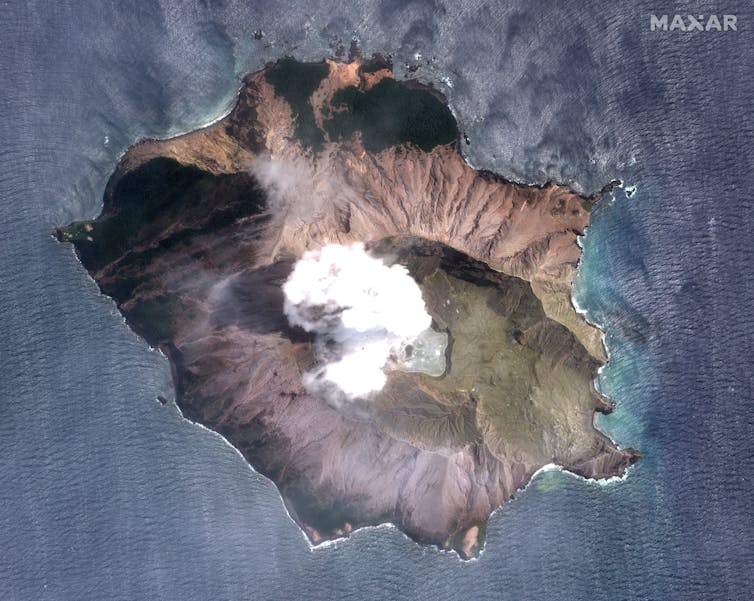 Whakaari/White Island is an active volcano.
NASA, CC BY-ND
Whakaari/White Island is an active volcano.
NASA, CC BY-ND
Bolder implementation of new technologies
The WorkSafe charges are a symptom of society demanding greater precision in warnings of volcanic eruptions. These are not unreasonable demands, considering the tragic consequences of missing the warning signals.
How do we face up to this expectation as volcanologists?
Primarily, we must be brave enough to try new things. Technology untested by actual events is risky, but volcanoes are not an ideal production line. They do not erupt often enough, or on a convenient schedule to effectively develop and test new systems well.
Also, each volcano is subtly different. This means we must be prepared as scientists and science agencies to be wrong, and we must prepare our communities for our failures.
Read more: Call for clearer risk information for tourists following Whakaari/White Island tragedy
We must harness the criticism of society to be bolder in our work. Clearly, we have not done enough to avoid the Whakaari tragedy, nor many other catastrophes over the past decades around the world. None of these calamities can be laid solely at the feet of volcano scientists, but our science advances can help other agencies do their work better.
Call for open flow of information
We must also push against political and corporate systems that attempt to control or sanitise science advice. Fear of being held legally or socially culpable for well-intentioned, but ultimately incorrect advice means new technology takes too long to be implemented.
The prime minister’s chief science advisor, Juliet Gerrard, has issued a statement highlighting the importance of science advice in emergencies.
Attempts to limit access to science through institutional or other barriers and preventing scientists from giving their free and frank advice in emergency situations […] places a handicap on good decision making by our officials and politicians. Only by being able to access all the available knowledge, including its level of uncertainty and whether it is disputed, can decision makers effectively weigh up the possible consequences of the paths forward, guided by the best evidence.
We must be much clearer about how volcanic hazard and risk is communicated to tourists, especially on volcanoes with a history of frequent eruptions. It is telling that the last five eruptions at Whakaari were not predicted, despite constant seismic monitoring over this time.
We also need a more proactive system that operates in real time and is more intuitive than the current volcanic alert level approach used widely around the world.
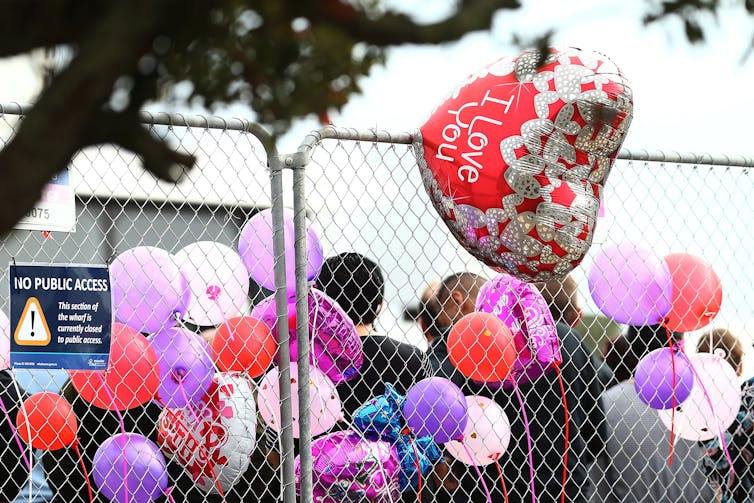 A tribute to the victims of the Whakaari/White Island eruption, from December 2019.
John Borren/Getty Images
A tribute to the victims of the Whakaari/White Island eruption, from December 2019.
John Borren/Getty Images
Questions and blame
Where does this leave volcano scientists in considering the court proceedings against GNS Science? Perhaps, the best approach is to welcome it.
A healthy society should review the role of science agencies in the prevention of disasters. Hard questions need to be asked so victims and their families can be sure we have done our best, with the best of our knowledge at the time.
But this should not be about blame. It should be about closing the gap between societal expectations of hazard information and how it is used or enforced at dangerous volcanoes — which is another topic addressed by charges also laid against those responsible for administering access to Whakaari.
From a scientist’s point of view, these charges against a science agency should be a call for innovation. Recognising the mass fatalities at Whakaari and other monitored volcanoes in recent times (including Ontake, Japan in 2014 and Merapi, Indonesia in 2010), we must do better to avoid a possible “next time”.
Authors: Shane Cronin, Professor of Earth Sciences, University of Auckland

















