

COVID has left Australia's biomedical research sector gasping for air
- Written by Gina Ravenscroft, Research Fellow, University of Western Australia
While COVID-19 has highlighted the value of medical research, it has unfortunately also seriously disrupted it. Lack of funding is driving members of Australia’s once-vibrant virology research community out of the sector, and forcing early-career researchers to turn to fundraising or philanthropy amid intense competition for federal government grants.
This disruption disproportionately affects early- and mid-career researchers (EMCRs) and laboratory-based scientists, especially women (who typically also shoulder the bulk of caring and home-schooling responsibilities).
In Australia, national funding of medical research happens mainly via the National Health and Medical Research Council. Over the past ten years there has been near stagnant investment, leading to a decline in funding in real terms. In 2019, the average success rates across the main NHMRC Ideas and Investigator Grant schemes was just 11.9%.
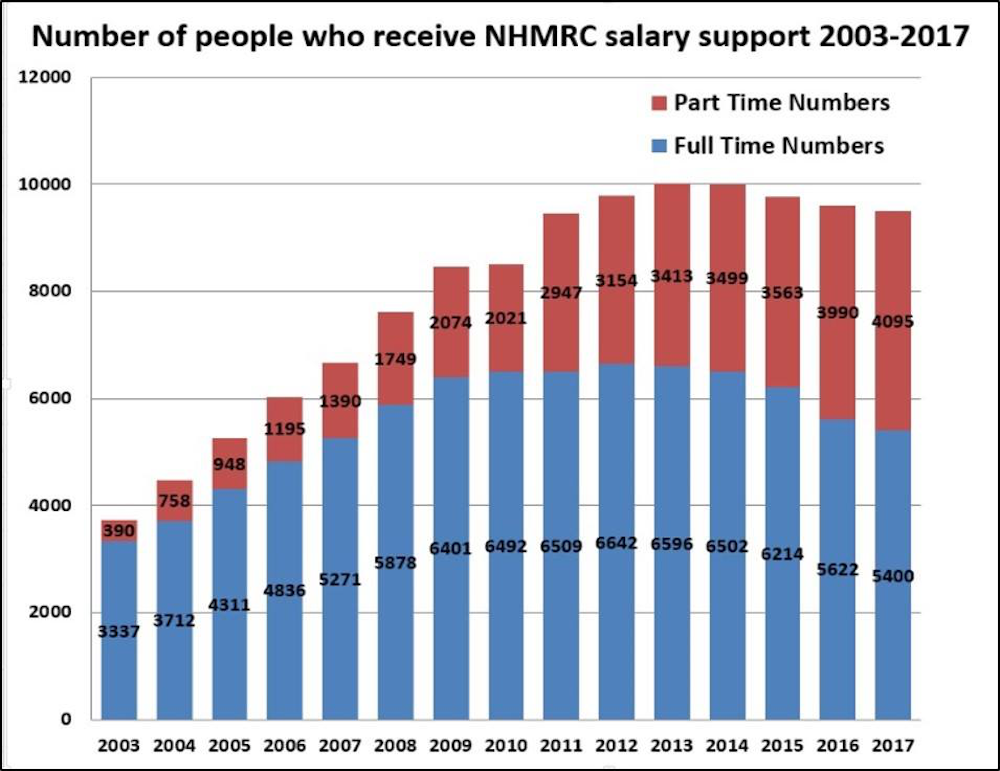 NHMRC salary support 2003-17.
Australian Society for Medical Research
NHMRC salary support 2003-17.
Australian Society for Medical Research
Stagnant investment, plummeting morale
Morale in the sector has plummeted and we have lost talented researchers to the United States, Europe and Asia, prompting leading universities to warn of a brain drain.
Eureka Prize-winning cancer biologist Darren Saunders and clinical geneticist Luke Hesson are leaving science altogether. The full-time medical research workforce declined by 20% between 2012 and 2017.
How did we get here?
In 2018, following extensive consultation, the NHMRC funding scheme was overhauled with major objectives to encourage innovation across the sector, reduce the burden on applicants and reviewers, and improve success rates of EMCRs.
In the first two years of this new scheme, the success rates for EMCR Investigator Grants (EL1-2) was just 11.7% (250 of 2,133 applications).
Read more: The NHMRC program grant overhaul: will it change the medical research landscape in Australia?
Schemes specifically designed to develop emerging talent are also receiving dwindling support. In 2017 the NHMRC awarded 181 “early career and career development fellowships”; by 2020 that figure had fallen to 122.
The 2019 success rate for NHMRC Ideas Grants scheme (which sustains fundamental research, including on vaccines) in Australia was only 11.1%, despite almost three times as many applications being ranked as “fundable” by expert peer reviewers.
Onus on universities
With such low success rates, it has fallen to universities to prop up their research departments and laboratories.
If these trends continue, Australia stands to lose an entire generation of medical researchers. This prompted the Association of Australian Medical Research Institutes in August to call for the government to fund 300 new fellowships for EMCRs through the federal budget.
AAMRI president Jonathan Carapetis said the lack of grants and fellowships has forced EMCRs to rely on philanthropy or fundraising to support their research, adding:
…due to the economic downturn resulting from COVID-19 the holes in this imperfect system have turned into chasms. These are the researchers who have finished their PhDs, are testing hypotheses on what causes different diseases, developing new treatments and vaccines… Our EMCRs are tomorrow’s scientific leaders, and without action to support them we will lose them.
This call, however, was not heeded in the recent federal budget, which contained no new money for biomedical research.
 Researchers called for more funding to be allocated in the 2020 federal budget.
AAP/Mick Tsikas
Researchers called for more funding to be allocated in the 2020 federal budget.
AAP/Mick Tsikas
Funding the future?
The federal government’s Medical Research Future Fund (MRFF) was established in 2015 and began dispensing funds in 2017. As the MRFF website explains, the government uses some of the net interest from the A$20 billion fund to pay for medical research. This year it will disperse around A$650 million.
The MRFF represented a major and very welcome funding boost to Australia’s health and medical research sector.
But the combined NHMRC and MRFF budget still only represents 0.53% of the total health expenditure in the federal budget.
This is a fraction of the 3% of health expenditure that would bring Australia’s health and medical research spending into line with other OECD countries. An increase to 3% of health expenditure would generate A$58 billion in health and economic benefits, according to a Deloitte Access Economics report commissioned by the Australian Society for Medical Research.
The MRFF has recently come under scrutiny as it emerged during Senate estimates that up to 65% of funds were distributed without peer review.
What’s more, researchers who narrowly missed out on the incredibly competitive NHMRC Investigator funding cannot apply to the MRFF unless they are a clinical researcher, meaning fundamental biomedical researchers engaged in translational research, but without a medical degree, miss out.
Without investment, advances are not possible
In the post-COVID era, a robust health and medical research sector is essential to lead the discoveries and innovations that will fuel our long-term economic recovery.
The National Association of Research Fellows (a peak body representing biomedical researchers; the authors of this article are on the NARF Executive) is calling for:
at least a doubling of federal funds into the Australian health and medical research sector
transparent, 360-degree oversight of the targeted calls for expression of interest and allocation of funds from the MRFF with involvement of NHMRC peer review.
strictly equal support for clinical and fundamental biomedical research.
This investment would position Australia as an international leader in health and medical research. Without better support for the sector, advances in patient treatment and care are simply not possible.
Authors: Gina Ravenscroft, Research Fellow, University of Western Australia

















