

Australia hasn't performed well at maths and science recently. We're about to find out if we've improved
- Written by Sue Thomson, Deputy CEO (Research), Australian Council for Educational Research
Every four years, the International Association for the Evaluation of Educational Achievement (IEA) releases data on how effective countries are in teaching mathematics and science in Years 4 and 8. Called TIMSS, (Trends in International Mathematics and Science), the 2019 results will be released tomorrow evening.
This is the seventh time the TIMSS test has been administered. Over the years, the results have attracted considerable attention from governments and those interested in education.
The first TIMSS test was in 1995. Results from the last cycle, TIMSS 2015, showed the maths and science achievement of Australia’s Years 4 and 8 students had flatlined. But many other countries had improved — including the United States and England.
What is TIMSS?
What many are wondering about the results tomorrow include:
how does Australia’s education system compare internationally – which countries are doing better than we are and which are doing worse?
how are we doing internally — across states and territories, between girls and boys, or children from different socioeconomic and cultural backgrounds?
Year 4 and Year 8 students involved in TIMSS complete tests in maths and science. They also answer questionnaires on their background and experiences in learning maths and science at school.
School principals and the students’ maths and science teachers also complete detailed questionnaires.
This information helps to paint a picture of what happens in schools and classrooms and what might influence student learning.
TIMSS is a sample assessment. It’s not possible to test every Year 4 or Year 8 student (that would take too long and cost too much).
So a representative random sample is drawn from all schools in each system being tested. One class from each school is then randomly selected to complete the paper-based or online assessment of maths and science.
Read more: Australian schools continue to fall behind other countries in maths and science
TIMSS was not designed to provide scores for individual students or schools — students don’t even complete the same test as all of the other students in the room. In TIMSS 2019, for example, there were more than 14 different test forms, covering different parts of the assessment.
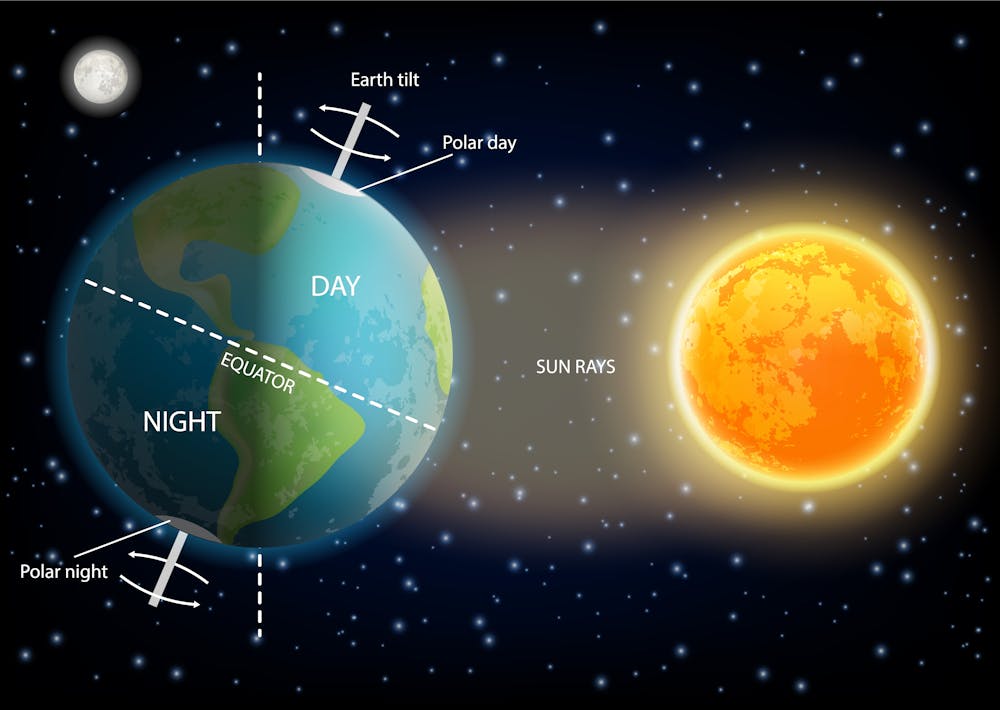 TIMSS tests maths and science concepts, like the effect of the earth rotating on its axis.
Shutterstock
TIMSS tests maths and science concepts, like the effect of the earth rotating on its axis.
Shutterstock
Those test scores are then put together statistically to form an overall picture of achievement.
In Australia, 571 schools and 14,950 students participated in TIMSS 2019.
What the test looks like
TIMSS looks at how well Year 4 and Year 8 students have mastered the factual and procedural knowledge taught in school maths and science curricula.
For example, do students know:
how many legs an insect has
what causes rust
what happens when light passes through a prism
what is the sum of the angles of a triangle
how to convert ¾ to a decimal
how to calculate an average.
Test questions can either be “constructed response” or “multiple-choice”.
For “constructed response” questions, students are asked to give a written response that could be as short as a single word or number, or as long as a couple of sentences.
Here’s an example of a constructed response question from Year 4 mathematics:
Hanif starts to write a number pattern: 6, 13, 20, 27 … He adds the same number each time to get the next number. What is the next number he should write in his pattern?
Answer = 34.
For multiple-choice questions, students select the correct answer from a selection of pre-written options. Here’s a multiple-choice question from Year 8 science:
Earth rotates on its axis. What does this cause?
- A. the seasons
- B. a solar eclipse
- C. day and night
- D. high and low tides
Answer = C. day and night.
TIMSS is different to other international tests
TIMSS is not the only international assessment Australia participates in.
In December 2019, results from the OECD’s PISA (Programme for International Student Assessment) made headlines as Australia’s PISA scores in maths and science were the lowest they had ever been.
While both TIMSS and PISA test maths and science, they are very different in terms of who they test and what the test is like. There are three main differences:
TIMSS tests students in middle primary and lower secondary. PISA tests 15 year olds, who are usually in Years 9, 10 or 11 in Australia and nearing the end of their compulsory schooling in many countries
TIMSS focuses on how well students have learnt the content of a defined curriculum. PISA focuses on how well students can apply reading, maths, science skills to real-life situations
TIMSS assessment content is jointly developed by participating countries based on a detailed analysis of national curricula. PISA assessment content is developed by OECD-selected experts based on the skills they think students should have mastered.
Testing at Year 4 and Year 8, rather than at the end of school, allows countries to see how well students are doing early in their education journey and where more effort might be needed. Focusing on a defined curriculum can help find where gaps in a country’s own curriculum might lie.
Read more: The PISA world education test results are about to drop. Is Australia getting worse?
TIMSS also provides a lot of contextual information collected through questionnaires from school principals, teachers and students. The questionnaire examine what is intended to be taught in science and maths (the intended curriculum) and how these things are actually taught (the implemented curriculum). While the assessment describes what students have learned (the attained curriculum).
Together, information from TIMSS can help improve Australia’s maths and science curricula and, ultimately, the educational outcomes of all Australian students.
Authors: Sue Thomson, Deputy CEO (Research), Australian Council for Educational Research

















