We can't just leave it to the NDIS to create cities that work to include people with disability
- Written by: Ilan Wiesel, Lecturer in Urban Geography, University of Melbourne
For the National Disability Insurance Scheme to be successful, our cities will need to change.
Our new research explores the impacts that the NDIS is having on Australia’s cities.
A major goal of the NDIS is to improve participation in mainstream services by people with disability. The success of the scheme will depend on how well it achieves this.
But the responsibility for change should be shared far more broadly – mainstream services must actively transform themselves to become more inclusive.
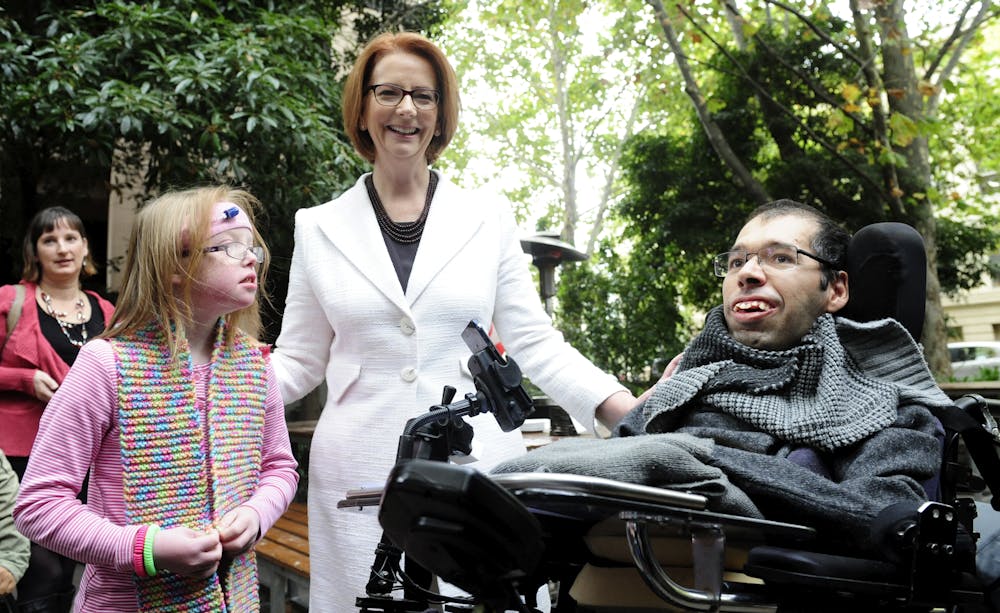 Prime Minister Julia Gillard speaks with disability services advocate George Taleporos in 2013 after announcing NDIS funding arrangements.
AAP Image/Julian Smith
Prime Minister Julia Gillard speaks with disability services advocate George Taleporos in 2013 after announcing NDIS funding arrangements.
AAP Image/Julian Smith
Read more: Three charts on: disability discrimination in the workplace
Functioning cities rely on a variety of health, education, welfare, sports and community services. These services are essential to the wellbeing and social inclusion of diverse people in our cities.
But despite being called “mainstream”, these services are never equally open to all members of society. Relentless privatisation of previously public programs and facilities has arguably undermined their capacity to provide services to users with “challenging” or “costly” needs.
The chair of the National People with Disabilities and Carer Council, Rhonda Galbally, has observed:
For many years people with disabilities found themselves shut in — hidden away in large institutions. Now many people with disabilities find themselves shut out — shut out of buildings, homes, schools, businesses, sports and community groups. They find themselves shut out of our way of life.
To ensure people with disability are included in our way of life, mainstream services and the wider community, along with the NDIS, will need to contribute to reshaping our cities.
When accessibility fails, people are shut out
People with disability face particular barriers to participating in mainstream services. Under Australian law, newly built or upgraded public spaces and premises must meet national accessible design standards. But even facilities designed to be accessible will fail in this if they are not well managed.
Frequently closed accessible checkout lanes at the supermarket and accessible toilets that are kept locked or used for storage are common examples of poor management.
Matters of accessibility are often discussed in relation to wheelchair users. However, people with disability are a diverse population and experience many forms of exclusion.
For example, communication barriers arise when information needed to use a service is not presented in comprehensible ways. The pace of activity in mainstream spaces is another potential barrier that can make people with disability feel unwelcome and excluded.
Staff in mainstream services are often unskilled in providing service to people with disability. This can prevent people with disability from using a service, leading to poor and even harmful outcomes. One recent example is the evidence of overprescription of antipsychotic drugs to people with intellectual disability in mainstream health services.
Read more: Change Agents: Rhonda Galbally and Bruce Bonyhady on the birth of the NDIS
Can the NDIS alone deliver on the promise of participation?
The NDIS will fund a wide range of specialist disability services, but “wherever possible” will help participants access mainstream systems. This includes training and personal assistance to build participants’ capacity to use these services. The majority of NDIS participants’ plans include funding assistance for access to mainstream services.
In addition, the NDIS will seek to “encourage mainstream services and community organisations to become more inclusive”.
The NDIS thus has a critical role to play in enhancing mainstream participation. It will be important to collect evidence about the effectiveness of its interventions. However, meaningful change will only occur if mainstream services themselves take action to become more inclusive.
It is not enough for services to avoid direct and intentional discrimination. It is also not enough to passively “accept” people with disability as service users. Mainstream services providers need to initiate internal changes to become more inclusive of people with disability.
Services will have to ensure staff are skilled up, redesign spaces and revise approaches to communication. Service users without disability will also need to adjust the ways they participate in services.
The most meaningful participation will be achieved when people with disability and those close to them are actively engaged in planning these changes and exerting their “right to the city”. In addition, a body of research evidence on inclusive adjustments in mainstream services will need to be built.
Most of these changes and challenges will occur in Australia’s cities. But the task will be no less challenging in regional areas where services are often undersupplied and geographically distant. Local and state governments have a critical role to play as funders, providers and regulators of mainstream services, to lead and drive these adjustments.
Many mainstream services are already badly underfunded and under pressure from competing demands from diverse users. Rather than compete with each other for scarce resources, alliances of users with and without disability must campaign together to revive the public services sector and make it more inclusive for all Australians.
Legislation will also need to be reviewed. Current law requires services to make minimal “reasonable” adjustments in order to avoid discrimination based on a person’s disability. More progressive legislation would require mainstream services to make exceptional adjustments so that people with disability are treated as equals while their differences are recognised and accommodated.
If the NDIS, governments, services and the wider community all play their parts, people with disability will experience greater participation in their community. This will enrich not only their lives but those of others. Australian cities and regions would benefit from the contributions of people with disability to their social, cultural and economic vitality.
Read more: NDIS needs the market to help make up at least 60% shortfall in specialist disability housing
Authors: Ilan Wiesel, Lecturer in Urban Geography, University of Melbourne