

Burnt ancient nutshells reveal the story of climate change at Kakadu — now drier than ever before
- Written by S. Anna Florin, Research fellow, University of Wollongong
Archaeological research provides a long-term perspective on how humans survived various environmental conditions over tens of thousands of years.
In a paper published today in Nature Ecology and Evolution, we’ve tracked rainfall in northern Australia’s Kakadu region over the past 65,000 years. We wanted to know how major changes in rainfall may have affected the region’s Aboriginal communities through time.
Our findings suggest the Kakadu region wasn’t as prone to dry spells as surrounding areas — and it likely functioned as a place of refuge for early Australians as they struggled through harsh and arid conditions.
Learning lessons from leftovers
To generate a rainfall record spanning 65,000 years, we used ancient food waste left behind by the First Australians living at Madjedbebe, a rock shelter on Mirarr country in the Kakadu region.
This site boasts the earliest known evidence of humans living in Australia. It also boasts plenty of Pandanus spiralis, a native plant commonly called “pandanus” or “screw pine”.
This plant, known as “anyakngarra” to the Mirarr people — the Traditional Owners of Madjedbebe — is very important to them.
 Anyakngarra (Pandanus spiralis) fruit. The tree is native to northern Australia and ubiquitous around the Top End’s waterholes and floodplains.
Author provided
Anyakngarra (Pandanus spiralis) fruit. The tree is native to northern Australia and ubiquitous around the Top End’s waterholes and floodplains.
Author provided
Its leaves are used for weaving, its trunk to create dye, its fruit flesh is used in a drink and its nuts (the seed kernels within the fruit) are consumed as a rich source of fat and protein.
Anyakngarra’s nuts were also eaten by the First Australians 65,000 years ago. Discarded nut shells have been preserved as burned fragments, disposed of in fireplaces over time.
These small remnants have proven hugely useful for our research team, which includes archaeologists, environmental scientists and Traditional Owners.
Read more: 65,000-year-old plant remains show the earliest Australians spent plenty of time cooking
In a nutshell
By analysing the isotopic composition in ancient anyakngarra nutshells, we could track rainfall at Madjedbebe. Specifically, we detected how much water (and therefore rainfall) was available to anyakngarra plants in the past.
This analysis is possible due to photosynthesis – the process by which plants convert carbon dioxide in the air into sugars. Anyakngarra plants absorb two isotopes of carbon from the atmosphere: ¹²C and ¹³C. Isotopes are different types of atoms within a chemical element that have the same number of protons but a different number of neutrons. Chemically, the isotopes of carbon are the same, but each has a different atomic “weight”.
Read more: Explainer: what is an isotope?
When environmental conditions are favourable, an anyakngarra plant will preferentially absorb more ¹²C than ¹³C. But if a plant is stressed by its environment, such as when it’s waterlogged due to seasonal flooding, it begins to absorb more ¹³C.
The isotopic composition (the ratio of ¹²C to ¹³C) is recorded in the sugars used by the plant for new tissue growth, including for the seasonal growth of nuts.
A higher proportion of ¹³C in a nutshell indicates that the plant it came from was waterlogged during its growth season. From this, we can conclude it likely experienced higher levels of rainfall.
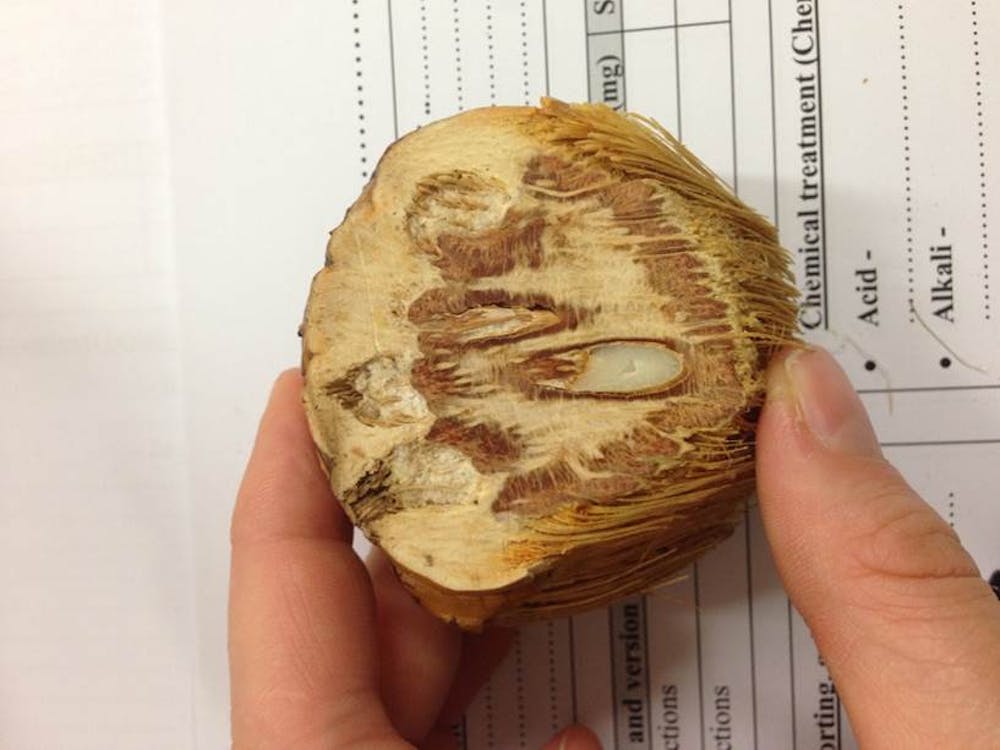 Pictured is the anyakngarra fruit, which has a fleshy section (now dried and fibrous) a hard nutshell and multiple white seeds (or nuts) inside.
Author provided
Pictured is the anyakngarra fruit, which has a fleshy section (now dried and fibrous) a hard nutshell and multiple white seeds (or nuts) inside.
Author provided
Like an oasis in a desert
Over the past 72,000 years, humans have lived through an ice age in which there were two particularly cold periods called “stadials”. During stadials, glaciers extended to cover parts of North America, northern Europe, northern Asia and Patagonia (in South America).
The height of the second stadial in this ice age was called the Last Glacial Maximum. While this occurred 22,000 to 18,000 years ago, intense cold and dry conditions in Australia started as early as 30,000 years ago.
During this time, water availability was the main challenge in arid northern Australia (rather than low temperatures). The country’s arid zone expanded dramatically and parts of central Australia may have been temporarily abandoned by Aboriginal people.
Yet the “palaeoclimatic” record we generated for Madjedbebe indicates that, although glacial stages did lead to less rainfall, the Kakadu region remained relatively well-watered during these periods.
Our records show that for as long as people have been around, rainfall at Madjedbebe is unlikely to have dropped below current levels. Thus, this area would have helped early Australians survive during long dry spells and may have also attracted others from surrounding areas.
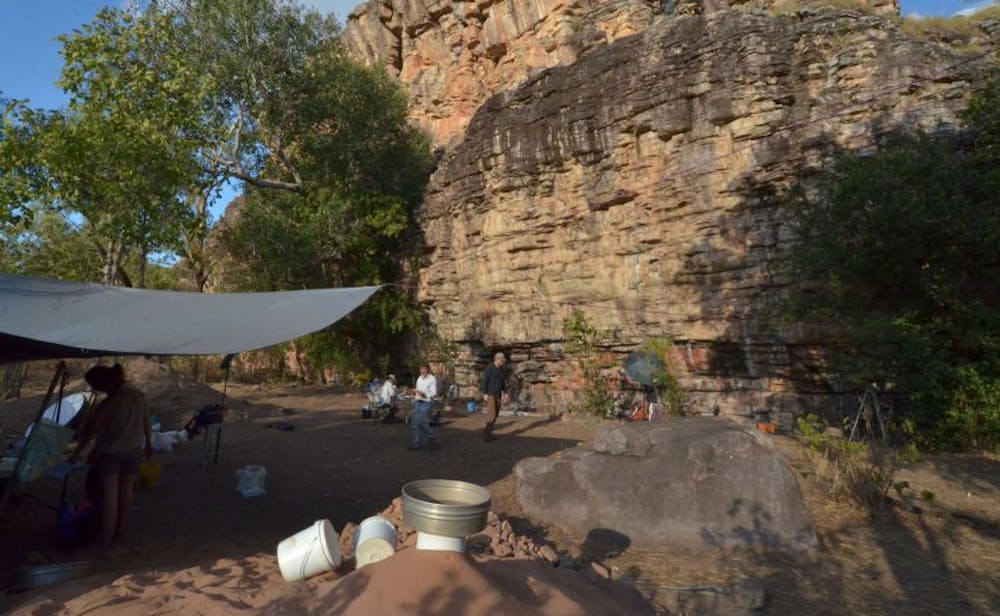 This is our research site, the Madjedbebe rock shelter in the Alligator Rivers region of the Northern Territory.
Dominic O'Brien/Gundjeihmi Aboriginal Corporation, Author provided
This is our research site, the Madjedbebe rock shelter in the Alligator Rivers region of the Northern Territory.
Dominic O'Brien/Gundjeihmi Aboriginal Corporation, Author provided
Changing with the seasons
Our findings are supported by other archaeological evidence from Madjedbebe. For instance, our research has revealed more stone tools were left at this site during the glacial periods. This implies more people gathered there at these times.
Also, because the Kakadu region was still drier during glacial periods as compared to inter-glacial periods, people had to travel further for food and other important resources.
Read more: Buried tools and pigments tell a new history of humans in Australia for 65,000 years
This is supported by evidence of an increased number of tools being brought to the site from further away. This points to increased mobility and new social arrangements being made as people adjusted to life in a harsher environment.
The challenge moving forward
Notably, over the past 65,000 years the driest time in the Kakadu region was not during the Last Glacial Maximum. It is today.
Rather than being the result of less rainfall occurring, this is likely due to higher evaporation caused by warmer inter-glacial temperatures. Aboriginal communities currently living in the Kakadu region are experiencing unprecedented aridity.
These difficult conditions are exacerbated by the threat of invasive plants and animals and disruption to cultural practices of landscape management, such as vegetation burning.
While the people of Kakadu have spent thousands of years adapting to environmental change, the scale and intensity of today’s anthropogenic impacts on regional climates and local landscapes poses an altogether different challenge.
Authors: S. Anna Florin, Research fellow, University of Wollongong

















