

Protect your dog from this new deadly disease outbreak. We still don't know how it got here
- Written by Peter Irwin, Emeritus professor, Murdoch University
While we continue to be occupied with the COVID pandemic, another life-threatening disease has emerged in northern Australia, one that’s cause for considerable alarm for the millions of dog owners around the country.
This disease — canine ehrlichiosis — is transmitted through the bite of a bacterium-carrying parasite called the “brown dog tick”. This vector parasite is widespread in warm and humid areas of Australia, and its bite can be potentially fatal for dogs.
Until the first cases were recently discovered last May, Australia was considered free of the disease. However, more than 300 dogs in Western Australia and the Northern Territory have now tested positive for it. There have also been reports from veterinary workers in the field of dogs dying without being tested or treated.
And it’s spreading — infected ticks that carry the deadly bacteria have been detected in South Australia, according to Mark Schipp, Australia’s chief veterinary officer. If you own a dog, it’s vital you take precautions to protect it as the outbreak is unlikely to be controlled any time soon.
Fever, lethargy and uncontrollable bleeding
Canine ehrlichiosis is caused by a bacterium called Ehrlichia canis (E. canis) carried by the tick. It first came to the attention of veterinary scientists in the 1960-1970s after affecting scores of military working dogs, often German Shepherds, in Southeast Asia during the Vietnam War.
 Ticks attached to the ears and fur of dogs.
Animal Management in Rural and Remote Indigenous Communities (AMRRIC)
Ticks attached to the ears and fur of dogs.
Animal Management in Rural and Remote Indigenous Communities (AMRRIC)
In Australia today, the disease appears most prevalent in regional areas and remote communities in WA and NT, where the ability to test dogs is restricted for logistical reasons. In some areas, such as communities in the Roper Gulf Shire, testing and treating dogs can be impossible during the wet season as severe flooding can prevent veterinarians from accessing the region.
However, with the detection of ticks in South Australia, veterinarians are concerned they could travel to more populous areas.
When an infected tick bites a dog, the bacterium enters white blood cells and multiplies rapidly, causing signs of illness the owner will only first notice about two weeks after transmission.
This animation on Canine ehrlichiosis has been developed by AMRRIC.The disease is characterised by fever, decreased appetite, lethargy and bleeding (such as nose bleeds). Some dogs develop severe and rapid weight loss, swollen limbs, difficulty in breathing and blindness.
One of the most serious effects of this disease is on the bone marrow, which can be fatal. Some dogs die of septicaemia as they can no longer fight off even the most innocuous of infections, or they bleed uncontrollably, which can also lead to death.
Ticks expanding southward
Every pet owner who has travelled into Australia with their dogs would know about the stringent testing procedures in place to ensure their canine companions do not bring canine ehrlichiosis into the country. This is especially important since the brown dog tick (the vector) has been in northern Australia for many years, but not with this particular infection.
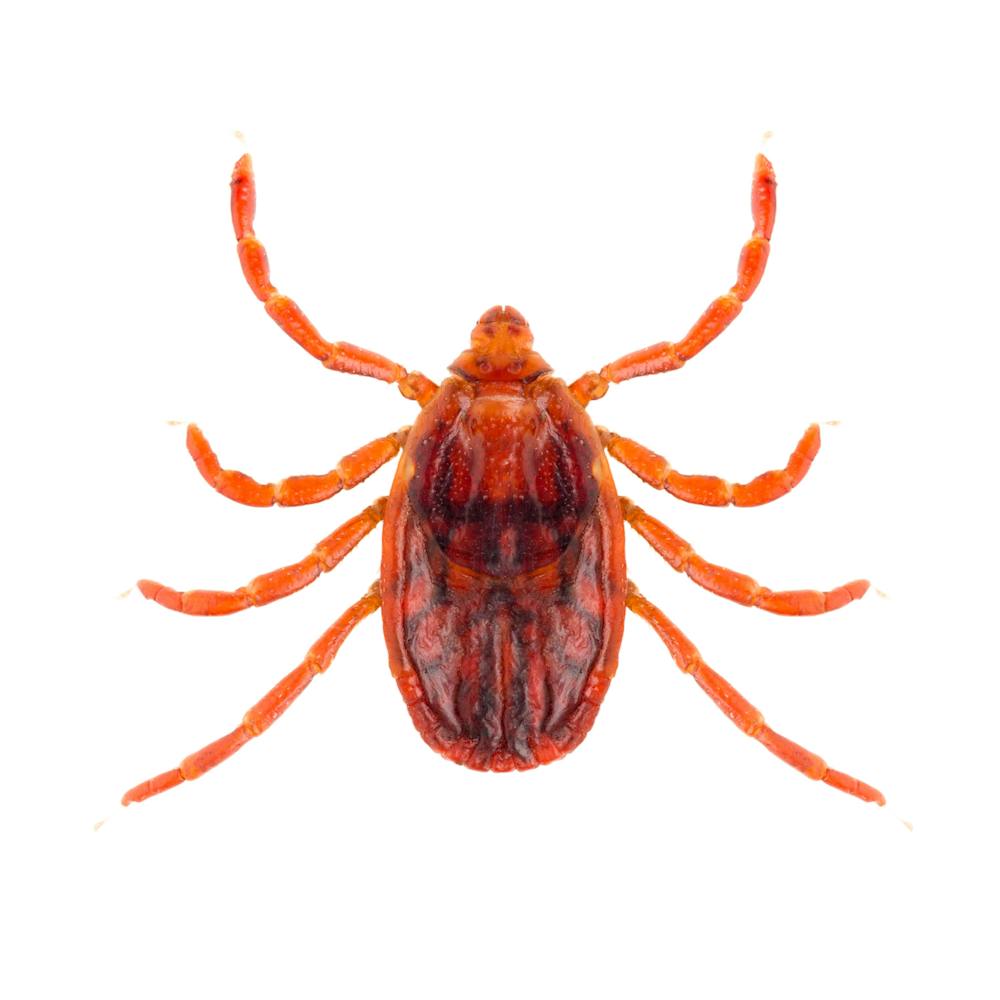 The brown dog tick (Rhipicephalus sanguineus) injects the bacterium E. canis when it bites a dog.
Shutterstock
The brown dog tick (Rhipicephalus sanguineus) injects the bacterium E. canis when it bites a dog.
Shutterstock
As with other serious animal diseases screened by biosecurity authorities, such as African Swine Fever and Screw Worm Fly, the bacterium E. canis is highly prevalent in tropical regions, including our closest northern neighbours (Indonesia, East Timor, Papua New Guinea) and the Pacific Islands.
However, our 2016 research shows a southwards expansion of the brown dog tick’s geographical range. The reasons why aren’t fully understood, but may include increased pet travel around the country and possibly also climate change.
Worse, the tick is also well adapted to indoor living and readily establishes within kennels or homes, and even in cooler climates. These conditions mean E. canis can spread to most parts of Australia.
 In addition to border controls, our isolated geography is another physical barrier to the establishment of canine ehrlichiosis.
Markus Winkler/Unsplash, CC BY
In addition to border controls, our isolated geography is another physical barrier to the establishment of canine ehrlichiosis.
Markus Winkler/Unsplash, CC BY
Protecting your best friend
Just as our health authorities have been with COVID-19, the response from the state and federal veterinary authorities to this outbreak of canine ehrlichiosis has been swift.
Most dogs will improve from treatment with antibiotics and other supportive measures. However, some may develop a chronic infection, which usually has a terminal outcome.
The disease isn’t contagious; only dogs bitten by the ticks will contract it. So it’s vital animal owners are proactive with the application of parasite prevention.
Owners should seek advice from their veterinarian about which products will protect their dogs from contracting this disease. Research has shown those that repel ticks and stop them attaching in the first place, such as effective tick collars, are the best way to prevent canine ehrlichiosis.
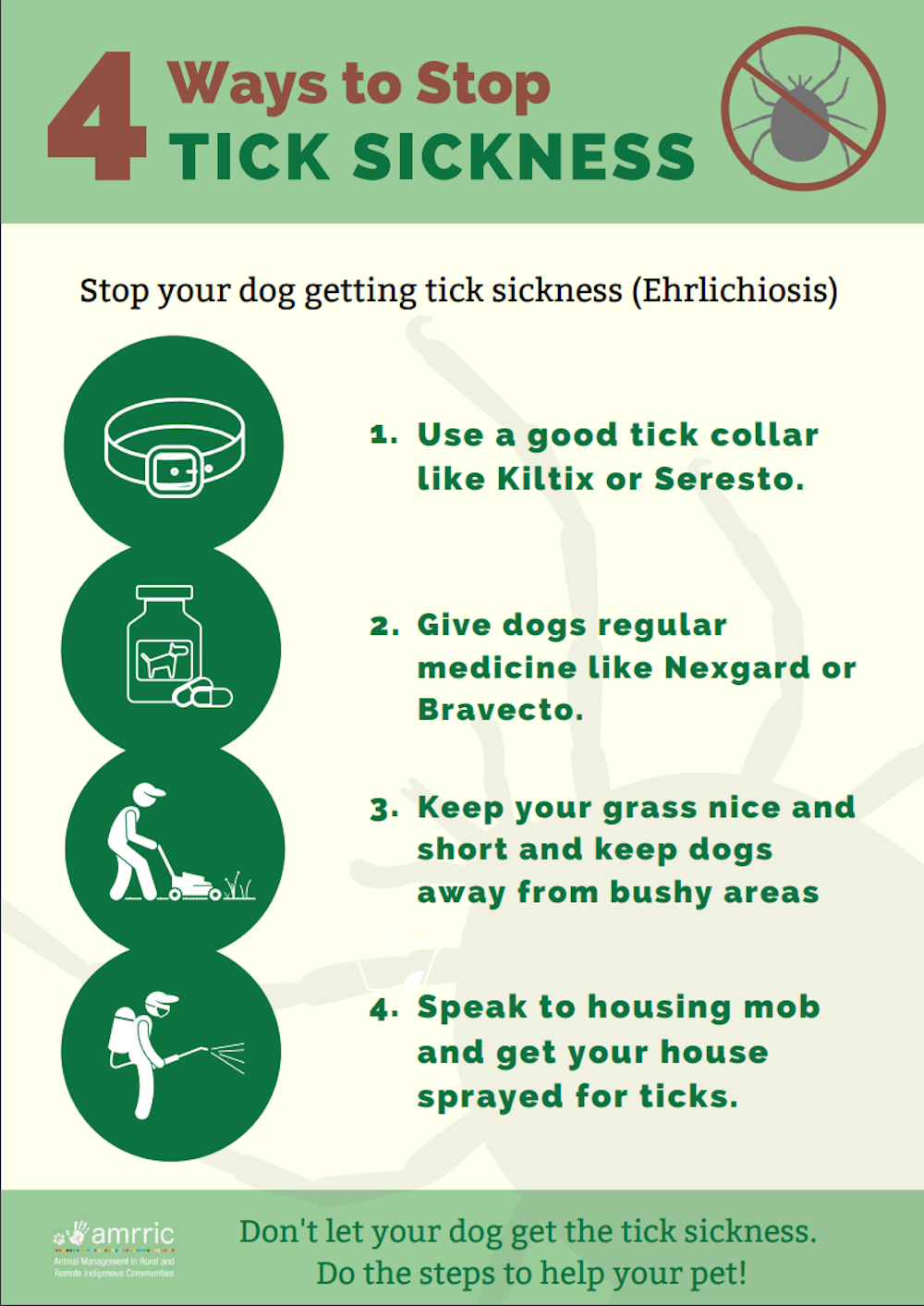 Four ways to stop tick sickness.
Poster courtesy of AMRRIC
Four ways to stop tick sickness.
Poster courtesy of AMRRIC
Important questions remain
Since the first Australian cases of canine ehrlichiosis were diagnosed, veterinary practitioners have raised questions about how the disease arrived (considering our border controls), as well as how it’s likely to play out in the future.
Was the infection carried into Australia by a dog travelling from an endemic country, or was there an undetected incursion of the contaminated tick itself? If this were the case, there are implications for other, potentially far more serious diseases, such as rabies, entering the continent in a similar manner.
And when exactly did the infection arrive? To be so widespread now would seem to imply its presence for quite some time, possibly several years.
Finally, what are the implications of this disease spilling over to other animals — and humans – in Australia? It would seem our native marsupials are in no danger from this disease; however, the potential impact on dingoes is unknown.
 The disease is diagnosed using blood tests conducted by state and federal veterinary laboratories.
Shutterstock
The disease is diagnosed using blood tests conducted by state and federal veterinary laboratories.
Shutterstock
A similar, rare disease in humans — called “human monocytic ehrlichiosis” (HME) — is caused by a different, closely related bacterium (Ehrlichia chaffeensis) and is characterised by fever, chill, headache, nausea and weight loss. However, one study in Venezuela revealed 30% of humans with HME were infected with a strain of E. canis.
HME isn’t known to occur in Australia, and the potential for E. canis to cause illness in humans here is currently unknown.
The discovery of E. canis in Australia reminds us of the importance of quarantine measures to protect our pets, just as we take such measures seriously for the protection of humans.
Read more: How to help dogs and cats manage separation anxiety when their humans return to work
The authors would like to gratefully acknowledge the contributions of Australia’s Chief Veterinary Officer Dr Mark Schipp to this article.
Authors: Peter Irwin, Emeritus professor, Murdoch University

















