

COVID is keeping us in our homes, but what makes working there a success or failure?
- Written by: Abbas Shieh, Assistant Professor of Urban Planning and Design, Islamic Azad University
The industrial revolution transformed cities, resulting in places of residence and work becoming more distant than ever before. This spatial segregation is still largely embedded in the design of our cities today.
But the COVID-19 pandemic might have brought our cities to a similarly dramatic turning point. Working from home has received a far-reaching fillip. Our pre-COVID survey of 277 remote-working employee and self-employed Australians shows most had a separate workspace for telework and generally felt satisfied with their home-work environment.
Read more: If more of us work from home after coronavirus we'll need to rethink city planning
But levels of satisfaction among workers in home-based settings vary. We identified some key factors to explain these differences.
Teleworkers’ work motivation increased with:
-
having a higher income
-
being a single parent with children
-
living in an apartment
-
satisfaction with workspace size
-
quality of home office equipment
-
the mobility of owning a private vehicle.
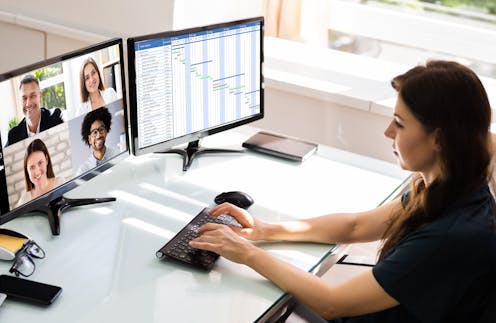
 The quality of the home office space is an important factor in satisfaction with working from home. Jelena Zelen/Shutterstock
For Australian sole parents, who are more likely to be women than men, telework at home can be an efficient and smart way of working. While having more time at home for caring responsibilities, they can work and earn money for household expenses.
Living and working in apartments can provide more opportunities for social interaction. It can also enable more efficient use of energy, lowering costs. Apartments and units are more likely to be located in higher-density urban areas, which offer better access to office and business services and other amenities.
At the same time, there were factors that decreased teleworkers’ motivation, including:
-
being in full-time employment
-
complicated corporate protocols
-
shorter time living in the current residence
-
feelings of isolation and distraction
-
having convenient access to public transport.
Access to public transport might seem counterintuitive but while enabling work-related journeys it also promotes more engagement outside the home, distractions to some extent, and so fewer feelings of isolation. Work-life balance at this micro-scale also has to be negotiated individually.
Read more: COVID impacts demand a change of plan: funding a shift from commuting to living locally
Home workplace qualities neglected
The pandemic has given new impetus to the critical rethinking of dispersed urbanisation that dates back to the sharp rise in energy prices in the early 1970s. The idea of working from home re-emerged at the dawn of the telecommunications revolution early in the 1980s.
Read more: Fancy an e-change? How people are escaping city congestion and living costs by working remotely
Our latest collective experience of working from home has brought into sharp relief both the pitfalls and the positives.
The academic literature on telework from fields such as organisational psychology focuses on maximising economic and logistical efficiency. Many studies ignore the positive and negative effects being in the home has on the worker.
Read more: How might COVID-19 change what Australians want from their homes?
How to improve support for telework
To date, organisational and managerial policies have been contradictory. There are public and private organisational guidelines and supportive government tax policies to encourage teleworking. These cover matters such as ergonomics and utilities (internet, electricity and technology).
But these policies do not practically or adequately support teleworkers’ access to appropriate conditions. Teleworkers can still be left alone with a host of problems and personal challenges.
Many of these issues are rooted in place-related factors. For example, although Australian tax-deduction policies cover internet, electricity and technology costs, they do not cover the capital costs of home renovations made to provide a home office or telework space. Yet these modifications are of great importance for successfully working from home.
Read more: Coronavirus could spark a revolution in working from home. Are we ready?
The OECD has recognised the risk of policies over-promoting teleworking for economic gains. The negative consequences, such as increased social isolation, distraction and work-family conflict, mainly affect the most vulnerable social groups. They include sole parents, people with disabilities and older people.
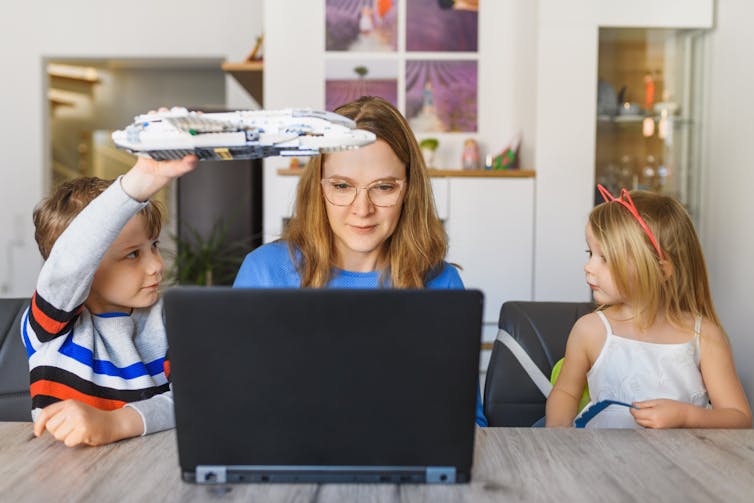 The distractions of family life can be stressful for people working from home. Igor Link/Shuttterstock
Based on our research, the government should:
-
encourage formal agreements for working from home
-
support modification of homes for telework for vulnerable social groups
-
develop opportunities in small regional cities
-
encourage more compact cities
-
develop public shared work offices and spaces at the local level.
These policy suggestions are consistent with many recent Australian urban development trends.
Read more: How COVID all but killed the Australian CBD
A smart city or a wise city?
Teleworking seems set to become a more entrenched work practice than ever before. Yet factors such as the impacts of home and place on human motivation have not been dealt with.
Over time, if governments want to encourage telework, our cities will need to change. Resources and infrastructure will need to be localised where people live – and increasingly work domestically – and not just in centralised employment districts.
Read more: Coronavirus reminds us how liveable neighbourhoods matter for our well-being
Authors: Abbas Shieh, Assistant Professor of Urban Planning and Design, Islamic Azad University


















