

Millennials are not the only 'burnout generation' (just ask the rest of us)
- Written by Steven David Hitchcock, Lecturer, University of Sydney
In her new book, Can’t Even, American journalist Anne Helen Peterson writes of how Millennials have become “the burnout generation”.
[It’s] feeling that you’ve hit the wall exhaustion-wise, but then have to scale the wall and just keep going. There’s no catharsis, no lasting rest, just this background hum of exhaustion.
The book, recently released in Australia, builds on the viral essay Peterson wrote in 2019.
At its heart, the book is a critique about the nature of modern workplaces and the modern economy.
As Petersen recently told Vox,
There’s a feeling of instability that’s the baseline economic condition for many, many millennials, and it’s enhanced by these other components of our lives that make it harder to turn away from.
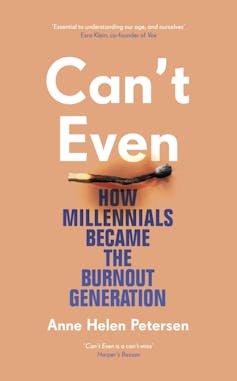 Can’t Even by Anne Helen Peterson has just been published in Australia.
Penguin Books Australia
Can’t Even by Anne Helen Peterson has just been published in Australia.
Penguin Books Australia
Peterson argues Millennials, born between the early 1980s and mid-1990s, have come of age in a world where more and more of their time is being demanded by not just work, but by life.
Technology means work follows us everywhere, at all hours, while leisure time happens (or is “performed”) on social media. Meanwhile, homes are turned into Airbnb rentals, cars become rideshare services.
What’s age got to do with it?
Peterson tells real and important stories about the frustration, anxiety, and malaise of herself and her contemporaries. However, she does us all a disservice by framing this as particularly “Millennial problem”.
While Peterson does acknowledge burnout impacts everyone, she assumes Millennials are a concrete group of people whose experience of burnout is exceptional.
 ‘Can’t Even’ describes the ‘background hum of exhaustion’ felt by Millennials.
www.shutterstock.com
‘Can’t Even’ describes the ‘background hum of exhaustion’ felt by Millennials.
www.shutterstock.com
The idea of clear generational groups, each possessing defining characteristics seems intuitive. It makes sense a group of contemporaries who had similar experiences in their formative years, would come to have similar attitudes, values, and beliefs.
But many scholars are uncertain that the generational groups as we know them — such as Millennials, Gen X or Baby Boomers — are as real or useful as we might think.
Read more: From Boomers to Xennials: we love talking about our generations, but must recognise their limits
Empirical research to prove generational groupings has produced “highly mixed and contradictory results”. So, many academics aren’t convinced birth-year groups even exist — there are too many variables.
For example, if a 20-year-old today doesn’t follow office etiquette, is this a product of them being Generation Z? Or because this person is new to the workforce?
Read more: Millennials at work don't see themselves as millennials
More broadly, the majority of research about generations have been undertaken across Europe, North America, and Australia/Oceania. Given these three regions combined make up less than 18% of the world’s population, it becomes clear how little we know.
So, while the frustrations of Peterson and her contemporaries are real — it is important to emphasise they are something everyone is facing.
‘Feelings of energy depletion’
Burnout has historically been studied in relation to workplace stress, particularly where employees are in a caring role.
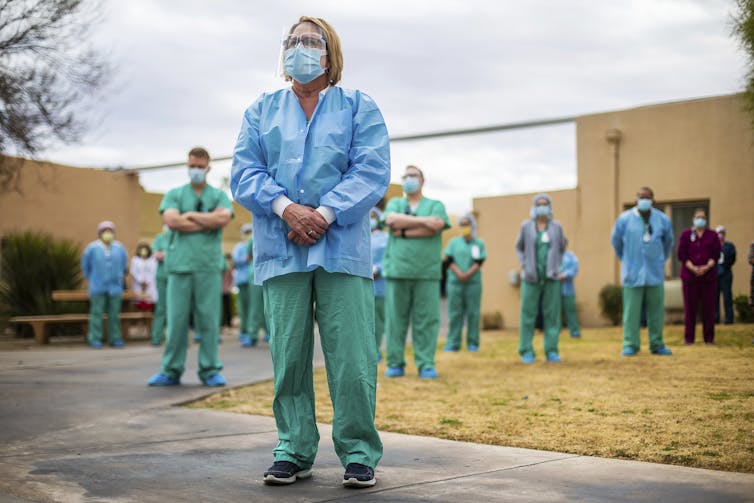 Traditionally ‘burnout’ has been examined as a form of workplace stress.
Josh Galemore/AAP
Traditionally ‘burnout’ has been examined as a form of workplace stress.
Josh Galemore/AAP
It is defined by World Health Organisation as
(a) feelings of energy depletion or exhaustion; (b) increased mental distance from one’s job, or feelings of negativism or cynicism related to one’s job; and (c) reduced professional efficacy.
But medical experts are starting to see burnout as a society-wide issue, particularly as people find themselves overwhelmed and fatigued by COVID-19. Similarly, mental health groups have identified burnout as a product of long-term, or chronic, stress.
That is to say, scientists and support services are coming to understand burnout is not necessarily a product of the workplace specifically — but everything going on in someone’s life — from how much technology they use, to how many commitments they have.
Everyone is over it
In 2020, who of us can say they aren’t feeling burned out?
After a summer of bushires, we had (and still have) a pandemic. For many, the boundaries between work and life have collapsed as we have needed to work, care, and relax at home — sometimes in the same room.
 COVID has brought a whole new meaning to ‘working from home’.
www.shutterstock.com
COVID has brought a whole new meaning to ‘working from home’.
www.shutterstock.com
COVID has been accompanied by a seemingly permanent state of angst, as we all found ourselves doomscrolling for the latest updates. Many people have also lost income and job security. And more than 2 million people around the world have lost their lives.
Burnout is about more than the pandemic
But it is not “just 2020”. The past several decades have seen huge changes to the way that we live, and engage with those around us.
For example, social media has had a profound effect — and not always for the better in terms of our mental health.
 The rise of 24/7 technology has made life easier … and unrelenting.
www.shutterstock.com
The rise of 24/7 technology has made life easier … and unrelenting.
www.shutterstock.com
In the workplace, an “overtime culture” has blossomed. As of 2019, about 13% of Australia’s workforce was working more than 50 hours a week.
The rise in casual employment may have allowed for more flexibility, but it has increased insecurity — with no paid leave, and unstable work schedules.
Here it is important to note, in 2020, those aged 15-24 made up less than 40% of all casual jobs. While the casual workforce is skewed towards younger workers - the casualisation of the workforce impacts all of us.
Read more: Uber might not take over the world, but it is still normalising job insecurity
On top of all of this, we have seen rising levels of student and household debt, skyrocketing house prices, and the increasing effects of climate change.
We all have plenty of reasons to feel bombarded by life.
How do you solve burnout?
So, what do we do? It goes without saying, widespread burnout due to social, economic, and political forces in the middle of a pandemic is a complex problem to solve.
At an individual level, resources do exist to help us address our mental health and support those around us.
Read more: The day is dawning on a four-day work week
However, systemic change is far more complex. Academics and world leaders have suggested reducing the work week might be an important step. Though, as noted by Peterson, it’s no longer just work demanding our time, energy, and attention.
As Peterson points out, one area that may need reimagining is how much and how often we consume information. Scholars in the 1960s were already raising concerns about the impact so much information could have on people, and in turn, society.
We as humans are social and curious creatures, but how much news, connection and information is good for us?
Comparing generations is a trap
As Slate journalist Shannon Palus observes, Peterson deserves credit for identifying big problems about a culture that constantly asks for more access to every aspect of our lives.
However, framing this issue as one belonging to, or uniquely impacting Millennials is a trap. It encourages us to compare different generations to see who is the least or most burned out.
Really, our attention should be devoted to working together to reduce burnout for everyone.
Authors: Steven David Hitchcock, Lecturer, University of Sydney

















