China's recycling ban calls for a long-term rethink in Australia
- Written by: Monique Retamal, Research Principal, Institute for Sustainable Futures, University of Technology Sydney
Australia’s recycling industry is in crisis, with China having effectively closed its borders to foreign recycling. Emergency measures have included stockpiling, landfilling, and trying to find other international destinations for our recycling – but none of these are sustainable long-term solutions.
To manage this problem sustainably, we need a mix of short and longer-term planning. That means taking a broader approach than the strategies agreed by state and federal environment ministers at last month’s emergency summit.
Read more: China's recycling 'ban' throws Australia into a very messy waste crisis
There is a wide range of potential strategies to address the crisis, shown in the diagram below. We have highlighted those that were endorsed at the ministers’ meeting, but there are many other options we could be considering too.
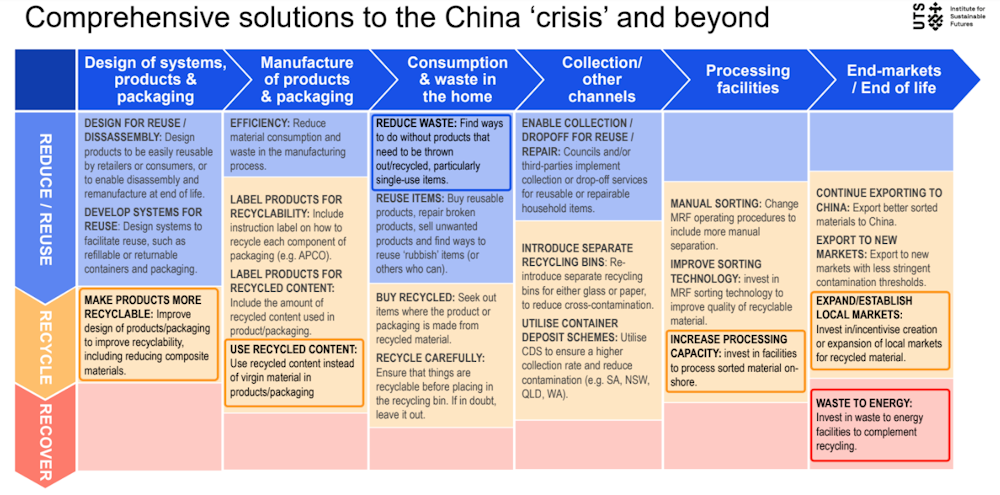 UTS Institute for Sustainable Futures, Author provided
Waste management is planned around “the waste hierarchy”. This sets out our options for dealing with waste, in order from most to least preferable for sustainability. To be effective, the government’s strategies need to follow this established hierarchy.
UTS Institute for Sustainable Futures, Author provided
Waste management is planned around “the waste hierarchy”. This sets out our options for dealing with waste, in order from most to least preferable for sustainability. To be effective, the government’s strategies need to follow this established hierarchy.
 UTS Institute for Sustainable Futures
This means that waste strategies should prioritise avoiding, reducing, and reusing, before recycling, energy recovery, and finally disposal to landfill as a last resort. So how do the ministers’ strategies stack up?
Top of the pile
The ministers agreed to reduce waste through consumer education and industry initiatives. These types of initiatives are important and sit at the top of the waste hierarchy, but the announcement is so far lacking in detail and targets.
Local councils have been running recycling education initiatives for a long time, with mixed success. Going beyond this to waste reduction is even harder and there are few successful examples. To do this well would require substantial investment of time and resources to identify and trial effective approaches to waste reduction. Education alone, without incentives and regulations, is unlikely to deliver sufficient change.
The ministers also endorsed a new target of making 100% of packaging recyclable, reusable or compostable by 2025. While this target is commendable, we should be prioritising reduction and reuse over recycling and composting when designing packaging.
The industry-led Australian Packaging Covenant Organisation (APCO) has already adopted “closing the loop” (improved recovery) as a performance criterion in its new Packaging Sustainability Framework, but incentives to prioritise reusable packaging are still needed. Refillable returnable glass bottles are common in Europe. Support from government and businesses for local pilots of these and similar schemes would help overcome barriers to implementation.
These “top of the hierarchy” approaches are all long-term and need serious attention to reduce the amount of waste we create in the first place.
Bottom of the heap
While we’re working on avoidance and reuse, we need to improve our domestic recycling system.
Read more:
The new 100% recyclable packaging target is no use if our waste isn't actually recycled
There are several ways to do this:
Increase domestic recycling capacity
The ministers also agreed to work together on expanding and developing our recycling industry. To do this, we need to focus on improving sorting, and reprocessing recyclables into materials that can be used for manufacturing. The recycling industry is advocating for new reprocessing facilities, but we need to develop local markets for recycled material at the same time to make sure we depend less on export markets.
Develop local markets
For recycling to happen, there needs to be a market for recycled content. The ministers agreed to advocate for more recycled materials in government procurement, such as recycled paper, road base, and construction materials. Procurement guidelines will be needed to ensure this goes ahead. Governments could take this a step further, and incentivise businesses to use recycled content in their products too.
Labelling products to indicate recycled content would also help generate demand from consumers.
Improve the quality of collected recyclables
This is an ongoing challenge, but will be essential for any future recycling pathways. Initiatives to achieve this were not detailed in the meeting. This will require upgrading our sorting facilities, and potentially improving our kerbside collection systems too.
Industry reports have suggested that re-introducing separate bins at the kerbside – or at least separating paper from glass – would greatly improve the quality of mixed paper compared with current co-mingled recycling. It would eliminate glass shards, which make re-milling paper much more difficult.
UTS Institute for Sustainable Futures
This means that waste strategies should prioritise avoiding, reducing, and reusing, before recycling, energy recovery, and finally disposal to landfill as a last resort. So how do the ministers’ strategies stack up?
Top of the pile
The ministers agreed to reduce waste through consumer education and industry initiatives. These types of initiatives are important and sit at the top of the waste hierarchy, but the announcement is so far lacking in detail and targets.
Local councils have been running recycling education initiatives for a long time, with mixed success. Going beyond this to waste reduction is even harder and there are few successful examples. To do this well would require substantial investment of time and resources to identify and trial effective approaches to waste reduction. Education alone, without incentives and regulations, is unlikely to deliver sufficient change.
The ministers also endorsed a new target of making 100% of packaging recyclable, reusable or compostable by 2025. While this target is commendable, we should be prioritising reduction and reuse over recycling and composting when designing packaging.
The industry-led Australian Packaging Covenant Organisation (APCO) has already adopted “closing the loop” (improved recovery) as a performance criterion in its new Packaging Sustainability Framework, but incentives to prioritise reusable packaging are still needed. Refillable returnable glass bottles are common in Europe. Support from government and businesses for local pilots of these and similar schemes would help overcome barriers to implementation.
These “top of the hierarchy” approaches are all long-term and need serious attention to reduce the amount of waste we create in the first place.
Bottom of the heap
While we’re working on avoidance and reuse, we need to improve our domestic recycling system.
Read more:
The new 100% recyclable packaging target is no use if our waste isn't actually recycled
There are several ways to do this:
Increase domestic recycling capacity
The ministers also agreed to work together on expanding and developing our recycling industry. To do this, we need to focus on improving sorting, and reprocessing recyclables into materials that can be used for manufacturing. The recycling industry is advocating for new reprocessing facilities, but we need to develop local markets for recycled material at the same time to make sure we depend less on export markets.
Develop local markets
For recycling to happen, there needs to be a market for recycled content. The ministers agreed to advocate for more recycled materials in government procurement, such as recycled paper, road base, and construction materials. Procurement guidelines will be needed to ensure this goes ahead. Governments could take this a step further, and incentivise businesses to use recycled content in their products too.
Labelling products to indicate recycled content would also help generate demand from consumers.
Improve the quality of collected recyclables
This is an ongoing challenge, but will be essential for any future recycling pathways. Initiatives to achieve this were not detailed in the meeting. This will require upgrading our sorting facilities, and potentially improving our kerbside collection systems too.
Industry reports have suggested that re-introducing separate bins at the kerbside – or at least separating paper from glass – would greatly improve the quality of mixed paper compared with current co-mingled recycling. It would eliminate glass shards, which make re-milling paper much more difficult.
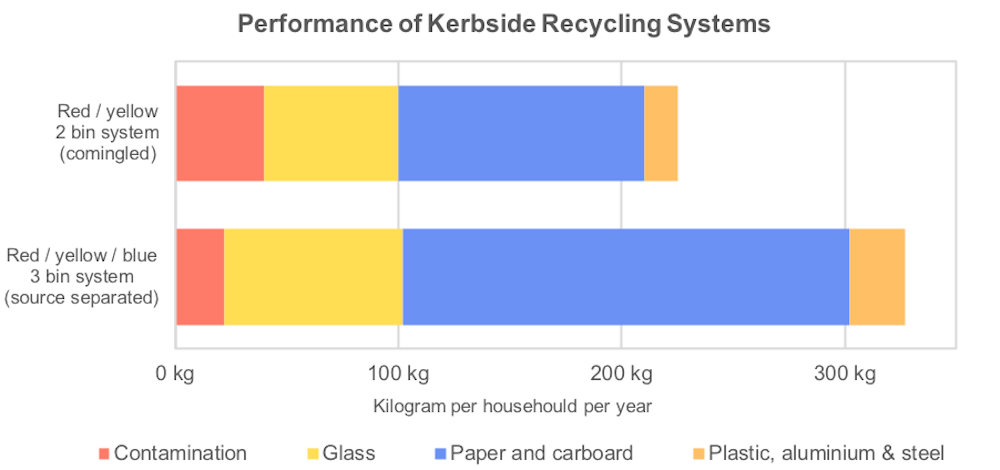 Adapted from Assessment of domestic Waste and Recycling/NSW DEC
Container deposit schemes also provide an excellent opportunity to collect better-value recycling streams. South Australia developed its scheme way back in 1977 and similar schemes are finally being rolled out in New South Wales (“return and earn”), and will soon be followed by Queensland and Western Australia.
Labelling products with recycling instructions may also help with collection quality. Industry organisations APCO, Planet Ark and PREP Design recently launched a labelling scheme to help packaging designers increase the recyclability of their packaging, and to give consumers information on how to recycle it.
Waste to energy?
Finally, the ministers also identified the potential to develop “waste to energy projects” through existing energy funding channels. This strategy falls lower down the hierarchy than recycling, as materials are no longer available to recirculate in the economy.
Waste to energy projects can be complementary to recycling in processing genuine residual waste (contaminants separated from recyclables at sorting centres), to achieve very high levels of diversion. This is already required under the NSW EPA energy from waste policy. However, waste to energy is not a solution to a recycling crisis and should not be used to deal with recyclables that can no longer be exported to China. It is not a short-term option either, because Australia does not have a mature waste to energy sector, and investment needs to happen at the right scale to ensure that it is complementary to recycling.
Read more:
The recycling crisis in Australia: easy solutions to a hard problem
Most of the strategies currently being pursued are sound in principle, although many of them need clearer plans for their funding and implementation, as well as ambitious targets.
We need a comprehensive range of short- and longer-term strategies if we are truly to get to grips with the recycling crisis. We should be wary of “silver bullets” such as waste to energy, or new export contracts that could undermine more sustainable long-term solutions.
The environment ministers agreed to update the National Waste Policy this year, incorporating circular economy principles, which is encouraging. This will be their opportunity to coordinate a nationally consistent response that promotes the development of resilient markets for recycled content, and reusable and re-manufactured products.
This will need to go beyond the current strong focus on recycling, and embrace the upper levels of the waste hierarchy. The next step will be to develop properly funded plans for implementing these changes.
Adapted from Assessment of domestic Waste and Recycling/NSW DEC
Container deposit schemes also provide an excellent opportunity to collect better-value recycling streams. South Australia developed its scheme way back in 1977 and similar schemes are finally being rolled out in New South Wales (“return and earn”), and will soon be followed by Queensland and Western Australia.
Labelling products with recycling instructions may also help with collection quality. Industry organisations APCO, Planet Ark and PREP Design recently launched a labelling scheme to help packaging designers increase the recyclability of their packaging, and to give consumers information on how to recycle it.
Waste to energy?
Finally, the ministers also identified the potential to develop “waste to energy projects” through existing energy funding channels. This strategy falls lower down the hierarchy than recycling, as materials are no longer available to recirculate in the economy.
Waste to energy projects can be complementary to recycling in processing genuine residual waste (contaminants separated from recyclables at sorting centres), to achieve very high levels of diversion. This is already required under the NSW EPA energy from waste policy. However, waste to energy is not a solution to a recycling crisis and should not be used to deal with recyclables that can no longer be exported to China. It is not a short-term option either, because Australia does not have a mature waste to energy sector, and investment needs to happen at the right scale to ensure that it is complementary to recycling.
Read more:
The recycling crisis in Australia: easy solutions to a hard problem
Most of the strategies currently being pursued are sound in principle, although many of them need clearer plans for their funding and implementation, as well as ambitious targets.
We need a comprehensive range of short- and longer-term strategies if we are truly to get to grips with the recycling crisis. We should be wary of “silver bullets” such as waste to energy, or new export contracts that could undermine more sustainable long-term solutions.
The environment ministers agreed to update the National Waste Policy this year, incorporating circular economy principles, which is encouraging. This will be their opportunity to coordinate a nationally consistent response that promotes the development of resilient markets for recycled content, and reusable and re-manufactured products.
This will need to go beyond the current strong focus on recycling, and embrace the upper levels of the waste hierarchy. The next step will be to develop properly funded plans for implementing these changes.
Authors: Monique Retamal, Research Principal, Institute for Sustainable Futures, University of Technology Sydney