The latest from Juno as Jupiter appears bright in the night sky
- Written by: Tanya Hill, Honorary Fellow of the University of Melbourne and Senior Curator (Astronomy), Museums Victoria
Now is a great time to see Jupiter in the night sky, as the planet reaches opposition on Wednesday, May 9.
Opposition means that Jupiter sits opposite the Sun in the sky. So tonight, as the Sun sets in the west, Jupiter can be found rising in the east. It’s lovely and bright, outshining all the stars of the night sky.
 In fact, opposition also means that Jupiter is at its closest to Earth, making the planet shine even more brilliantly than usual. So be sure to look east over the next few weeks to catch Jupiter at its best.
 Jupiter will be seen throughout May, rising in the east at sunset, ahead of the constellation Scorpius.
Museums Victoria/stellarium
Jupiter like we’ve never seen it before
Also catching Jupiter at its best will be NASA’s spacecraft, Juno. After a five-year journey, Juno entered orbit around Jupiter in mid-2016.
Read more:
Early images of the closest look at Jupiter's Great Red Spot
It’s the second spacecraft to orbit Jupiter (after Galileo in 1995), but importantly it’s the first to orbit Jupiter’s poles, allowing us to see a part of the planet that can’t be seen from Earth.
Jupiter will be seen throughout May, rising in the east at sunset, ahead of the constellation Scorpius.
Museums Victoria/stellarium
Jupiter like we’ve never seen it before
Also catching Jupiter at its best will be NASA’s spacecraft, Juno. After a five-year journey, Juno entered orbit around Jupiter in mid-2016.
Read more:
Early images of the closest look at Jupiter's Great Red Spot
It’s the second spacecraft to orbit Jupiter (after Galileo in 1995), but importantly it’s the first to orbit Jupiter’s poles, allowing us to see a part of the planet that can’t be seen from Earth.
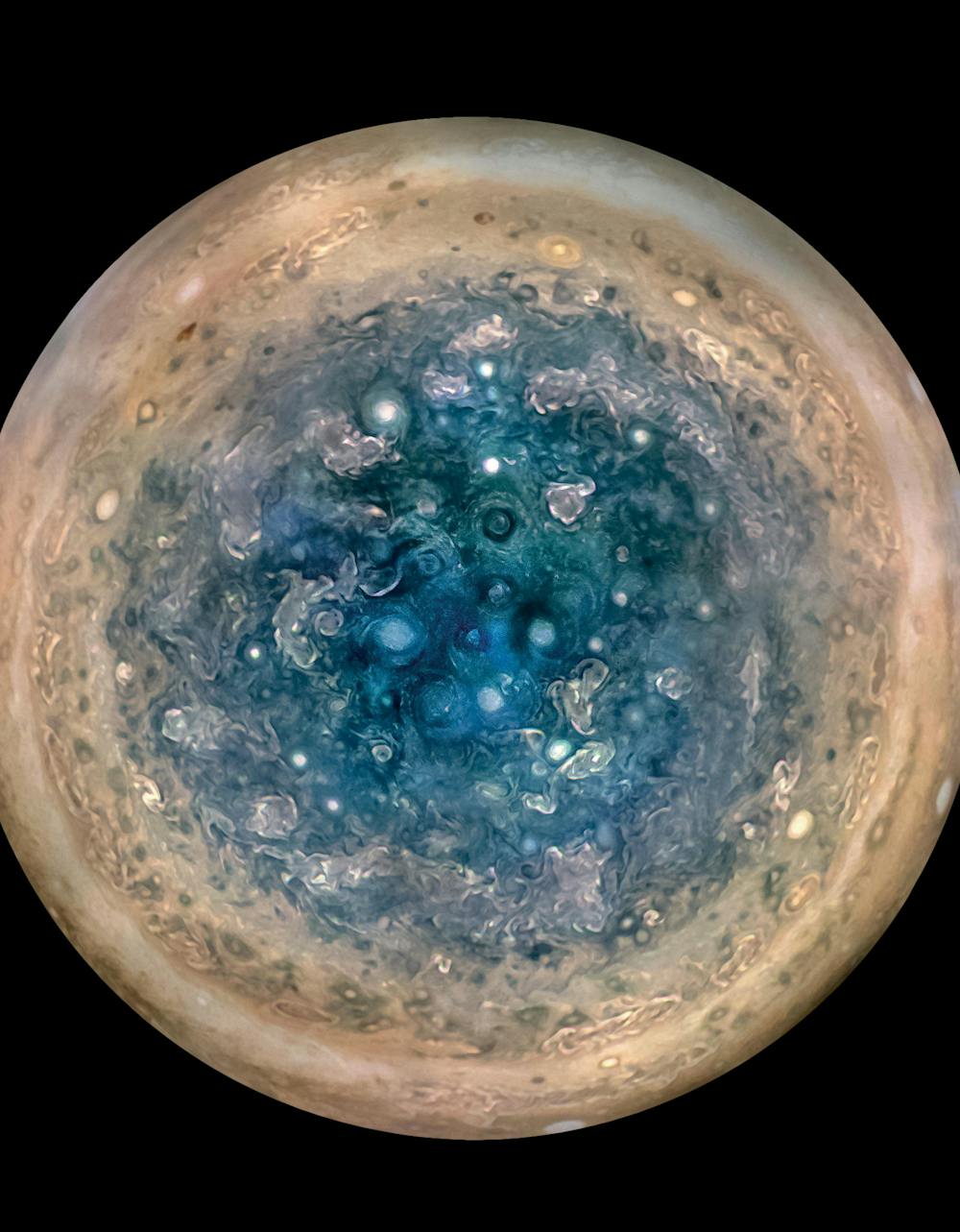 A new look at Jupiter, where multiple images have been combined to show the south pole in full sunlight.
NASA/JPL-Caltech/SwRI/MSSS/Betsy Asher Hall/Gervasio Robles
Juno has shown us that Jupiter’s colourful bands – the clearly defined belts and zones (the dark and light bands, respectively) circling the bulk of the planet – give way to a striking configuration of cyclones at each of Jupiter’s poles.
Discovering cyclones at the top and bottom of Jupiter is not completely unexpected, but what’s surprising is their stability and the patterns they have formed.
A new look at Jupiter, where multiple images have been combined to show the south pole in full sunlight.
NASA/JPL-Caltech/SwRI/MSSS/Betsy Asher Hall/Gervasio Robles
Juno has shown us that Jupiter’s colourful bands – the clearly defined belts and zones (the dark and light bands, respectively) circling the bulk of the planet – give way to a striking configuration of cyclones at each of Jupiter’s poles.
Discovering cyclones at the top and bottom of Jupiter is not completely unexpected, but what’s surprising is their stability and the patterns they have formed.
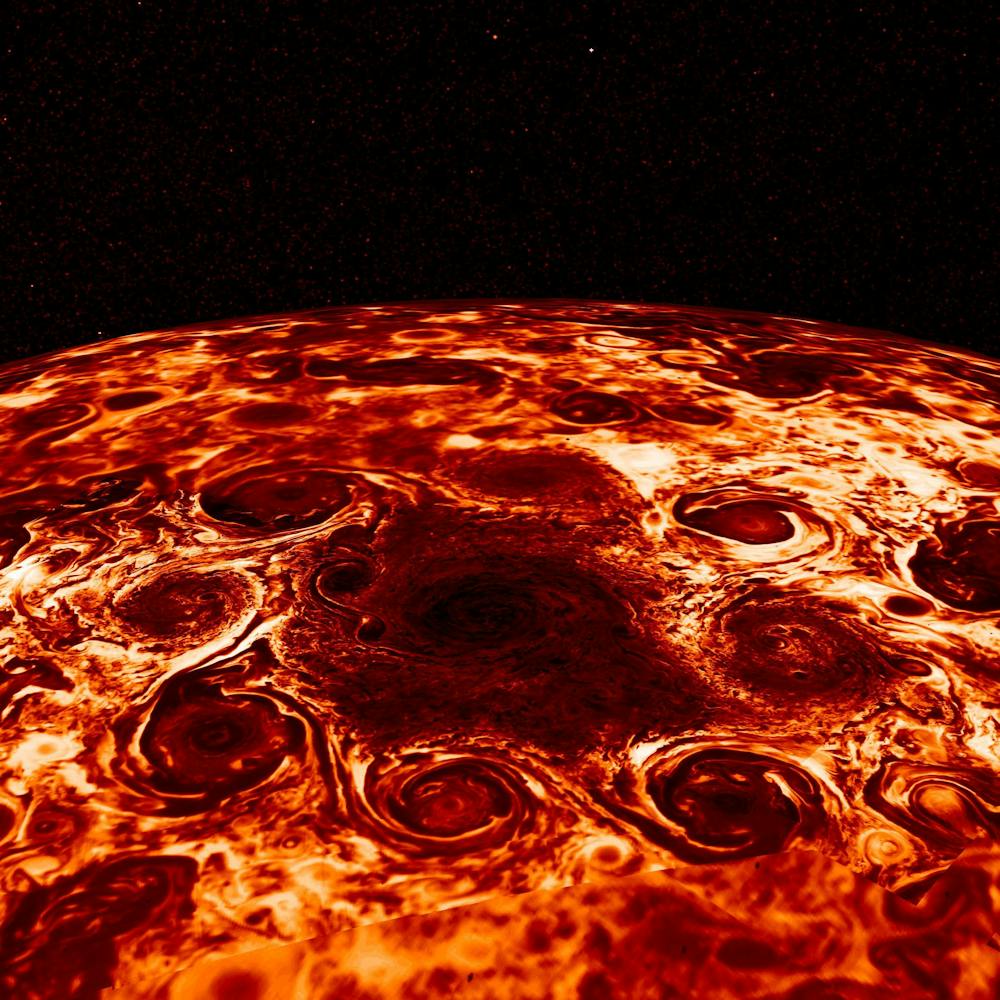 Jupiter’s northern cyclones in infrared, which captures the radiating heat. In this original image, darker regions are colder and cloudier, while brighter regions are relatively cloud-free, allowing us to look deeper.
NASA/JPL-Caltech/SwRI/ASI/INAF/JIRAM
At the north pole, one central cyclone is surrounded by eight outer cyclones. In the south, the central cyclone has five others encircling it.
These cyclones are huge – the southern ones range from 5,600km to 7,000km in diameter; that’s about as wide as Mars. The northern ones are slightly smaller, with diameters of around 4,000km to 4,600km. The wind speeds are as great as 350km per hour.
Jupiter’s northern cyclones in infrared, which captures the radiating heat. In this original image, darker regions are colder and cloudier, while brighter regions are relatively cloud-free, allowing us to look deeper.
NASA/JPL-Caltech/SwRI/ASI/INAF/JIRAM
At the north pole, one central cyclone is surrounded by eight outer cyclones. In the south, the central cyclone has five others encircling it.
These cyclones are huge – the southern ones range from 5,600km to 7,000km in diameter; that’s about as wide as Mars. The northern ones are slightly smaller, with diameters of around 4,000km to 4,600km. The wind speeds are as great as 350km per hour.
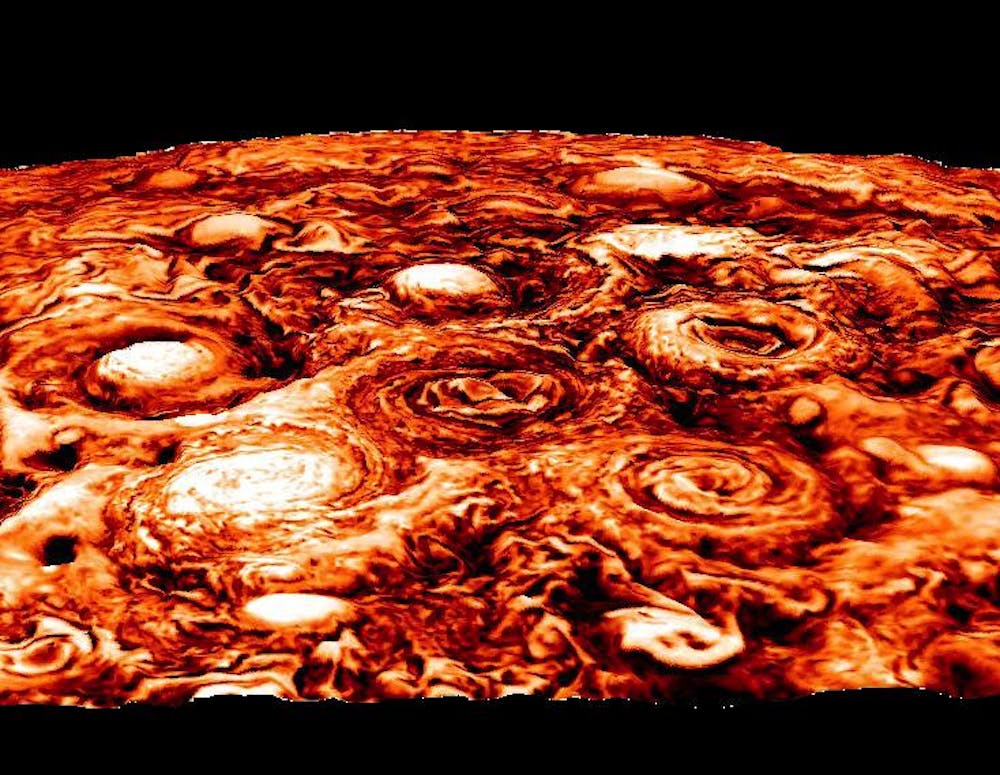 Jupiter’s southern cyclones. Note this enhanced image shows an inverted view, the darker regions are deep, while the higher, thicker clouds are white. This view aims to match the way we see clouds in space images of Earth.
NASA/JPL-Caltech/SwRI/ASI/INAF/JIRAM
Over the seven months of observations analysed so far, the cyclones have remained surprisingly distinct, with no signs that they might merge together. Yet most of the cyclones are so tightly packed that their spiral arms are touching. (You can see the movement of the cyclones in this raw footage.)
Also, the pattern itself is highly stable and shows barely any motion. Even though there’s a central cyclone churning around the pole, its motion doesn’t seem to be pushing the outer cyclones to circle around it (a la “Ring a Ring o’ Roses”). If they are circling the pole, then they must be drifting very slowly.
Juno - please drive safely
The other exciting thing about Juno is that it was built to probe the inner depths of Jupiter. One way it does this is by intricately mapping Jupiter’s gravitational field to a precision 100 times better than ever before.
Every 53 days, Juno carries out a stunning Jupiter flyby. The probe takes two hours to travel from one pole to the other, zipping past at more than 200km/h and skimming just 4,000km above Jupiter’s cloud tops.
The latest Jupiter flyby (from April, 2018) shown in 70 seconds. NASA/JPL/SwRI/MSSS/SPICE/Gerald Eichstädt.As Juno races by the planet it feels the gravitational tug of Jupiter. It speeds up slightly when flying over regions of high mass and slows down wherever the mass drops off.
These tiny changes in Juno’s speed are measured using a kind of interplanetary radar gun; Juno transmits a radio signal of a certain frequency and when it arrives here on Earth, any change to that frequency alerts us to Juno’s changing speed.
Feeling the pressure
If we think about Earth, there is a clear distinction between the clouds, the atmosphere, and the rocky planet itself.
Jupiter’s southern cyclones. Note this enhanced image shows an inverted view, the darker regions are deep, while the higher, thicker clouds are white. This view aims to match the way we see clouds in space images of Earth.
NASA/JPL-Caltech/SwRI/ASI/INAF/JIRAM
Over the seven months of observations analysed so far, the cyclones have remained surprisingly distinct, with no signs that they might merge together. Yet most of the cyclones are so tightly packed that their spiral arms are touching. (You can see the movement of the cyclones in this raw footage.)
Also, the pattern itself is highly stable and shows barely any motion. Even though there’s a central cyclone churning around the pole, its motion doesn’t seem to be pushing the outer cyclones to circle around it (a la “Ring a Ring o’ Roses”). If they are circling the pole, then they must be drifting very slowly.
Juno - please drive safely
The other exciting thing about Juno is that it was built to probe the inner depths of Jupiter. One way it does this is by intricately mapping Jupiter’s gravitational field to a precision 100 times better than ever before.
Every 53 days, Juno carries out a stunning Jupiter flyby. The probe takes two hours to travel from one pole to the other, zipping past at more than 200km/h and skimming just 4,000km above Jupiter’s cloud tops.
The latest Jupiter flyby (from April, 2018) shown in 70 seconds. NASA/JPL/SwRI/MSSS/SPICE/Gerald Eichstädt.As Juno races by the planet it feels the gravitational tug of Jupiter. It speeds up slightly when flying over regions of high mass and slows down wherever the mass drops off.
These tiny changes in Juno’s speed are measured using a kind of interplanetary radar gun; Juno transmits a radio signal of a certain frequency and when it arrives here on Earth, any change to that frequency alerts us to Juno’s changing speed.
Feeling the pressure
If we think about Earth, there is a clear distinction between the clouds, the atmosphere, and the rocky planet itself.
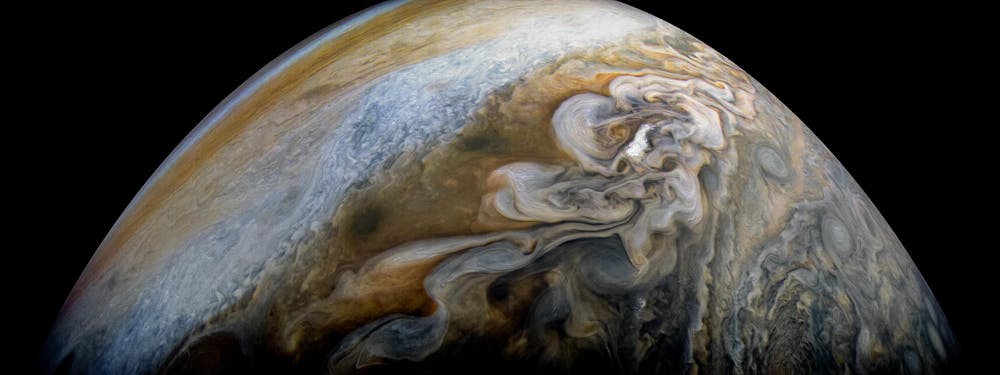 Swirling cloud belts of Jupiter’s northern hemisphere.
NASA/JPL-Caltech/SwRI/MSSS/Kevin M Gill
But being made of gas, Jupiter is essentially all atmosphere. By definition, the planet begins when the atmospheric pressure of its gas equals 1 bar. That’s equivalent to the pressure we feel at sea level on Earth.
This provides a kind of surface for Jupiter, as such, although it is biased by our Earthling viewpoint. Juno is already giving us much better insights into how Jupiter is truly structured.
Previously what we’ve seen of Jupiter, the banded belts and zones, are the cloud tops sitting just above the planet’s “surface”. They circle around the planet, with alternate bands moving in opposite directions.
Juno’s data has shown that this banding continues deep into Jupiter, appearing to be much more than just a thin layer of weather (that’s driven by the Sun).
Swirling clouds of Jupiter from Voyager 1 (1979). NASA/JPL/Björn Jónsson/Ian Regan.How low can you go?
Juno’s gravity mapping was separated into two components: a static component, modelled as Jupiter’s gas rotating as one; and a dynamic component, arising from flows.
The dynamic component was revealed by a north-south asymmetry in Jupiter’s gravity field. What that means is that the way gravity varied from the equator up to the north pole was not consistent with how it changed from the equator down to the south pole.
Swirling cloud belts of Jupiter’s northern hemisphere.
NASA/JPL-Caltech/SwRI/MSSS/Kevin M Gill
But being made of gas, Jupiter is essentially all atmosphere. By definition, the planet begins when the atmospheric pressure of its gas equals 1 bar. That’s equivalent to the pressure we feel at sea level on Earth.
This provides a kind of surface for Jupiter, as such, although it is biased by our Earthling viewpoint. Juno is already giving us much better insights into how Jupiter is truly structured.
Previously what we’ve seen of Jupiter, the banded belts and zones, are the cloud tops sitting just above the planet’s “surface”. They circle around the planet, with alternate bands moving in opposite directions.
Juno’s data has shown that this banding continues deep into Jupiter, appearing to be much more than just a thin layer of weather (that’s driven by the Sun).
Swirling clouds of Jupiter from Voyager 1 (1979). NASA/JPL/Björn Jónsson/Ian Regan.How low can you go?
Juno’s gravity mapping was separated into two components: a static component, modelled as Jupiter’s gas rotating as one; and a dynamic component, arising from flows.
The dynamic component was revealed by a north-south asymmetry in Jupiter’s gravity field. What that means is that the way gravity varied from the equator up to the north pole was not consistent with how it changed from the equator down to the south pole.
 Jupiter is turbulent above and below.
NASA/JPL-Caltech/SwRI/MSSS/Gerald Eichstadt/Sean Doran
It also became clear that these changes in gravity tracked the banded structure of Jupiter’s cloud layer.
As a result, the cloud tops must extend into Jupiter, becoming swirling jet streams that reach depths of 3,000km. The amount of mass swirling around was calculated to be 1% of Jupiter’s total mass – more than triple the mass of the Earth.
Is there a ‘planet’ deep within?
By analysing the static component of Jupiter’s gravitational field, it was found that there is a point where Jupiter’s gas starts to rotate in harmony, like a rigid sphere.
It sits below a wind depth of at least 2,000km but less than 3,500km, which is well consistent with the jet stream findings.
Read more:
Launching in May, the InSight mission will measure marsquakes to explore the interior of Mars
At this depth, the pressure is 100,000 times greater than what we feel at the Earth’s surface and temperatures soar. Electric currents flowing through the compressed hydrogen gas and constrained by Jupiter’s powerful magnetic field, are thought to slow the winds down and drag the gas into uniform motion.
First views of Jupiter’s magnetic dynamo shows irregularities and intense magnetic hot spots. NASA Goddard Space Flight Center.As Juno continues to swing by Jupiter, scientists hope to better understand the dynamo powering Jupiter’s magnetic field and ultimately to determine if Jupiter has a solid core, made of some kind of icy rock subjected to more than 50 million bars of pressure. Now that’s truly out of this world.
Jupiter is turbulent above and below.
NASA/JPL-Caltech/SwRI/MSSS/Gerald Eichstadt/Sean Doran
It also became clear that these changes in gravity tracked the banded structure of Jupiter’s cloud layer.
As a result, the cloud tops must extend into Jupiter, becoming swirling jet streams that reach depths of 3,000km. The amount of mass swirling around was calculated to be 1% of Jupiter’s total mass – more than triple the mass of the Earth.
Is there a ‘planet’ deep within?
By analysing the static component of Jupiter’s gravitational field, it was found that there is a point where Jupiter’s gas starts to rotate in harmony, like a rigid sphere.
It sits below a wind depth of at least 2,000km but less than 3,500km, which is well consistent with the jet stream findings.
Read more:
Launching in May, the InSight mission will measure marsquakes to explore the interior of Mars
At this depth, the pressure is 100,000 times greater than what we feel at the Earth’s surface and temperatures soar. Electric currents flowing through the compressed hydrogen gas and constrained by Jupiter’s powerful magnetic field, are thought to slow the winds down and drag the gas into uniform motion.
First views of Jupiter’s magnetic dynamo shows irregularities and intense magnetic hot spots. NASA Goddard Space Flight Center.As Juno continues to swing by Jupiter, scientists hope to better understand the dynamo powering Jupiter’s magnetic field and ultimately to determine if Jupiter has a solid core, made of some kind of icy rock subjected to more than 50 million bars of pressure. Now that’s truly out of this world.
Authors: Tanya Hill, Honorary Fellow of the University of Melbourne and Senior Curator (Astronomy), Museums Victoria
Read more http://theconversation.com/the-latest-from-juno-as-jupiter-appears-bright-in-the-night-sky-96108