

how I rediscovered the rare cloaked bee in Australia, hidden for a century
- Written by James B. Dorey, PhD Candidate, Flinders University
It’s not often you get to cast your eyes on a creature feared to be long-gone.
Perhaps that’s why my recent rediscovery of the native bee species Pharohylaeus lactiferus is so exciting — especially after it spent a century eluding researchers.
But how did it stay out of sight for so long?
A creature overshadowed
Australia is home to 1654 named species of native bee. Unfortunately, these are often overshadowed in the eyes of public by the widespread and invasive European honeybee.
Scientific research on Australian native bees is lagging, compared to many other nations.
With this in mind, it may not be surprising to learn some native species can go unnoticed for many years. Although, when it’s the only representative of a whole genus, one might start to worry about losing something special.
In this case the genus is Pharohylaeus, where “pharo” means “cloaked”, as these bees’ first three abdominal segments overlay the others to resemble a cloak.
I found the cloaked bee P. lactiferus during a major east coast sampling effort of more than 225 unique sites. The discovery, and what I learnt from it, helped me find more specimens at two additional sites.
It also made me wonder why P. lactiferus had been missing for so long. Is it naturally rare, hard to find, or perhaps threatened?
Read more: We taught bees a simple number language – and they got it
Taxonomic trouble
Many Australian bees are very difficult to identify to a species level. In fact, some might be nearly impossible.
However, P. lactiferus is a relatively distinct black and white masked bee. Masked bees are those from the subfamily Hylaeinae, named so because they often have striking, bright facial patterns on an otherwise dark face.
With this distinctive appearance, identification issues weren’t a contributor to the mystery of P. lactiferus.
Seeing red
Still, despite having sampled extensively across sites and flowering plant species, I only found P. lactiferus on two types of plant: the firewheel tree and the Illawarra flame tree — both of which boast exuberant red flowers.
 The Illawarra flame tree (Brachychiton acerifolius).
James Dorey, Author provided
The Illawarra flame tree (Brachychiton acerifolius).
James Dorey, Author provided
Bees generally don’t see shades of red, so such plants are usually pollinated by birds. It could be that bee researchers tend to avoid sampling these red flowering plant species for this reason.
Then again, bee vision and bee perception are not always the same. And bees are also guided by their keen sense of smell.
Habitat specialisation
So far, I’ve only found P. lactiferus within about 200 metres of one major vegetation subgroup, which is tropical or sub-tropical rainforest.
The first specimens I collected were in Atherton, Queensland. I later found more in Kuranda and Eungella. Some of these specimens are now stored in the South Australian Museum.
 One sampling site was Mt Bartle Frere, the highest mountain in Queensland.
Author provided (No reuse)
One sampling site was Mt Bartle Frere, the highest mountain in Queensland.
Author provided (No reuse)
The habitat specialisation of P. lactiferus may suggest it has an above-average level of vulnerability to disturbances, particularly if it needs a strict set of requirements to make it through its entire life-cycle.
It is one of myriad bee species that nest in narrow, wooden hollows. Some bees such as Amphylaeus morosus dig these themselves and may require specific plant species to make their nest in.
Others such as Exoneurella tridentata need to use holes made by weevil larvae in two particular tree species: western myall and bullock bush.
Rainforests are also notoriously hard to sample. If a bee species spends much of its time in the high canopy, finding it would be difficult.
That said, two early collectors managed to find six specimens of P. lactiferus between 1900 and 1923. So its rarity doesn’t necessarily come down to it being a canopy-dweller.
Read more: The mystery of the blue flower: nature's rare colour owes its existence to bee vision
Potential threats
We know in the bioregions where P. lactiferus has been found that rainforests have undergone both habitat destruction and fragmentation since European colonisation. This threat hasn’t abated and Queensland is still a land-clearing hotspot.
We also know these rainforests burnt across Queensland every year between 1988 and 2016. The 2019-20 black summer megafires burnt nearly double the area of any previous year.
For some bee species this may not be a problem. But for a species that potentially requires specific foods, habitats and even other species, it could mean local extinction.
Only so many populations of a single species can disappear, before there are none left.
Where does this leave us?
P. lactiferus persists, which is wonderful. Unfortunately, we can’t yet say whether or not it is threatened.
To determine this confidently would require a robust, extensive and targeted survey regime.
We may not be able to undertake such a regime for all 1654 of the named bee species in Australia. But perhaps we could make that effort for the country’s only cloaked bee.
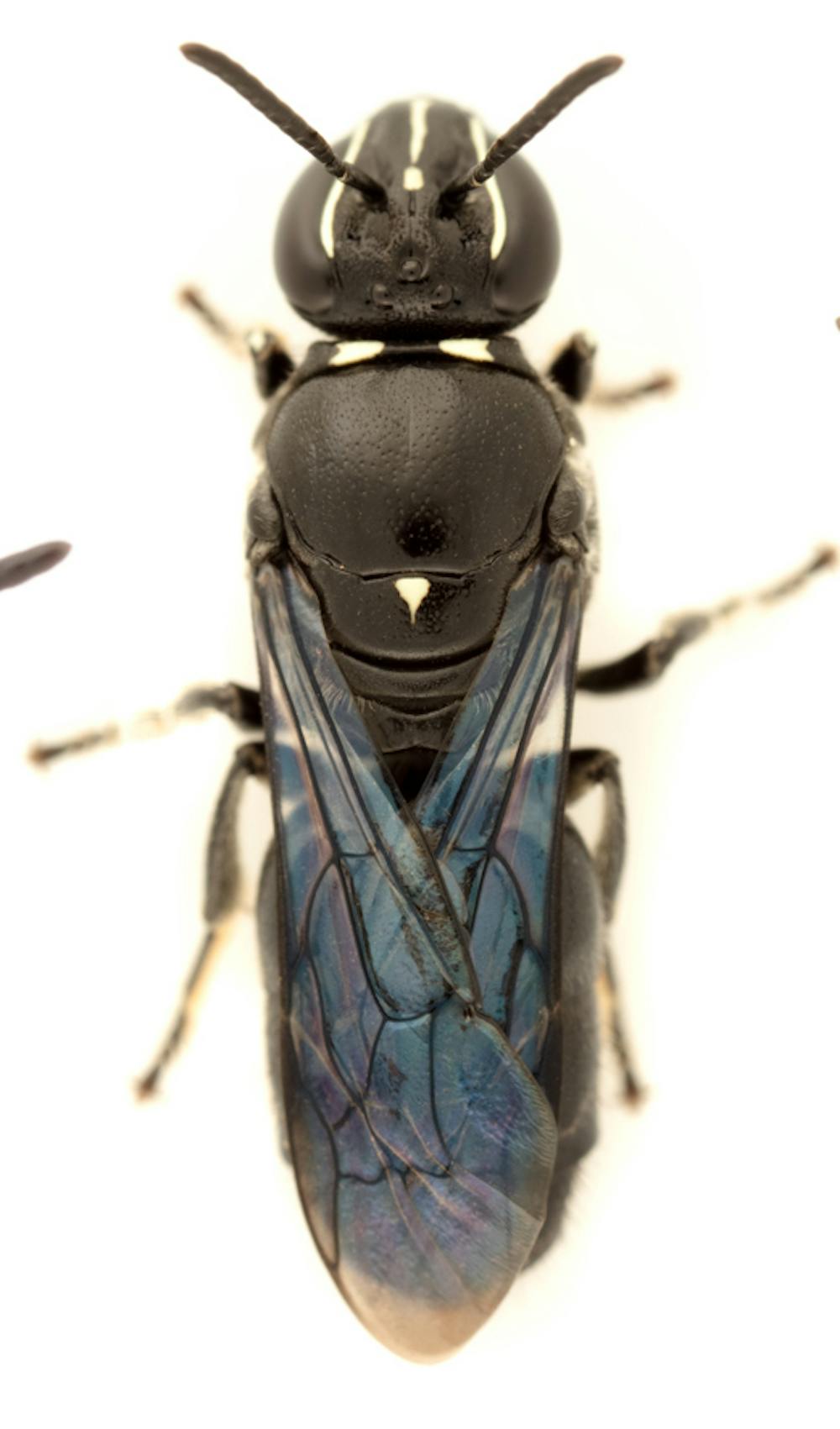 A close up of Pharohylaeus lactiferus.
James Dorey, Author provided (No reuse)
A close up of Pharohylaeus lactiferus.
James Dorey, Author provided (No reuse)
Authors: James B. Dorey, PhD Candidate, Flinders University

















