

Melting ocean mud helps prevent major earthquakes — and may show where quake risk is highest
- Written by Kate Selway, Macquarie University
The largest and most destructive earthquakes on the planet happen in places where two tectonic plates collide. In our new research, published today in Nature Communications, we have produced new models of where and how rocks melt in these collision zones in the deep Earth.
This improved knowledge about the distribution of melted rock will help us to understand where to expect destructive earthquakes to occur.
What causes earthquakes?
Giant earthquakes, such as the magnitude-9.0 quake in 2011 that caused the Fukushima nuclear disaster, or the magnitude-9.1 event in 2004 that caused the Boxing Day tsunami, occur at the collision zones between two tectonic plates. In these so-called subduction zones, one plate slides beneath the other.
Read more: The Fukushima quake may be an echo of the 2011 disaster — and a warning for the future
The sinking plate acts as an enormous conveyor belt, carrying material from the surface down into the deep Earth. Earthquakes occur where the sinking plate gets stuck; strain builds up until it eventually quickly releases. Fluids and molten rocks in the system lubricate the plates, helping them slide past each other and stopping big earthquakes from happening.
When happens when ocean mud ends up inside Earth?
My colleague Michael Förster and I were interested in what happens to sediments when they are carried down into the deep Earth at a subduction zone. These sediments start out as thick layers of mud on the ocean floor but get carried down into the deep Earth as part of the sinking plate.
Michael took a sample of mud collected from the ocean floor and heated it up to the high temperatures and pressures it would experience in a subduction zone. He found the sediments melt and then react with the surrounding rocks, forming the mineral phlogopite and also saline fluids.
A puzzle solved
Geophysical models of subduction zones allow us to map out exactly where the molten rocks and fluids are. These measurements are like x-rays of Earth’s interior, helping us peer into places we cannot otherwise see.
We were particularly interested in models of the electrical conductivity of subduction zones. This is because the fluids and molten rock we were looking at are more electrically conductive than the surrounding rock. Models of subduction zones have long been enigmatic, because they show Earth is very conductive in regions where people did not expect to see a lot of fluids and molten rock.
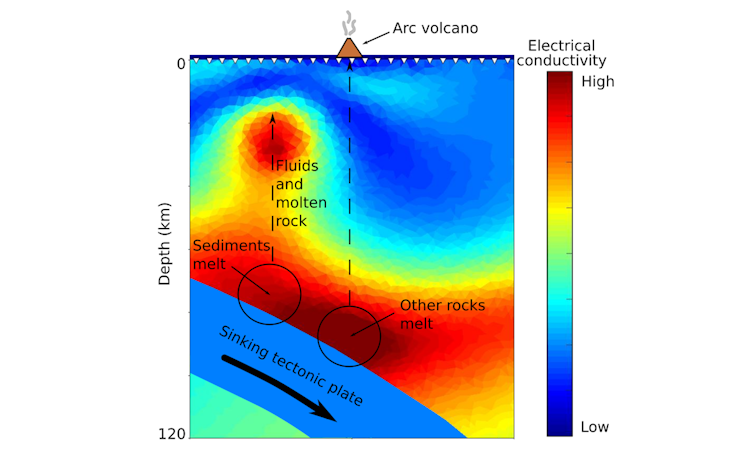 Melting sediment from the seafloor helps tectonic plates slide over one another without creating major earthquakes.
Selway & Forster, Author provided
Melting sediment from the seafloor helps tectonic plates slide over one another without creating major earthquakes.
Selway & Forster, Author provided
I calculated the electrical conductivity of the phlogopite, molten sediments and fluids that were produced in the experiments and found they matched extremely well with the geophysical models. This provides good evidence that what we see in the experiments is happening in the real Earth, and allows us to calculate where the molten rock and fluids are in subduction zones around the world.
Understanding where big earthquakes are likely to occur
Giant earthquakes are not likely to occur in the parts of the subduction zone where the sediments melt. All of the products of the melting — the molten rock itself, the saline fluids, and even the mineral phlogopite — help the two plates slide past each other easily without causing large earthquakes.
We compared our models with locations of earthquakes in subduction zones along the west coast of the United States. We found there were no large earthquakes where sediments were melting, but the movement of fluids from the melted sediments could explain some small, non-destructive earthquakes and very faint signals of tremor where the two plates easily slide past each other.
Read more: Breaking new ground – the rise of plate tectonics
Earthquakes are a tangible reminder that we live on an active planet and that, deep beneath our feet, huge forces are making rocks flow and melt and collide. Accurately predicting earthquakes will be an ongoing goal of geoscientists for decades to come.
It requires intricate detective work to weave together all the tiny threads of information we have about processes that occur so deep in the Earth that we will never be able to see or sample them. Our results are one new thread in this puzzle. We hope it will contribute to one day being able to keep people safe from the risk of earthquakes.
Read more: Underground sounds: why we should listen to earthquakes
Authors: Kate Selway, Macquarie University

















