

We all hope for a 'good death'. But many aged-care residents are denied proper end-of-life care
- Written by Davina Porock, Professor of Nursing, Director of Centre for Research in Aged Care, Edith Cowan University
Death is inevitable, and in a civilised society everyone deserves a good one. It would therefore be logical to expect aged-care homes would provide superior end-of-life care. But sadly, palliative care options are often better for those living outside residential aged care than those in it.
More than a quarter of a million older Australians live in residential aged care, but few choose to be there, few consider it their “home”, and most will die there after living there for an average 2.6 years. These are vulnerable older people who have been placed in residential aged care when they can no longer be cared for at home.
The royal commission has made a forceful and sustained criticism of the quality of aged care. Its final report, released this week, and the interim report last year variously described the sector as “cruel”, “uncaring”, “harmful”, “woefully inadequate” and in need of major reform.
Quality end-of-life care, including access to specialist palliative care, is a significant part of the inadequacy highlighted by the report’s damning findings. This ranked alongside dementia, challenging behaviours and mental health as the most crucial issues facing the sector.
Longstanding problem
In truth, we have already known about the palliative care problem for years. In 2017 the Productivity Commission reported that end-of-life care in residential aged care needs to be better resourced and delivered by skilled staff, to match the quality of care available to other Australians.
This inequality and evident discrimination against aged-care residents is all the more disappointing when we consider these residents are among those Australians most likely to find themselves in need of quality end-of-life care.
The royal commission’s final report acknowledges these inadequacies and addresses them in 12 of its 148 recommendations. Among them are recommendations to:
enshrine the right of older people to access equitable palliative and end-of-life care
include palliative care as one of a range of integrated supports available to residents
introduce multidiscpliniary outreach services including palliative care from local hospitals
require specific training for all direct care staff in palliative and end-of-life care skills.
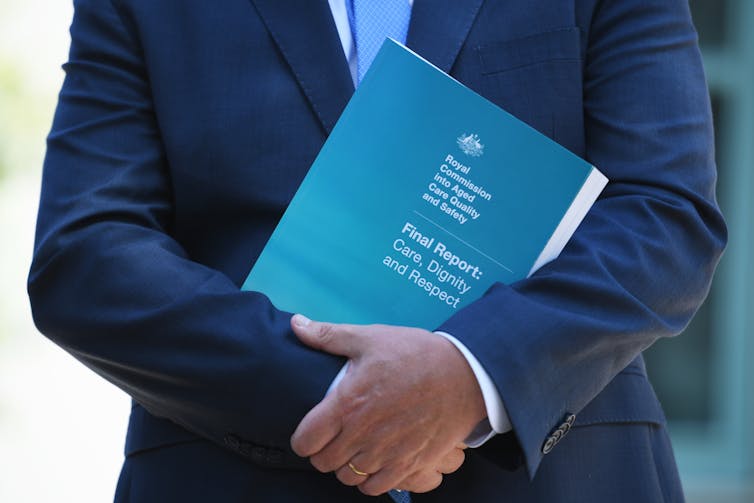 The aged care royal commission’s final report, released this week, handed down 148 recommendations. Twelve of them acknowledged longstanding problems with end-of-life care in residential aged care.
Dean Lewins/AAP
The aged care royal commission’s final report, released this week, handed down 148 recommendations. Twelve of them acknowledged longstanding problems with end-of-life care in residential aged care.
Dean Lewins/AAP
What is good palliative care?
Palliative care is provided to someone with an active, progressive, advanced disease, who has little or no prospect of cure and who is expected to die. Its primary goal is to optimise the quality of life for that person and their family.
End-of-life care is provided by palliative care services in the final few weeks of life, in which a patient with a life-limiting illness is rapidly approaching death. This also extends to bereavement care for family and loved ones.
Unlike in other sectors of Australian society, where palliative care services are growing in line with overall population ageing, palliative care services in residential aged care have been declining.
Funding restrictions in Australian aged-care homes means palliative care is typically only recommended to residents during the final few weeks or even days of their life.
Read more: What is palliative care? A patient's journey through the system
Some 70% of Australians say they would prefer to die at home, surrounded by loved ones, with symptoms managed and comfort the only goal. So if residential aged care is truly a resident’s home, then extensive palliative and end-of-life care should be available, and not limited just to the very end.
Fortunately, the royal commission has heard the clarion call for attention to ensuring older Australians have as good a death as possible, as shown by the fact that a full dozen of the recommendations reflect the need for quality end-of-life care.
Moreover, the very first recommendation — which calls for a new Aged Care Act — will hopefully spur the drafting of legislation that endorses high-quality palliative care rather than maintaining the taboo around explicitly mentioning death.
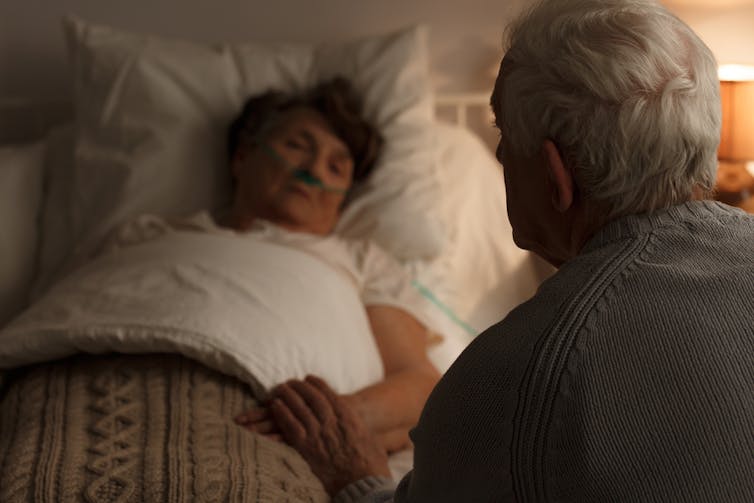 Around 70% of Australians would prefer to die at home in the company of loved ones.
Shutterstock
Around 70% of Australians would prefer to die at home in the company of loved ones.
Shutterstock
Let’s talk about death
Of course, without a clear understanding of how close death is, and open conversation, planning for the final months of life cannot even begin. So providing good-quality care also means we need to get better at calculating prognosis and learn better ways to convey this information in a way that leads to being able to make a plan for comfort and support, both for the individual and their loved ones.
Advanced care planning makes a significant difference in the quality of end-of-life care by understanding and supporting individual choices through open conversation. This gives the individual the care they want, and lessens the emotional toll on family. It is simply the case that failing to plan is planning to fail.
We need to break down the discomfort around telling people they’re dying. The unpredictability of disease progression, particularly in conditions that involve frailty or dementia, makes it hard for health professionals to determine when exactly palliative care will be needed and how to talk about it with different cultural groups.
Read more: Passed away, kicked the bucket, pushing up daisies – the many ways we don't talk about death
These conversations need to be held through the aged-care sector to overcome policy and regulation issues, funding shortfalls and workforce knowledge and expertise.
We need a broader vision for how we care for vulnerable Australians coming to the end of a long life. It is not just an issue for health professionals and residential care providers, but for the whole of society. Hopefully the royal commission’s recommendations will breathe life into end-of-life care into aged care in Australia.
Authors: Davina Porock, Professor of Nursing, Director of Centre for Research in Aged Care, Edith Cowan University

















