

new research finds widespread violence against Australian mosques
- Written by Scott Poynting, Adjunct Professor, Charles Sturt University
The horrendous mass murders in New Zealand on March 15 2019 had a strong link with Australia.
The New Zealand royal commission into the attacks found the Australian perpetrator had long subscribed to violent right-wing Islamophobia and had taken this with him to New Zealand. In fact, Muslim communities in New Zealand had reported threats and violence for years, including suspicious behaviour at one of the mosques targeted in Christchurch.
After the Christchurch attack, we surveyed mosques in Australia to gauge the extent of anti-Muslim attacks here. We cannot understand the Christchurch massacre without comprehending the Australian context that at least in part incubated it.
Our research finds the threat of similarly motivated acts of hatred remains widespread. During 2020, we surveyed 75 mosques from five states and two territories of Australia about their experiences of violence in the five years from 2014 to 2018, as well as detailed questions about 2019. About half of the responses were from imams or mosque officials, 15% from volunteers and 35% from other congregation members.
Most concerning is that over half (58.2%) of participating mosques (or worshippers at them) had experienced targeted violence between 2014 and 2019. The threat of an attack increased in cases where there had been public attention. For example, mosques that were reported in the media (100%) or experienced online opposition to the development of the mosque (83%) experienced higher rates of victimisation.
Read more: The royal commission report on the Christchurch atrocity is a beginning, not an end
The types of violence suffered by mosque attendees and the mosque buildings included arson, physical assault, graffiti, vandalism, verbal abuse and online abuse and hate mail, including death threats. There were notable geographical differences in these occurrences of violence. Despite being home to more mosques, attacks against Sydney mosques between 2014 and 2018 were proportionally lower (at 41% of the 51 respondent mosques) than for Melbourne (70% of 17 mosques) and Brisbane (89% of nine mosques).
The proportion of attacks against mosques in Australian states and territories was 29% in 2019, in the wake of the Christchurch massacre. Again, these were disproportionately distributed between the states, with a higher proportion of attacks directed at mosques in Brisbane and Melbourne.
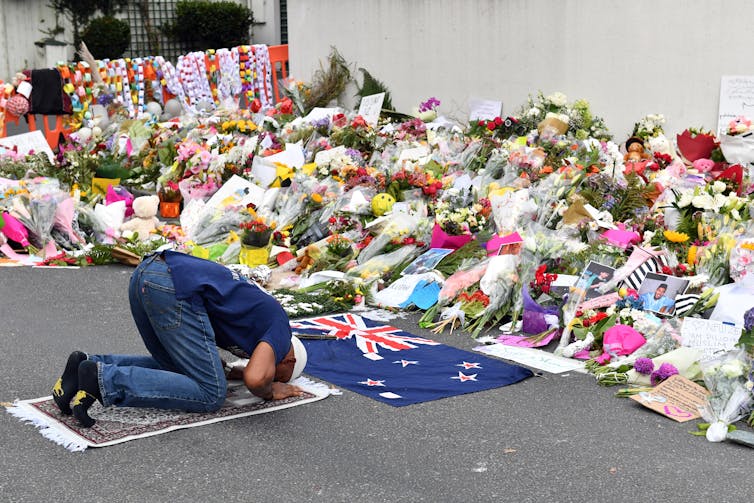 In the wake of the Christchurch terror attack, Australian mosques are still being targeted with threats and violence.
Mick Tsikas/AAP
In the wake of the Christchurch terror attack, Australian mosques are still being targeted with threats and violence.
Mick Tsikas/AAP
In 2019 alone, 30% of respondent mosques had experienced a graffiti attack, with 17% reporting two or more instances. Some 12% had experienced one or more arson attacks, with one mosque reporting six such incidents in that year. Mosques were also vandalised, with 34% of participating mosques experiencing at least one such incident, and three mosques experiencing four to five incidents. Hate mail was received by 17% of the mosques.
Beyond attacks against mosques themselves, their attendees were targeted similarly by Islamophobic violence. Just under 40% of the mosques reported verbal abuse of their attendees in 2019. In addition, 17% had received threats of violence (with one actual physical assault), while 20% experienced objects thrown at them or the mosque.
Mosque attendees in Christchurch before the 2019 attacks reported similar experiences. Some were reported to police, some were shared within the communities. This ripple effect of community knowledge about safety and visibility no doubt shapes all mosque attendees’ experiences of religious observance.
Visibility enhances community connectedness, yet it also means hate crime perpetrators can easily find targets.
Some mosque officials attested anecdotally, during our follow-up, to a higher level of attention by mosque communities to security during 2019 in the aftermath of the Christchurch atrocity. They also said they feared drawing attention to their mosque out of concern for the safety of their attendees. This probably affected our survey’s response rate by making people wary of responding.
This was a pilot study, with a relatively small sample size. A larger survey completed by nominated mosque officials who consistently report incidents will provide more robust data in future studies.
In line with the calls by the Race Commissioner, we suggest a national, independent hate crime reporting system is needed to capture the experiences of targeted communities in Australia. While the Islamophobia Register Australia offers a forum through which some Muslims can report their experiences of Islamophobic violence, a system of reporting these incidents at the mosque in real time may provide us with a better idea of their full impact.
Our findings from this pilot study suggest mosque attacks in Australia are neither new nor rare. Too often, only the most egregious cases of hate-crime violence, of which the Christchurch massacre is one of the worst, come to media and public attention.
This should not lead us to overlook the everyday terror that Muslim clergy and mosque attendees must grapple with when enlivening their faith at their places of worship. A systematic and timely analysis of mosque attack data will enhance long-term security for mosques and their communities.
Authors: Scott Poynting, Adjunct Professor, Charles Sturt University

















