

Why New Zealand should invest in smart rail before green hydrogen to decarbonise transport
- Written by Susan Krumdieck, Professor and Director, Advanced Energy and Material Systems Lab, University of Canterbury
Green hydrogen is being touted as an alternative to fossil fuels in New Zealand. The government has invested NZ$8.4 million to explore its potential and $19.9 million in a hydrogen energy facility.
Globally, 6% of natural gas and 2% of coal are used to produce industrial hydrogen, contributing carbon dioxide emissions equal to the United Kingdom and Indonesia combined. Green hydrogen is produced by using electricity from renewable sources to split water. But is hydrogen a realistic fuel option?
Domestic production of a low-carbon transport fuel using New Zealand’s mostly renewable electricity sounds like a great idea.
But let’s not ignore the obvious opportunity of providing a truly sustainable transport system by building up a homegrown, high-tech integrated smart rail and urban tram network that uses renewable electricity directly via overhead lines.
Let’s first establish the parameters. In evaluating the prospects for green hydrogen we must have a clear objective: achieve non-fossil fuel sustainable transport.
In 2019, New Zealand imported about 55 million barrels of petroleum products, at a cost of $5.4 billion. New Zealanders drove 45 billion kilometres in 4.4 million vehicles, including 23,000 freight trucks.
Nearly all of the imported fuel went into personal and road freight transport, the largest and fastest-growing component of national carbon dioxide emissions (42.6% of the total in 2018).
Substituting green fuel for petrol and diesel would reduce emissions but not improve congestion, commuting time and heavy truck traffic. Freight transport in particular would be more sustainable by shifting from road to rail, which can have 75% lower carbon dioxide emissions than road transport.
Capacity for sustainable transport
Live system data from Transpower, the operator of New Zealand’s national grid, shows how much electricity is generated using different sources, from the installed capacity of 9,237 megawatts.
At the time of writing, on an average late summer day, about half of the hydro capacity was being used, and there was no wind-generated contribution. It would be possible to use around 2,400MW for transport and still have 20% of capacity left over as a safety margin.
KiwiRail has announced the $1 billion purchase of 100 new locomotives and 900 new wagons to replace current stock, much of which is more than 50 years old. A locomotive delivers 2.4MW of power. Electric locomotives cost $1.2 million per MW, and a recent electrification project cost $371m for 20km.
It is feasible that New Zealand could have five times as many locomotives on an extensive electric rail network and take up at least 80% of the current truck freight. With that kind of network, intercity passenger travel could also be shifted significantly from roads onto rail.
Read more: Smart tech systems cut congestion for a fraction of what new roads cost
An electric rail network with 500 2.4MW locomotives would use about 1,400MW at maximum capacity, if all trains are running at the same time with 85% electric efficiency. Urban trams, light rail, electric vehicles and scooters could be using the remaining 1,000MW capacity.
Electric rail is common in Europe. Norway recently built 200km of overhead electric rail line at a cost of NZ$2.5 million per km. Building motorways in New Zealand costs $35 million per km on average.
Transport fuelled by hydrogen
Let’s start with the same 1,400MW of spare hydro generation capacity and explore the green hydrogen system.
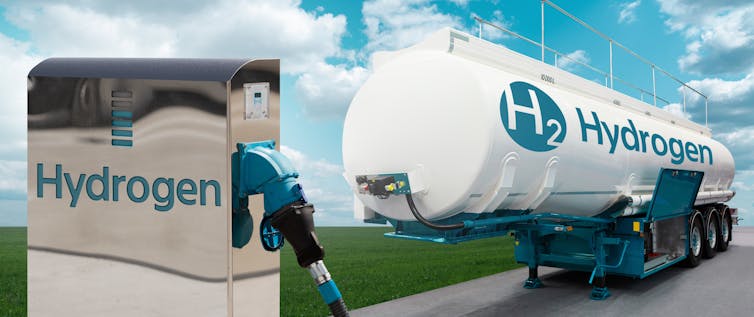 Green hydrogen is being touted as a renewable fuel, but there are a few freight trucks and no locomotives on the market.
Shutterstock/Scharfsinn
Green hydrogen is being touted as a renewable fuel, but there are a few freight trucks and no locomotives on the market.
Shutterstock/Scharfsinn
The AC electricity would need to be converted to DC and used in electrolysers to spit water (63% conversion efficiency) and the hydrogen would be compressed and stored in special high-pressure tanks (20% energy input). It would then have to be converted to electricity using a fuel cell (50% conversion efficiency), and finally used in an electric motor (85% efficiency).
The 1,400MW could drive 100 2.4MW locomotives using green hydrogen — the same rail capacity as New Zealand already has today. In other words, using hydrogen would mean New Zealand could fuel one-fifth of the trains an overhead electric direct-drive system could run.
Read more: Hydrogen: where is low-carbon fuel most useful for decarbonisation?
In the hydrogen scenario, a substantial outlay would be required for the electrolysers ($1.6 million per MW with a 15-year lifespan), hydrogen compressors and storage tanks ($1 million per MW hydrogen). A 1,400MW hydrogen system capital cost would be $4.3 billion every 15 years.
We would also need to import hydrogen trains and vehicles. This is a problem. There are currently fewer than 10,000 hydrogen vehicles in the world and no trains on the market.
It is difficult to estimate the cost of a hydrogen-based rail system, but the fuel cells that drive locomotives cost about $4.1 million each, which is extra cost on top of the $2.9 million for the electric locomotive.
The engineering, technology and life cycle costs are known for electric rail and tram networks, but we know less about hydrogen-based transport options. The obvious, affordable and sensible options should be given more support than highly speculative propositions.
The transition from diesel trucks to integrated electric rail, coastal shipping and local electric delivery will require infrastructure investments but deliver many skilled jobs. Rail traffic schedules can be “smart” and managed in real time, taking advantage of current renewable capacity and negating the need for storage.
New Zealand could achieve low-carbon transport via direct electrification, while the realistic potential for hydrogen to fuel the country’s freight transport is negligible.
Authors: Susan Krumdieck, Professor and Director, Advanced Energy and Material Systems Lab, University of Canterbury

















