

Journalists and security agencies don't need to be friends. But can they at least talk to each other?
- Written by Peter Greste, Professor of Journalism and Communications, The University of Queensland
Like dogs and cats, snakes and rats, journalists and the government are not supposed to be friends.
It is always going to be a fractious, difficult relationship. We, the voters and taxpayers, grant politicians enormous power and resources to run the government on our behalf. The media’s job is to make sure they do it responsibly and ethically.
As the American newspaper baron William Randolph Hearst reportedly once said, “news is whatever someone doesn’t want printed; all else is advertising”.
The natural order of things requires there to be a necessary tension between those two institutions. But mutual hostility isn’t necessarily always a good thing.
Why the media’s role is vital
A toothy media is particularly important when it comes to monitoring the instruments of government power.
Over the years, our state and federal governments have amassed an awesome array of tools ostensibly designed to keep us safe from those who would do us harm. There are the usual agencies, such as the Australian Federal Police, ASIO and the Australian Defence Forces.
But there are many more that work largely out of public view, with yawn-inducing names like the Office of National Intelligence (responsible for collating and assessing intelligence reports from abroad), AUSTRAC (which monitors our financial system for clues about organised crime), the Australian Signals Directorate (which eavesdrops on electronic communications), and the Australian Geospatial-Intelligence Organisation (another of our international spy agencies).
Read more: Australia has enacted 82 anti-terror laws since 2001. But tough laws alone can't eliminate terrorism
Nobody is denying the need to give our security services the means to track and stop people like terrorists, criminals and foreign agents, but even the most disciplined agencies can abuse that power.
While there are institutional checks and balances designed to keep them under control, painful recent history tells us they don’t always work. That is why the whistle of last resort — the one most directly engaged with the public — is the media.
Recent examples of journalist arrests
In 2019, the AFP infamously raided journalists from two news organisations over their reporting of two separate stories that exposed abuses or potential abuses of power.
Dan Oakes and Sam Clark from the ABC had been covering allegations of war crimes by Australian Special Forces in Afghanistan, while News Corp’s Annika Smethurst had revealed quiet government plans to expand the ASD’s authority, allowing it to snoop on the domestic communications of ordinary Australians.
While both stories involved sensitive, classified documents, they also revealed things that every Australian ought to have been concerned about. Put simply, they were fine examples of journalists doing their jobs. (The AFP has since dropped the cases against all three journalists.)
Most recently, Victorian police arrested two journalists from the Herald Sun — a reporter and a photographer — who were covering an anti-vaccination protest in Melbourne.
They were initially told they would be fined for failing to comply with the state government’s lockdown policies, but the police later apologised and confirmed they would not be. While this was not a national security issue, it is an example of the type of misunderstanding that is becoming more prevalent between the media and police.
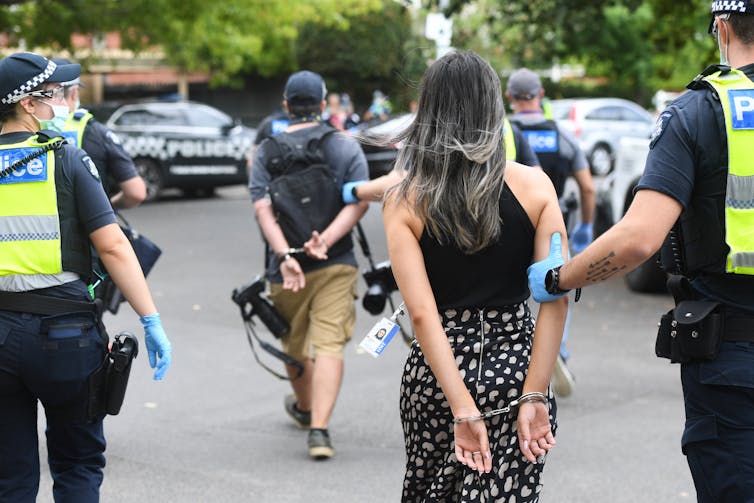 A Herald Sun photographer and journalist are arrested during the anti-vaccination rally in Melbourne.
Erik Anderson/AAP
A Herald Sun photographer and journalist are arrested during the anti-vaccination rally in Melbourne.
Erik Anderson/AAP
A new working group to bridge the divide
To be clear, while there is an undeniable risk that journalists will either deliberately or inadvertently damage national security with their reporting, there are very few (if any) examples in recent Australian history.
The AFP raids and Melbourne arrests expose a critical problem — a deep and widening gulf in trust and communication between the agencies and the media that can - and clearly have - boiled over in ways that damage both institutions. In the process, it also undermines our democracy.
The raids, in particular, undermined public confidence in the integrity of the police, while sending a deeply threatening message to other journalists and whistleblowers involved in similar public interest stories.
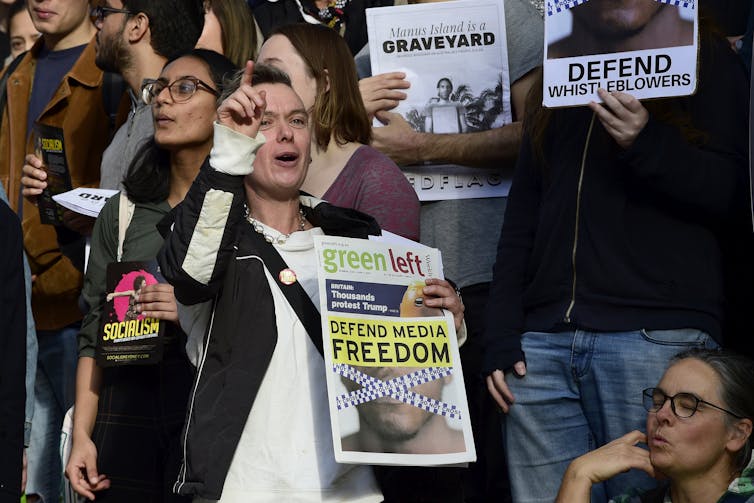 Protesters calling for greater protection of press freedom following the AFP raids in 2019.
Biance de Marchi/AAP
Protesters calling for greater protection of press freedom following the AFP raids in 2019.
Biance de Marchi/AAP
Legislation is important. The Alliance for Journalists’ Freedom, which I helped set up and now represent as a spokesman, believes Australia needs a Media Freedom Act to entrench press freedom in law.
But we also believe another mechanism is necessary — something that creates lines of communication between the media and security agencies. The idea is to protect the media’s freedom and independence, while helping the two sides understand one another — and avoid either damaging reporting or unnecessary police action.
The best way to do that is a working group of senior news editors and officials from the security agencies. They should not be the agency heads or editors-in-chief, but their senior deputies, who have the authority to represent their organisations without getting bogged down in formalities.
By meeting and discussing issues regularly, the working group should be able to develop both trust and lines of informal communication to head off any potential problems before they erupt.
Read more: To protect press freedom, we need more public outrage – and an overhaul of our laws
Discussions without the threat of investigation
The Parliamentary Joint Committee on Intelligence and Security appears to agree with the AJF.
In the wake of the AFP raids, it held an inquiry into press freedom and national security and came up with an undeveloped recommendation remarkably similar to what the AJF has been proposing:
the formulation of a mechanism to allow for journalists and media organisations, in the act of public interest journalism, to consult with the originating agency of national security classified information without the threat of investigation or prosecution.
That last phrase is key. News organisations doing their jobs will often uncover classified information. They should be allowed to discuss it with the relevant agencies, “without the threat of investigation or prosecution”, so they can flag stories to avoid exposing damaging information. Similarly, the security agencies should be allowed to raise issues of concern to them.
One of the reasons Australia’s democracy is among the safest and most prosperous in the world is because we have had a vigorous, independent free press capable of holding the system to account. If in trying to keep us safe, the security agencies end up undermining one of the key pillars of that system, national security is ultimately undermined.
The AJF’s idea for a National Working Group is designed to help maintain the integrity of Australia’s security, while protecting press freedom.
Authors: Peter Greste, Professor of Journalism and Communications, The University of Queensland

















