

Teeth contain detailed records of lead contamination in humans and other primates
- Written by Tanya M. Smith, Professor in the Australian Research Centre for Human Evolution & Griffith Centre for Social and Cultural Research, Griffith University
Lead is a powerful toxin. It can affect almost every organ and system in the body, and babies are extremely vulnerable to its harmful effects. Infants’ brains grow rapidly during the first year of life, and even low levels of lead exposure have been associated with brain development deficits.
It’s also more common than you might think. Many popular baby foods and infant formulas available in the US were recently found to contain elevated levels of lead and other heavy metals.
Few studies have examined Australian-sourced infant formulas and foods, and those that have show lead levels are generally low. However, more than half of the products sold in Australia are imported — so international problems are still a concern.
Lead leaves traces in growing teeth. In a new study published in BioEssays, we used a very sensitive technique called laser-ablation mapping to analyse the teeth of young macaque monkeys. We found traces of lead from both commercial infant formula and the milk of their own mothers. This provided clues of events that happened years, or even decades, earlier.
Read more: How safe is your baby food?
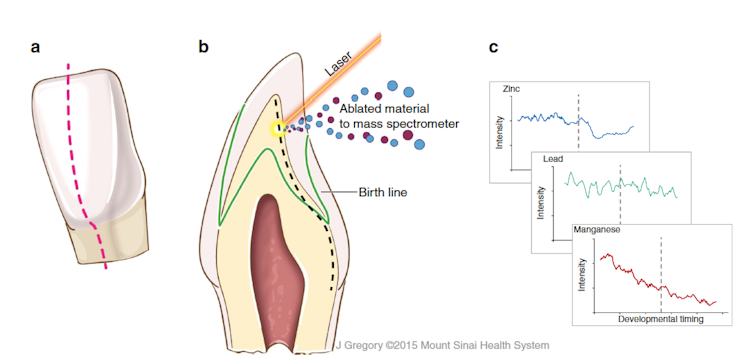 How laser-ablation mapping works: a) the tooth is sliced open; b) a small sample is vaporised by laser; c) the levels of different elements over the span of tooth growth is determined with a mass spectrometer.
Arora et al. (2017), Nature Communications
How laser-ablation mapping works: a) the tooth is sliced open; b) a small sample is vaporised by laser; c) the levels of different elements over the span of tooth growth is determined with a mass spectrometer.
Arora et al. (2017), Nature Communications
The stories teeth tell
The development of teeth records each day of our childhoods, including birth, as well as the chemistry of the food and water we consume. Public health specialists in Australia and the US have worked out how to measure infants’ metal intake using the concentrations of different elements and growth lines in teeth.
Our team honed this analytical model through a 2013 study of human, monkey, and Neanderthal nursing histories. We tracked changes in the trace element barium, which is stored in bones and teeth, and concentrated in calcium-rich milk. While barium is toxic in large amounts or certain compounds, small amounts in milk and foods like Brazil nuts do not seem to be particularly harmful.
Read more: Got milk? Our breastfeeding habits are older than you think
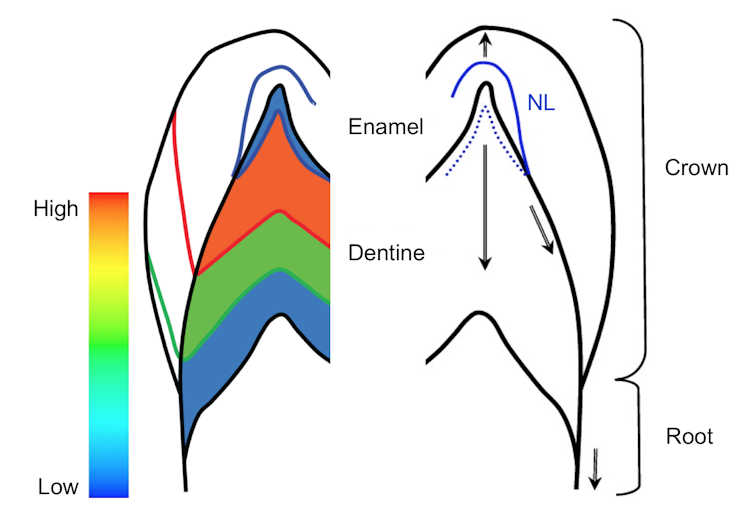 Changes in the concentrations of different elements may indicate milk intake following birth (blue to orange), the end of exclusive suckling (orange to green), and the cessation of milk intake (green to blue) in primate teeth. The neonatal line (marked NL) marks birth, and identifying microscopic daily growth increments allows precise age estimates of childhood dietary changes, health challenges, and lead exposure.
Smith et al. BioEssays (2021).
Changes in the concentrations of different elements may indicate milk intake following birth (blue to orange), the end of exclusive suckling (orange to green), and the cessation of milk intake (green to blue) in primate teeth. The neonatal line (marked NL) marks birth, and identifying microscopic daily growth increments allows precise age estimates of childhood dietary changes, health challenges, and lead exposure.
Smith et al. BioEssays (2021).
In our new study we were able to show a precise correspondence between the onset of suckling and elevated lead levels, which disappeared when the macaque infants stopped consuming Enfamil formula or mothers’ milk. Captive monkey mothers may be exposed to lead from water pipes or old paint, as lead was once a widely used paint additive that has a pleasant sweet taste.
How barium and lead get into teeth
Milk is an important source of calcium for infant growth, but it may also contain other less helpful ingredients. Barium and lead are known as bone-seeking elements: when abundant they can transfer to the bloodstream and substitute for calcium in the hard mineral that strengthens our growing bones and teeth.
We’ve also discovered that when young monkeys become very sick, they may tap their skeletal stores of calcium to maintain metabolic balance, also inadvertently releasing lead and barium from bones back into the bloodstream and ultimately locking them into growing teeth. This form of elemental recycling means that we can also explore health histories after individuals stop nursing.
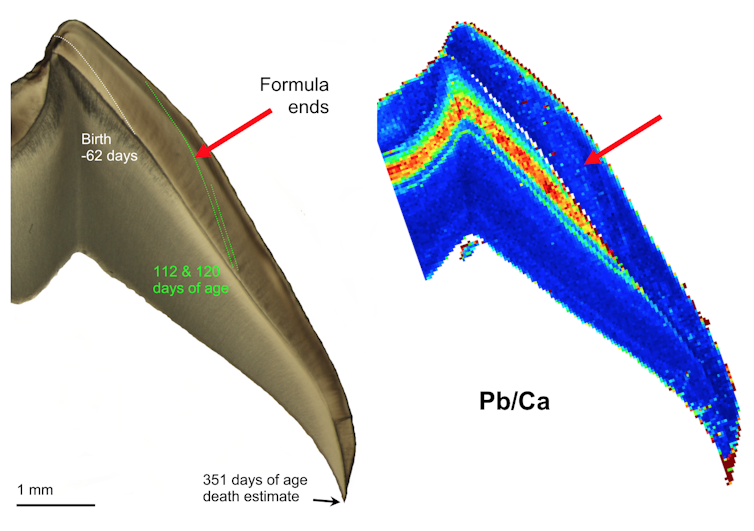 Monkey molar showing formation timing on the microscope image (left) and lead concentrations (normalized to calcium on the right). Lead in the enamel drops markedly with the cessation of formula (Enfamil) intake at 112 days of age (red arrows), which is even more apparent in the underlying dentine. A second macaque infant provided Enfamil in 1976–77 also implicates this commercial source, consistent with reports of metal contamination of various human infant formulas. Image credit: Smith et al. (2021) BioEssays.
The origin of lead found in humans’ teeth is more difficult to pin down than it is for captive monkeys. Likely factors range from environmental pollution and drinking water to soils used to grow food. Public health crises such as the water contamination in Flint, Michigan in 2014–2015 are currently under investigation to better understand the timing and degree of lead exposure in children from that region.
Our new study also revealed wild primates can be exposed to lead in their natural environments. We found lead bands in the teeth of baboons that grew up in Ethiopia and orangutans from Borneo and Sumatra. While human industrial activity may explain some of these cases, we recently uncovered lead intake in Neanderthal children roughly 250,000 years ago.
In that instance the lead was likely derived from geological deposits in southeast France, a region that has since been commercially mined. The two Neanderthals likely ate or drank something contaminated with lead, although we couldn’t rule out the possibility they may have inhaled lead released into the air through combustion during the winter and early spring.
Read more: What teeth can tell about the lives and environments of ancient humans and Neanderthals
Studies of nonhuman primates and ancient hominins help us to better understand our own physiology, including the sensitive recording systems inside our own bodies. They point to complex environmental problems as well as the dangers of the natural world.
Our study adds to the evidence that lead exposure is common around the world. To safeguard our health, we need better regulation of food, water, and air quality.
Authors: Tanya M. Smith, Professor in the Australian Research Centre for Human Evolution & Griffith Centre for Social and Cultural Research, Griffith University

















