

Concussion risks aren't limited to the AFL. We need urgent action to make sure our kids are safe, too
- Written by Annette Greenhow, Assistant Professor, Faculty of Law, Bond University
The AFL season kicked off this week with the defending champion Richmond Tigers taking on Carlton in front of nearly 50,000 fans at the Melbourne Cricket Ground — apparently the largest sport crowd in Australia since the beginning of the COVID-19 pandemic.
In the lead-up to the new season, however, the focus has not solely been on the footy. Much attention is also being paid to the darker side of the sport: concerns over concussions and the safety of its players.
Last month, the Guardian published a report saying the AFL is considering creating a $2 billion concussion trust fund to support past, present and players.
Then, the coroner’s report into the death of AFL legend Danny Frawley found chronic traumatic encephalopathy (CTE), a degenerative brain disease, had been “a potential contributor” to the depression he had suffered.
The coroner recommended the AFL “actively encourage” players to donate their brains to the Australian Sports Brain Bank for scientific research to
improve the safety of future generations of footballers and others engaged in contact sports.
Last week, the AFL said it wanted to be involved in the investigation into the suicide of 38-year-old former player Shane Tuck, who had also suffered mental health problems. One of the brain bank researchers said Tuck had “the worst case” of CTE he had ever seen.
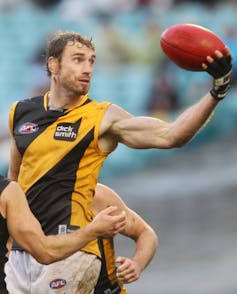 Shane Tuck during a game in 2010.
Ben MacMahon/AAP
Shane Tuck during a game in 2010.
Ben MacMahon/AAP
All of this comes months after former AFL player Shaun Smith was awarded a $1.4 million insurance payout for the “total and permanent disablement” he suffered as a result of concussions — the first of its kind in Australia.
With the AFL placing such attention on this issue, it’s important to also consider what these developments mean for other levels of the sport, especially schoolchildren.
Should my child be signing up to join the footy team?
This was the exact question I asked myself when I first started researching the dangers of concussions in professional sport in 2010.
I assumed that at the school level, our kids would be entering a sports system that was optimally safe and acknowledged the risks of contact sport. But this wasn’t necessarily the case. There was no real understanding of who was responsible for making the system safe.
Read more: Concussions and kids: know the signs
We’ve known for years that the dangers of mismanaging concussions are not just an elite-level footy concern that stops at the boundary lines of the MCG. This should, in fact, be regarded as a prominent public health issue.
Given this, who should ultimately take the lead on this at the school and junior level — the government (the guardians of the public’s health) or the AFL (the guardians of the sport)? The answer is a mixture of both.
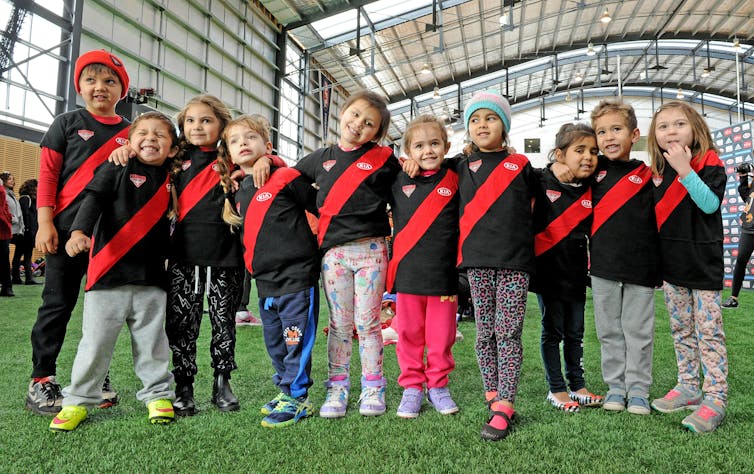 Kids from the Yappera and Bubpa Aboriginal schools attend an event at the Essendon Football Club.
Joe Castro/AAP
Kids from the Yappera and Bubpa Aboriginal schools attend an event at the Essendon Football Club.
Joe Castro/AAP
A prominent public health issue
Unlike some countries, Australian governments have traditionally adopted a “hands off” approach when it comes to the legal regulation of sport-related concussions.
The federal government has taken some steps toward framing this as a public health concern in recent years by developing a Concussion in Sport Australia information website. It provides guidance for athletes, parents, coaches and teachers on everything from the early signs of a concussion to the long-term consequences.
Some state and territory governments have partnered with professional groups to develop their own concussion in sport protocols and education workshops for community sport programs.
These are all positive steps in the right direction, but the approach remains patchy and inconsistent across the country.
Recognising the wider social context, I put out an urgent call in 2018 for a collective and nationally coordinated response.
My proposal aimed to bring together state governments, sporting codes and medical and other experts to work with Sport Australia on designing a national concussion framework. What we needed was a consistent approach across sports to reduce and manage the risks associated with concussion in sport — all guided by research.
The idea didn’t make much headway with governments. There is still more work to be done.
How laws in other countries are helping
While the data are patchy, experts agree that sport-related concussions among children are very common, and the effects of concussions in children are different from those in adults. Experts also agree that children and adolescents should be subject to more conservative and careful concussion management.
The United States is far ahead in this effort. Youth sport concussion laws are now in place in states across the country that focus on mitigating the risk of mismanaging concussions and preventing serious complications.
The laws generally focus on three central principles) — education, immediate removal from play and medical clearance before return. While far from perfect in terms of regulatory process, these laws have gone a long way to heighten awareness of the dangers of concussion.
There has been success on this front in the Canadian province of Ontario.
A government mandate was issued in 2014 requiring schools to develop a concussion protocol as part of the curricula. Then, in 2018, a new law was passed that required all sport organisations to establish a concussion code of conduct and removal from sport and return-to-play protocols for children under 18.
Australia does not have similar laws. The Australia Institute of Sport has issued a position statement that reads:
Children should not return to contact/collision activities before 14 days from complete resolution of all concussion symptoms.
But what is clearly needed are stronger laws or collaborative governance mechanisms to ensure our kids are entering an optimally safe sports system.
Read more: Can headband sensors reduce underreported concussions in kids?
What has the AFL done?
The AFL does not have the same legislative mandate as government, but it wields significant influence as the guardian of the sport.
According to the AFL, concussion has been on its radar for over 25 years, but most of this has been focused on the elite level of the sport.
The AFL Community Club website does provide guidelines on managing concussions for community football, which includes a sport concussion assessment tool for children aged five to 12.
Read more: Is the National Rugby League legally liable for the long-term impacts of concussions?
However, some of the AFL’s affiliate networks across the country have outdated or hard-to-find information on concussion safety on their websites. Given the prominence of the issue, this inconsistency is something the AFL needs to urgently address.
In December, the AFL advertised for a new “concussion lead” to coordinate its strategy on head trauma and concussion responses, which signifies just how serious this issue has become.
Undoubtedly, the AFL has had a lot on its plate navigating the COVID-related disruptions to the sport, but the time is right to adopt a wider lens in developing an effective concussion strategy to keep our kids safe.
If this article has raised issues for you, or if you’re concerned about someone you know, call Lifeline on 13 11 14.
Authors: Annette Greenhow, Assistant Professor, Faculty of Law, Bond University

















