

Sally Sara's first play, Stop Girl, is a bold exploration of war trauma and journalism
- Written by Rodney Tiffen, Emeritus Professor, Department of Government and International Relations, University of Sydney
Review: Stop Girl, directed by Anne-Louise Sarks, Belvoir.
Stop Girl is a loosely autobiographical play by ABC journalist Sally Sara exploring her emotional traumas seeking to readjust to life in Sydney after years reporting from war-torn Afghanistan.
The play begins in Kabul with Suzie (Sheridan Harbridge) highly competent and confident, knowing how to operate in that dangerous and chaotic city, a productive and skillful reporter.
Her motto is “don’t connect”: to treat life there as a story, to practise professional detachment rather than get personally involved in the country’s human suffering.
The play then switches to her psychological unravelling in Sydney, haunted by memories, unable to relax or enjoy life. Having covered a bombing in a supermarket in Kabul, she feels unable to enter her local Woolworths. She copes less and less well, descending into a deep and potentially suicidal depression, failing to cope at work, and feeling alienated from the people around her.
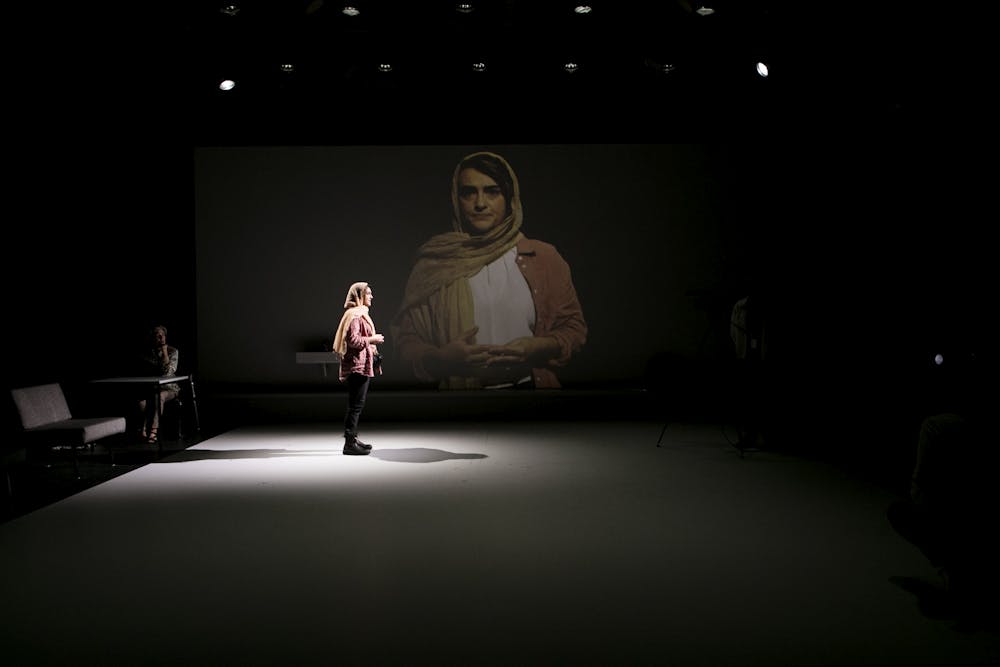 In Afghanistan, Suzie survives through isolation.
Brett Boardman/Belvoir
In Afghanistan, Suzie survives through isolation.
Brett Boardman/Belvoir
While her key to functioning in Afghanistan was “don’t connect”, her inability to connect in Sydney is central to her suffering. Her “solution” is to seek escape, unsuccessfully applying for a posting to Paris, and, more desperately, planning to return to Kabul as a freelance.
Her childhood friend and loyal supporter Bec (Amber McMahon) has taken a different route. She also works with the ABC but is not consumed by her work, enjoys married life and is deeply involved with her three children. A tragedy for Bec was the stillbirth of her son, which occurred while Suzie was busily reporting from the Congo.
Suzie’s cameraman in Afghanistan, Atal (Mansoor Noor), came to Australia after receiving threats because of his work with the ABC, and is now applying for asylum.
Growing up in a country at war, he is rejoicing in the affluence, freedom and safety of Sydney, enjoying it all — except the Potts Point dogs. His optimism is a counterpoint to Suzie’s pessimism, and as such he has some of the strongest lines in the play.
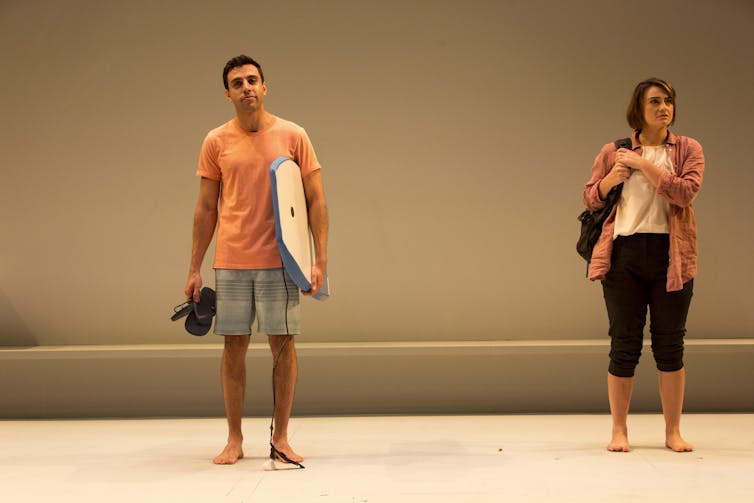 Atal finds new possibilities in his new home in Sydney. Suzie struggles to feel at home in her old hometown.
Brett Boardman/Belvoir
Atal finds new possibilities in his new home in Sydney. Suzie struggles to feel at home in her old hometown.
Brett Boardman/Belvoir
Both Bec and Atal provide a contrast with Suzie with their strong anchoring in family and other immediate relationships.
The third character is Suzie’s widowed mother, Marg (Toni Scanlan), loving and well-meaning but in the early parts of the play having very limited insight into Suzie’s aspirations and torments. Later, the reconnection between the two of them helps Suzie’s recovery, to help her realise that whatever her achievements abroad they cannot be an escape from the challenges of living at home.
The trauma of reporting on trauma
It was brave of Sara to write such a revealing play. Taken simply, it offers a very good night in the theatre – well-crafted, always moving forward, skillfully staged, its serious themes leavened by many funny moments.
Its larger value lies in opening up the issue of Post-Traumatic Stress Disorder.
It was only in 1980 the American psychiatric bible, the Diagnostic and Statistical Manual of Mental Disorders, first included the term. Before then, there were terms like “shell shock” and “battle fatigue”, which not only underestimated its duration and severity but also betrayed a lingering prejudice that all that was required was an act of will to overcome it.
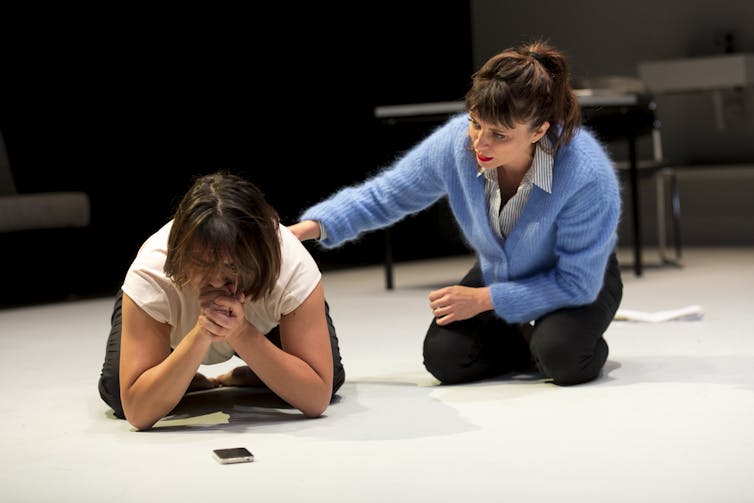 Post-Traumatic stress disorder doesn’t only impact those directly in combat. The traumas of war can impact everyone involved.
Brett Boardman/Belvoir
Post-Traumatic stress disorder doesn’t only impact those directly in combat. The traumas of war can impact everyone involved.
Brett Boardman/Belvoir
PTSD has been frequently diagnosed among returned combatants after the Vietnam, Iraq and Afghanistan wars. One can only imagine the countless numbers of servicemen returning from World Wars I and II who spent years suffering from undiagnosed depression.
Read more: Vietnam and Iraq: lessons to be learned about mental health and war
Moreover, it is not only direct participants who are affected, and not only military conflict, but also other disasters and crimes that may precipitate it.
Within journalism, there has been increasing recognition of the emotional toll reporting on traumatic events may have. The Dart Center, dating back to the 1990s, is devoted both to helping journalists report trauma more sensitively, and to lend support to journalists reporting such events.
Crafting a new image
Among the many recurring traumas Suzie brought home with her, the one which haunts her the most was from a hospital in Kandahar, filming a boy called Abdul in agony, critically injured by a landmine. When she returned the next day, he was still alive, but soon after she left, he suffered a massive brain haemorrhage and died.
She feels she deserted him, and failed to keep a central tenet of war reporting: honour the dead.
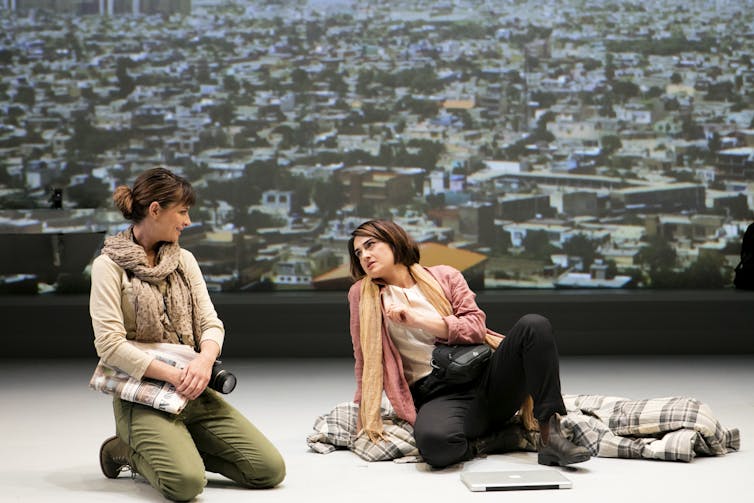 Stop Girl offers up a new, and more honest, image of the war reporter.
Brett Boardman/Belvoir
Stop Girl offers up a new, and more honest, image of the war reporter.
Brett Boardman/Belvoir
The emotional impact of powerlessness – an inability to affect a great injustice or alleviate suffering before one’s eyes – is the special trauma of the observer, of the journalist. An old stereotype was of the macho foreign correspondent, of an Ernest Hemingway figure who treated other people’s suffering as grist for their mill, and went on, emotionally unscathed, from one escapade to the next.
Sara’s play is a strong and eloquent antidote to this outdated image.
Stop Girl plays at Belvoir, Sydney, until April 25.
Authors: Rodney Tiffen, Emeritus Professor, Department of Government and International Relations, University of Sydney

















