

There are lots of poverty lines, and JobSeeker doesn't keep people above any of them
- Written by Ben Phillips, Associate Professor, Centre for Social Research and Methods, Director, Centre for Economic Policy Research (CEPR), Australian National University
This week, many Australians are holding their breath.
On Sunday, we saw the end of the JobKeeper payment, with an estimated 150,000 people expected to now lose their jobs as a result. On Wednesday, the Coronavirus Supplement (which boosted the JobSeeker payment) will also stop.
Taking into account a recent $50-a-fortnight rise in the base rate of JobSeeker, this will see most people on JobSeeker earn about $620 a fortnight or $44 a day.
The Australian Council of Social Service has been among those advocating for more support for unemployed Australians, arguing people will “plunge into poverty” with these latest payment changes.
But this week, when interviewed about the impact of the cuts, Social Services Minister Anne Ruston cast doubt over the concept of a poverty line. As she told Radio National’s Fran Kelly,
I’m not entirely sure I agree [there is an established line]“.
Last year, Ruston also said the government has never sought to have a "narrow” definition of poverty and does not consider a poverty line when setting welfare payments.
Technically, Ruston is correct. There is no agreed poverty line for Australia and the setting of welfare payments requires more thought than just the calculation of a single poverty line.
However, there are various estimates for the poverty line, and all are well above the JobSeeker rate for April and beyond.
How to calculate poverty
There are two main approaches to calculating poverty — you can either look at absolute poverty or relative poverty.
Absolute poverty is a concept that largely relates to developing countries and is mostly defined around the ability of a person or household to provide the most basic necessities such as food, water and shelter. Relative poverty is usually defined as a percentage of average or median incomes.
A person or household in relative poverty would be one whose income is low enough that they will struggle to provide a living standard that is generally considered acceptable in our society.
For a developed country like Australia, the relative poverty concept is usually the most relevant. These families might struggle to afford items most people take for granted such as clothes to wear for job interviews, housing, the internet, or mobile phones.
Calculating relative poverty is usually based on the reported incomes from nationally representative household surveys such as the Australian Bureau of Statistics’ Survey of Income and Housing. The usual definition used by researchers in Australia is any household whose income falls below 50% of the median (middle) income is in poverty.
There are various minor complexities around the definition of income (disposable vs gross, whether to deduct housing costs, whether to use the median or 60% of income and how to adjust incomes for different household compositions and sizes).
Ultimately, the measures are all imperfect, but so long as they are consistent through time, they provide a useful guide. They show population-wide dimensions and trends about who is likely to be under considerable financial stress.
The Melbourne Institute poverty line
The only established “poverty line” in Australia is the Melbourne Institute poverty line. This measure is a mix of both absolute and relative poverty. Absolute, in that it was based on a basic basket of goods and services a person or family could survive on and relative in that it has been indexed through time using changes in per capita income.
This measure suggests the poverty line is around $1,100 per fortnight for a single person in the workforce and $891 for someone not in the labour force (such as a retiree). An unemployed person is considered to be part of the labour force.
This poverty line is based on research from the Henderson Inquiry into poverty in the early 1970s. While this inquiry is out of date, the numbers nevertheless remain reasonably sensible and consistent.
Relative poverty measures don’t usually discriminate between employed or unemployed or the family type as does the Melbourne Institute measure. Most relative poverty estimates would put the single adult poverty line at around $800 to $1,000 per fortnight.
Our modelling
Colleagues and I have been doing modelling on the impact of these cuts on poverty in Australia, particularly for those who rely on JobSeeker payments as their main source of income.
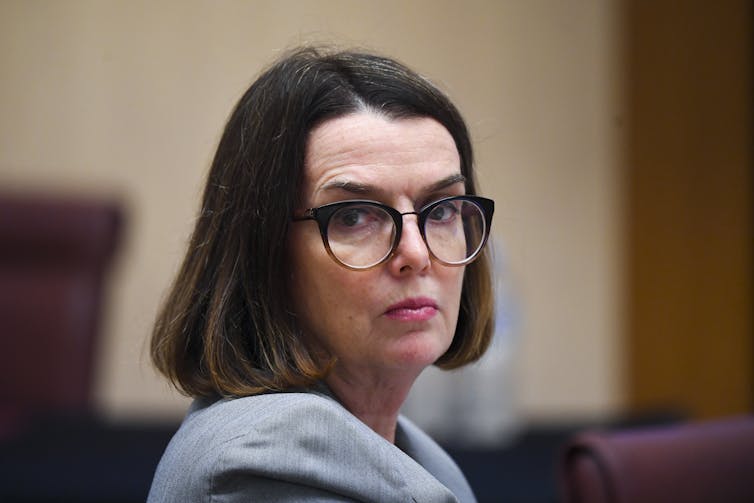 Social Services Minister Anne Ruston has consistently dismissed calls for a significant, permanent rise to JobSeeker Payment.
Lukas Coch/AAP
Social Services Minister Anne Ruston has consistently dismissed calls for a significant, permanent rise to JobSeeker Payment.
Lukas Coch/AAP
As we told a Senate committee earlier this month, before COVID, the poverty rate for people receiving Newstart (the old name for JobSeeker) was 88%. When JobSeeker was doubled during COVID, this dropped to 26%. From April 1, poverty will balloon out again to 85%.
Not all households are the same: some are single, some have couples, some have children and some get other payments such as rent assistance or family payments. However, the majority of households whose main income source is the JobSeeker payment will still fall well under the poverty line, whichever way you calculate it.
The problem with JobSeeker
The problem with JobSeeker is the payment has been indexed with inflation, rather than incomes, since the mid-1990s. Since then, incomes have increased by about 50% more than inflation, so the JobSeeker rate has fallen behind the general living standard in Australia. The JobSeeker payment is also about 35% below the age pension payment.
The evidence is compelling that the old JobSeeker rate of around $570 per fortnight required a much more significant increase than $50 per fortnight. This is particularly so because from April, there is likely to be a very large number of people — in the range of 1.2 to 1.4 million — on the payment. This is based on current JobSeeker recipient trends and the expected additional recipients transferring from JobKeeper.
So yes, there are different ways to define and calculate a poverty line. But there can be no doubt JobSeeker is not enough to keep people above it — or any honest assessment of a decent safety net and standard of living.
Authors: Ben Phillips, Associate Professor, Centre for Social Research and Methods, Director, Centre for Economic Policy Research (CEPR), Australian National University

















