

We can't close schools every time there's a COVID outbreak. Our traffic light system shows what to do instead
- Written by Fiona Russell, Senior Principal Research Fellow; paediatrician, The University of Melbourne
Brisbane has entered a snap lockdown to prevent SARS-CoV-2 transmission from a quarantine breach. Schools — including out-of-hours school care — across Greater Brisbane will be closed until the second term starts on April 19, except for vulnerable children and children of essential workers.
Daycare centres will also only be open for vulnerable children and those of essential workers.
Snap lockdowns are the new normal for managing hotel quarantine breaches. These have previously occurred in New South Wales, South Australia, Victoria and Western Australia bringing four capital cities and parts of Sydney to a halt.
While there are processes in place to try and prevent quarantine breaches happening again, this issue will be with us for some time until the COVID-19 vaccination program reaches high coverage — with a vaccine effective against variants. Soon international travel will open up as well, increasing the risk despite the use of vaccination passports.
We need to learn to live with COVID-19 as we continue efforts to vaccinate Australians. Closing daycare centres and schools has a significant effect on the mental health, well-being and learning of children and young people. We are seeing the short term effects and can only guess the long-term effects of this for now, but emerging research is concerning.
Read more: From WW2 to Ebola: what we know about the long-term effects of school closures
In Australia, where there is almost no community transmission of SARS-CoV-2 we need a layered strategy — depending on the amount of community transmission – to ensure the response isn’t the same every time with each snap lockdown: closing schools.
Separating schools from the snap lockdown response is possible. Here’s how to do it.
A traffic-light system
In February 2021, the Australian Health Protection Principal Committee (AHPPC) released guidelines on minimising the risk of COVID transmission in schools. These state that with COVIDsafe plans in place, schools remain safe places with students and staff “continuing to enjoy the benefits of learning on site”.
While this is national advice, states have failed to incorporate it into their lockdown planning.
International organisations such as World Health Organization, UNESCO and UNICEF recommend taking into account the level and intensity of community transmission of COVID-19 before deciding to close schools or childcare centres. They all state closing schools “should be regarded as a measure of last resort”.
The US Centers for Disease Control recommends plans to be adapted depending on the level of viral transmission in the school and throughout the community, as this may rapidly change.
We did a review into COVID-19 transmission in Victorian schools last year and found schools could be re-opened safely towards the end of Victoria’s months’ long lockdown. Our review included transmission data between January 25 2020 (the date of the first known case in Victoria) and August 31 2020.
Our analysis found children younger than 13 transmit the virus less than teenagers and adults. In instances where the first case in a school was a child under 13, a subsequent outbreak (two or more cases) was uncommon. A New South Wales report also found the transmission rate in schools to be rare (less than 1%).
Our recommendations are very similar to the US Centers for Disease Control school guidelines principles.
Standard precautions at school, when there is no community transmission should include:
staying home if unwell and getting tested
physical distancing between staff
testing, tracing and isolation if a case at school is confirmed
hand hygiene and cough etiquette
enhanced cleaning
improved ventilation.
In the case of a snap lockdown in response to a single case or small case cluster, when there is a breach of quarantine, and to avoid community transmission, the measures should be layered depending on the degree of community transmission and targeted to affected geographical areas.
Schools should stay open, but measures should be dialled up (to yellow, as below) to include masks for all teachers and staff, and secondary school students, enhanced physical distancing and no singing, indoor sports or wind instruments. Movement of adults around the school at drop-off and pick up should be limited.
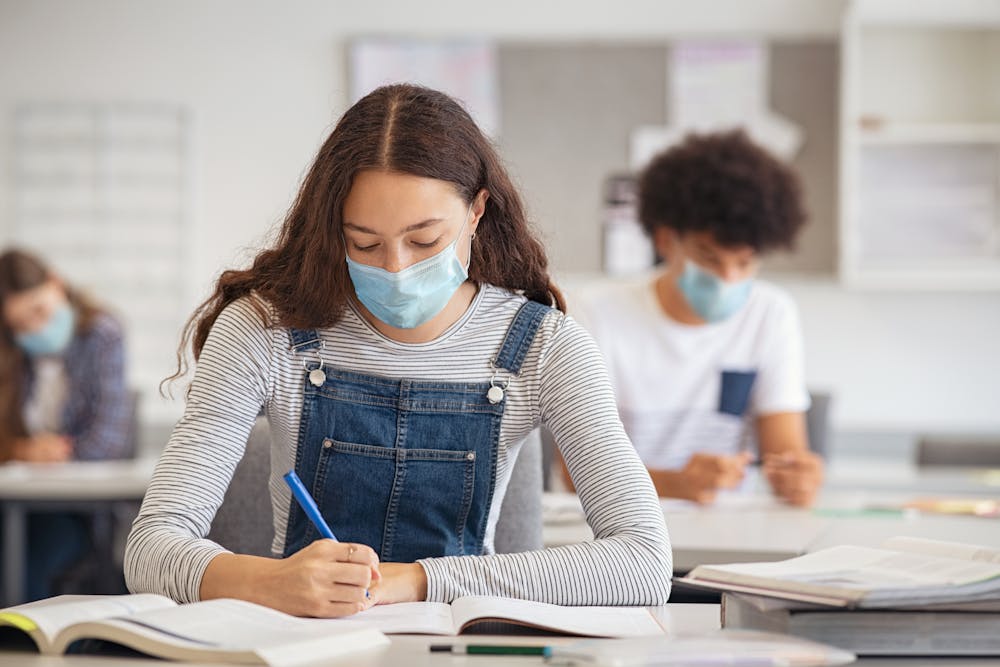 During a snap lockdown in the community, high school students can be asked to wear masks.
Shutterstock
During a snap lockdown in the community, high school students can be asked to wear masks.
Shutterstock
If community transmission becomes more extensive and the initial three- to-five day lockdown has not contained the outbreak, measures should be dialled up again (orange) in the affected geographic areas.
Reducing class sizes in secondary school may prevent school transmission as teenagers seem to transmit to a similar degree as adults. But we suggest reducing class sizes for years 7-10 alone (such as having only 50% of students attending school in these year levels) which reduces the density of students and preserves face-to-face schooling for years 11 and 12 students who may have exam pressures.
Only when community transmission is at very high levels causing the lockdown to be extended, and community cases are rapidly rising, should we consider school closures altogether.
But again, this should only be for the affected geographic areas.
We know this works
School mitigation measures such as the ones we have outlined have been successful in New South Wales and Victoria during low and moderate transmission, respectively. This has also been successful in primary schools in Norway, and in kindergartens to the final year of school in the US.
Adults can rationalise and regulate their emotions but a snap lockdown can be very distressing for children and adolescents, many of whom are still struggling, exacerbated by the very difficult process of managing uncertainty, again.
Read more: Are the kids alright? Social isolation can take a toll, but play can help
We need to change this trajectory to prioritise children’s mental health and learning. Prior to the next snap lockdown, all states and territories need to develop a plan to minimise disruption and stress on schools and families. Children will disproportionately bear the ongoing burden of COVID-19 through school shut down and parental stress. We should do our very best to minimise this into the future.
Recommendations need to be clear as to when to close only hot-spot schools and when to keep all schools open but dial up all the mitigation strategies. This would keep most kids safe, at school and protected from the impacts of school closures.
It is essential state and territory health departments work with their respective education departments and the teachers unions to develop plans now, that can be rolled out immediately and as required, based on the best evidence.
Given it is clear we will live with COVID-19 for the foreseeable future, planning to keep schools and childcare centres open during the pandemic should be an urgent priority. School closures should not be a reactionary measure but a last resort. Our kids depend on it.
Authors: Fiona Russell, Senior Principal Research Fellow; paediatrician, The University of Melbourne

















