

The WHO report into the origin of the coronavirus is out. Here's what happens next, says the Australian doctor who went to China
- Written by Dominic Dwyer, Director of Public Health Pathology, NSW Health Pathology, Westmead Hospital and University of Sydney, University of Sydney
The World Health Organization (WHO) overnight released its report into the origins of the coronavirus, a report I contributed to as a member of the recent mission to Wuhan, China.
The report outlines our now well-publicised findings: SARS-CoV-2, the virus that causes COVID-19, most likely arose in bats, and then spread to humans via an as-yet unidentified intermediary animal. The evidence we have so far indicates the virus was possibly circulating in China in mid-to-late November 2019. We considered viral escape from a laboratory extremely unlikely.
However, the release of the report prompted governments, including in the United States, United Kingdom and Australia, to share their concerns over whether investigators had access to all the data. The joint statement also called for greater transparency when investigating pandemics, now and in the future.
So what happens next?
Our report also recommended what research is needed for a more complete picture of the origins of the coronavirus.
The key focus of this next stage of investigations is looking at what happened before people realised there was a clinical problem in December 2019, not just in China but in other countries with early cases, such as Italy and Iran. This would give us a more complete picture of whether SARS-CoV-2 was circulating earlier than December 2019.
For instance, if we just focus on China for now, we know there were influenza-like respiratory illnesses in Wuhan in late 2019. In fact, we looked at data from more than 76,000 cases for the WHO report, to see whether these could have been what we now call COVID-19. But work is already under way to re-analyse those data using different techniques, to see if we’ve missed any earlier cases.
Read more: Yes, we need a global coronavirus inquiry, but not for petty political point-scoring
Talks are also under way to see whether blood donations in China in 2019 can be analysed to see if they contain antibodies to SARS-CoV-2. This would tell us whether the people who donated those samples had been infected by the virus. These types of investigations take time.
Then there’s what we can learn from molecular epidemiology (the genetic makeup of the virus and its spread). For instance, if we find a lot of variation in the genetic sequence of early samples of SARS-CoV-2, this tells us there had already been transmission for some time. That’s because the virus doesn’t mutate unless it infects and transmits. We can use modelling to say what might have happened up to three or more weeks beforehand.
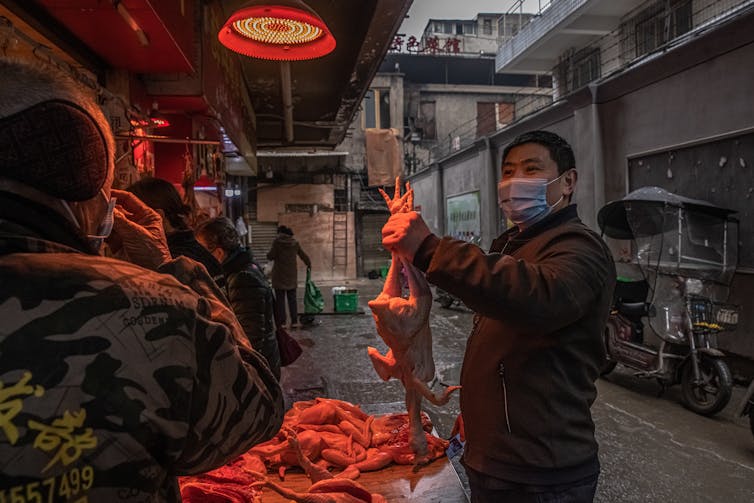 Although the WHO report has looked at the role of markets in China in the spread of SARS-CoV-2, we need to re-analyse data and look further afield.
Roman Pilipey/EPA/AAP
Although the WHO report has looked at the role of markets in China in the spread of SARS-CoV-2, we need to re-analyse data and look further afield.
Roman Pilipey/EPA/AAP
We also need to link those molecular epidemiology data to actual clinical data. Until now those data have largely been separate, with the molecular data held in research or university laboratories and the patient data held elsewhere. We need to make those connections to tell us which infections were related, and how far back in time they go.
There are also many biological samples sitting in laboratories around the world that we need to analyse, and not just in Wuhan. So we have to do a bit of detective work to locate them and analyse them to understand the pattern of disease and to help sort out the origin. There is no central database of samples and what antibodies or genetic material they might contain.
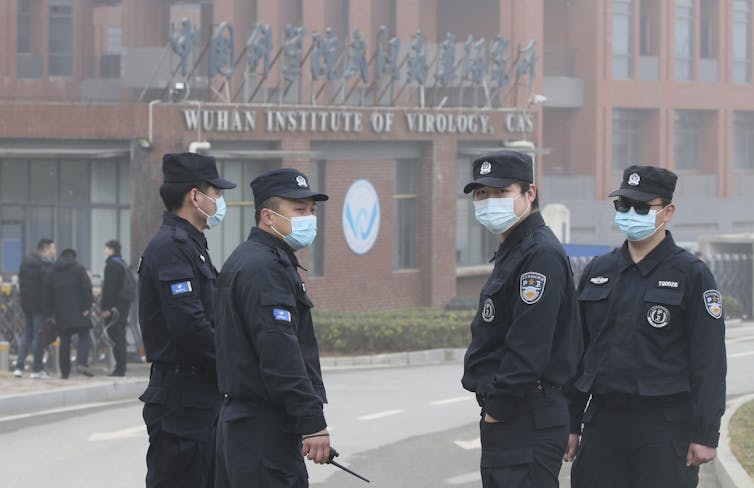 We considered it was extremely unlikely the virus escaped from a laboratory. But laboratories around the world hold samples that have yet to be analysed and could give us clues.
Koki Kataoka/AP/AAP
We considered it was extremely unlikely the virus escaped from a laboratory. But laboratories around the world hold samples that have yet to be analysed and could give us clues.
Koki Kataoka/AP/AAP
For instance, there are SARS-CoV-2 positive blood donations in the US and France, and cases in Italy, and there’s sewage testing in Spain. These are places with early outbreaks of respiratory illnesses that may help us find out if SARS-CoV-2 was circulating earlier than we first thought.
We also need more studies into the role of frozen food products in transmitting the virus. Although we considered the “cold chain” a possible pathway to transmission, we still don’t know how big a factor this was, if at all.
Read more: Was coronavirus really in Europe in March 2019?
Finally, there’s ongoing sampling of animals and the environment for signs of SARS-CoV-2 or related viruses. Can we find the parent virus (the one that eventually mutated into SARS-CoV-2) in a bat in a cave somewhere? Where do we look? At bats across Southeast Asia, Central Asia, into Europe? We need to look at the range of these bats and where they live. These types of investigations can take ages.
Can we find the virus in an intermediary animal, and if so, what type of animal and where? Again, these are difficult studies to set up.
Cooperation needed
The key here is to keep trying to work together and avoid the over-politicisation of the whole exercise.
Rather than blaming governments, we need to foster cooperation and trust between investigators, between and within countries. This not only helps us during this pandemic; it’s the key to managing future pandemics. The more cooperative we are, the more likely we are to get the best results. We have to make sure politics doesn’t muck that up.
Authors: Dominic Dwyer, Director of Public Health Pathology, NSW Health Pathology, Westmead Hospital and University of Sydney, University of Sydney

















