

New Zealand’s new housing policy is really just a new tax package — and it’s a shambles
- Written by Norman Gemmell, Chair in Public Finance, Te Herenga Waka — Victoria University of Wellington
Economists like to talk about “optimal policy instruments” — essentially, policies that achieve their objectives more effectively or efficiently than the alternatives, and have minimal unintended consequences.
Judged by those criteria, the New Zealand government’s recently announced package of housing policy instruments is a long way from optimal. You might even call it a shambles.
How so? To the uninformed, the package’s main elements may seem to address the housing affordability crisis by doing several things:
removing tax deductibility of interest on loans for residential property investments
extending the bright-line test — the period after which the property sale attracts a capital gains tax (CGT) liability — from five to ten years
favouring new builds in these tax changes
introducing a “changes of use” rule that effectively makes family homes liable to CGT if sold within ten years and rented out for more than one year
and raising income and house price caps for the government’s First Home Grant scheme.
If we examine the package in light of the three optimal policy requirements, however, we can see the problems.
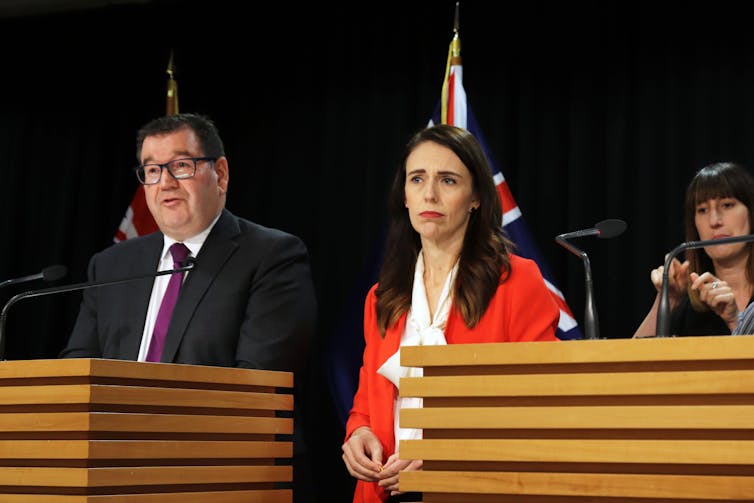 Prime Minister Jacinda Ardern and Finance Minister Grant Robertson announce the Labour government’s housing policy changes.
GettyImages
Prime Minister Jacinda Ardern and Finance Minister Grant Robertson announce the Labour government’s housing policy changes.
GettyImages
Achieving the policy’s objective
Economists have a policy “rule” that to achieve various policy objectives, you need at least as many policy instruments. The housing package is a hodgepodge of inter-related measures, but it has several explicit objectives:
stabilising house prices
facilitating home ownership
discouraging (ill-defined) speculative investment
increasing the housing stock with mainly (undefined) “affordable homes”
closing what the government claims is a housing “tax loophole”.
To these, add implicit objectives of tackling perceived income and wealth inequalities between tenants, landlords and homeowners.
Overall, this is quite a task, and it would be remarkable if any set of housing policies could achieve such wide-ranging objectives.
Arguably, the primary target of this policy package is stopping the inexorable upward march of (mainly Auckland) house prices. Failing to achieve that would simply put it among a long line of attempts by previous governments (National and Labour) over the past 20 years at least.
In all cases, the biggest problem has been insufficient political commitment to boosting housing supply.
Unintended consequences
All taxes cause “distortions”, mostly unintended, which need to be mitigated. Furthermore, policies that have conflicting objectives are “incoherent” and typically among the most distorting. This applies to the housing package’s removal of interest deductibility.
Previously, in New Zealand and almost every other country, interest on business loans is treated as a legitimate expense and therefore tax deductible, regardless of the nature of that business.
With that coherent principle now not applying to housing, then, what about other types of business loans the government thinks it should favour or disfavour? No doubt arguments could be made for such policies, but the result is an ad hoc tax system that generates multiple undesirable distortions and perverse incentives.
It could be argued the “new build” aspect of the housing package gets some incentives right by directing rental housing investment toward increasing the housing stock.
But with already existing constraints on new house building — such as planning regulations and availability of suitable land — the policy is likely to have little impact. It will simply shift housing investors from competing with first-time buyers for existing properties to competing with them for new properties.
Over time the rental housing stock becomes a patchwork of homes that do or don’t qualify for tax exemptions. Exploiting these new loopholes and assorted distortions to property prices will likely provide plenty of employment for tax accountants.
A back door capital gains tax
It would be rare to find a liability based on transactions and timing among the principles of a good tax policy. But the bright-line test manages both — it incentivises delaying property sales to avoid the tax even when selling would otherwise be in the taxpayer’s best interest.
It was originally introduced in 2010 with a two year threshold, without supporting evidence, supposedly to stop so-called speculators from flipping properties for quick profits. A ten year threshold cannot be branded an anti-speculation policy, it is simply a back-door CGT.
As with most back-door policies, this CGT is inevitably less transparent and coherent than a policy designed to tackle the problem head-on would be.
Read more: NZ student accommodation is expensive and under-regulated — here are 10 ways to fix it
Consider the hypothetical case of an Auckland homeowner relocating to Sydney to work for two years. It wouldn’t be sensible to sell the Auckland house due to high transaction costs and the risk of slipping on the property ladder when trying to buy back later. Much better to rent in Sydney while also renting out the Auckland home.
But this would now generate a potentially substantial tax bill on the family home. Indeed, one calculation showed just such a plausible scenario could generate a CGT liability of almost a year’s salary — simply to move to a similarly priced house.
Alternative policy instruments
If there are better alternatives, they do not lie in even more ad hoc fiddling with a coherent tax regime.
Instead, like the famous real estate mantra of “location, location, location”, the mantra for New Zealand housing policy should be “supply, supply, supply”. Specifically, supply in Auckland.
Successive governments have aimed policies nationwide when rapid house price inflation is almost exclusively urban and essentially an Auckland phenomenon.
Without policies that reform construction sector regulations and open up more land for urban housing, there is little prospect of Auckland house prices stabilising while current demand-driven trends persist. To make matters worse, the government’s first-home buyer schemes will merely raise demand without incentivising supply.
With too many objectives and the probability of numerous unintended consequences, the government’s housing policies risk being seriously incoherent.
Authors: Norman Gemmell, Chair in Public Finance, Te Herenga Waka — Victoria University of Wellington

















