

Why China's attempts to stifle foreign media criticism are likely to fail
- Written by Tony Walker, Vice-chancellor's fellow, La Trobe University
When China’s ambassador to Australia, Cheng Jingye, summoned journalists to the Chinese embassy last week, this was not an occasion for polite exchanges on a troubled relationship between Beijing and Canberra.
Cheng was intent on communicating a forceful message to Australian reporters that China was intent on fighting back against what it regards as a great wall of unfavourable publicity about its treatment of its Uyghur minority.
In some media reporting of the press conference, the exercise was referred to as a “charm offensive”. However, a more accurate characterisation would be to describe it as an attempt by China to draw a line under increasingly negative foreign reporting of its activities.
This reporting is having real world consequences for China’s image abroad. It is inviting pushback from an international community that is mobilising against Chinese overreach. Beijing will not be insensitive to the risks of brand damage to China’s reputation, or risks of sanctions.
The Biden administration’s canvassing of a potential boycott of the 2022 Winter Olympics in China will have got Beijing’s attention. If countries, led by the United States, stay away this would represent a significant loss of face.
Global campaign against unfavourable reporting
Senior Chinese officials and Uyghurs appeared via video during Cheng’s embassy briefing to refute media accounts of human rights abuses in the Xinjiang region as “Western lies”, “fabrications” and the work of “anti-China forces”.
In its propaganda offensive, China has not been averse to using the “fake news” label, popularised by former US President Donald Trump to assail its critics.
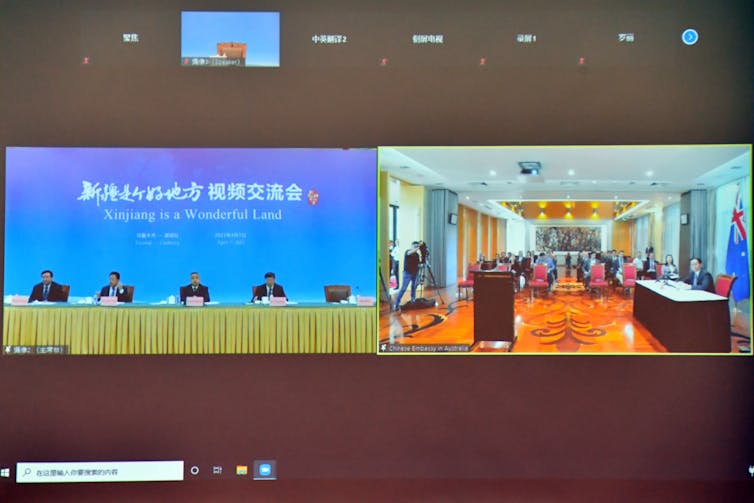 Part of the propaganda video display during Cheng’s press briefing.
Mick Tsikas/AAP
Part of the propaganda video display during Cheng’s press briefing.
Mick Tsikas/AAP
Cheng’s press conference was part of a larger, global campaign against unfavorable reporting in which Beijing has resorted to a combination of bluster and in some cases reprisals against journalists who have cut too close to the bone.
Australian citizen Cheng Lei appears to be a case in point. Cheng, an anchor for state broadcaster China Global Television Network (CGTN), was detained in China last year without explanation, but now stands accused of ill-defined national security breaches.
In private social media posts, she had criticised China’s initial response to the coronavirus pandemic. It is not clear whether this is the basis of allegations against her, but no other reasonable explanation has been forthcoming to this point.
China appears to have been particularly displeased by the reporting of the BBC. In February, Beijing banned all BBC broadcasting in China in retaliation for British authorities having revoked the license of the Chinese overseas broadcaster, CGTN. This represented a significant escalation in the conflict between the Chinese authorities and Western media.
What Chinese propaganda is seeking to achieve
Cheng’s propaganda exercise should therefore be seen as part of a global campaign to stifle what China regards as unfair and damaging criticism of its policies at home and abroad under paramount leader Xi Jinping.
If this Canberra media event was designed to dampen negative reporting in the Australian media, however, the campaign is unlikely to work for the simple reason there is little, or no, sign of Beijing reversing its antagonistic behaviour towards Western media.
Read more: Despite China's denials, its treatment of the Uyghurs should be called what it is: cultural genocide
Scarcely a day passes without criticism of foreign media in Chinese state-controlled outlets. These attacks underscore the gap that exists between Western perceptions of the role of journalists in democratic societies and China’s view that media should serve the interests of the state.
Typical of the sort of criticism levelled at Western media is the following contribution to the nationalistic Global Times by a professor of international relations at Shanghai’s Fudan University.
What some media have done is exaggerate Chinese authorities’ fault in a bid to overthrow the Chinese system. Take the BBC. This British media outlet did not call on the British public to overthrow the British government even if it has miserably failed to effectively curb the spread of COVID-19. This is double standards.
This level of naivete is hard to credit, but it is revealing nevertheless of the gap that exists between Chinese views of the Western media and vice versa.
China’s bluster against Western media may play to nationalist sentiment at home, but it is hardly likely to be effective in neutralising foreign media criticism.
Australian media will not stop providing a platform for legitimate and widely publicised concerns about China’s mistreatment of its minorities; its disrespect for the “one country, two systems” agreements it signed with the UK to facilitate the handover of Hong Kong; its threatening behaviour towards Taiwan; and its expansion of base facilities in disputed waters of the South China Sea.
Beijing’s trade war against Australia smacks of the sort of overreach that may have become a staple of Chinese propaganda in state-run media, but in reality this is not a campaign that serves China’s own interests.
That is assuming Beijing is concerned about promoting itself as a reasonably constructive citizen in its own Indo-Pacific neighborhood.
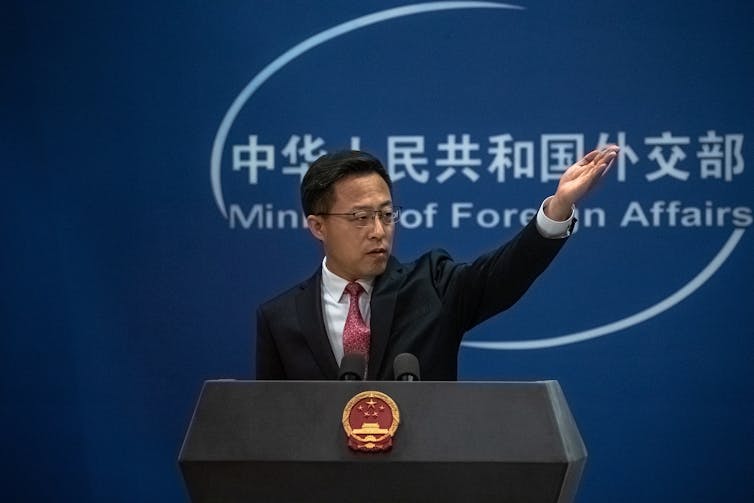 Foreign Ministry spokesman Zhao Lijian has become the face of Beijing’s more belligerent stance toward Western powers.
ROMAN PILIPEY/EPA
Foreign Ministry spokesman Zhao Lijian has become the face of Beijing’s more belligerent stance toward Western powers.
ROMAN PILIPEY/EPA
China’s dismal treatment of journalists
China’s press freedom record leaves a lot to be desired.
In the latest Reporters Without Borders world press freedom index, China rated 177 out of 180. It is by far the world’s largest captor of journalists with at least 121 detained, some in life-threatening conditions.
In March, the Foreign Correspondents’ Club of China reported an intensification of harassment of foreign reporters and increased use of “visa weaponisation”. This had led to the expulsion of 18 foreign correspondents in the first half of 2020. Others, like ABC’s Bill Birtles and the Australian Financial Review’s Michael Smith left because of concerns about being detained..
China regards the FCCC as an “illegal” organisation. As Cedric Alviani, Reporters Without Borders’s East Asian bureau head, said,
In recent years, Chinese regime apparatus has come to consider foreign correspondents as unwanted witnesses and goes to great length to prevent them from collecting information that doesn’t mirror its propaganda.
In a 2019 survey of the 10 “most censored” countries in the world by the Committee to Protect Journalists, China rated fifth behind only Eritrea, North Korea, Turkmenistan and Saudi Arabia. It said,
China has the world’s most extensive and sophisticated censorship apparatus. […] Since 2017, no website or social media account is allowed to provide a news service on the internet without the Cyberspace Administration of China’s permission. Internet users are blocked from foreign search engines, news websites, and social media platforms by the Great Firewall. […] Foreign social media platforms such as Twitter, Facebook and YouTube are banned.
This is the lived reality for foreign journalists in China in the Xi era, and for Chinese consumers of uncensored news, for that matter.
Read more: What's behind China's bullying of Australia? It sees a soft target — and an essential one
At no other stage since China began opening to the outside world in the Deng Xiaoping era of the late 1970s have conditions for foreign correspondents in China been more threatening — or more counterproductive from Beijing’s point of view.
China’s war against the foreign media is at a tangent to its proclaimed ambition to continue opening its economy to foreign investment. The anti-Western media campaign jars with hopes that it would become a responsible international stakeholder, as well.
If Ambassador Cheng’s press conference marks a new stage in China’s battles with foreign media, this promises to be a long march.
Authors: Tony Walker, Vice-chancellor's fellow, La Trobe University

















