

I understand the rationale to limit travellers from India, but I still feel uneasy
- Written by Hassan Vally, Associate Professor, La Trobe University
On Thursday, national cabinet agreed to list India as a “high-risk” country and temporarily reduce the number of people returning to Australia from the country by 30%.
Prime Minister Scott Morrison said other countries would soon be added to the high-risk list, although only India has been included so far.
Being an Australian who is of Indian heritage but has lived in Australia his whole life, the images from India over the past few days have pulled at my heartstrings in a way that has surprised me — just when I thought I’d become somewhat desensitised to the destruction the COVID-19 pandemic can wreak.
India is in the midst of an unparalleled catastrophe, even by the devastating standards we have witnessed over the last year. On Thursday it reported the largest single-day increase of COVID cases for any country since the pandemic began, with 314,835 new cases. Many hospitals are running out of oxygen.
Read more: After early success, India's daily COVID infections have surpassed the US and Brazil. Why?
It’s not necessarily surprising, given many substantial drivers of transmission are present in India: poverty, areas of very high population density, a lack of resources and limited lockdowns, to name a few. What’s also very clear is that, as alarming as the COVID numbers being reported are, they’re clearly an underestimation of the true level of spread.
With one in three tests coming up positive in some parts of the country, the real number may be several times higher than what’s being detected.
I have to admit I’m torn by the Australian government’s response to this situation. From a disease-control perspective, I understand the rationale. By limiting entry of people from high-risk countries, we certainly limit our exposure to risk in Australia.
As we have seen many times during the pandemic, hotel quarantine is not perfect and the risk of infection escaping these facilities is very real. Clearly, one of the triggers for this decision has been the hotel transmission of cases seen over the past few days in Perth.
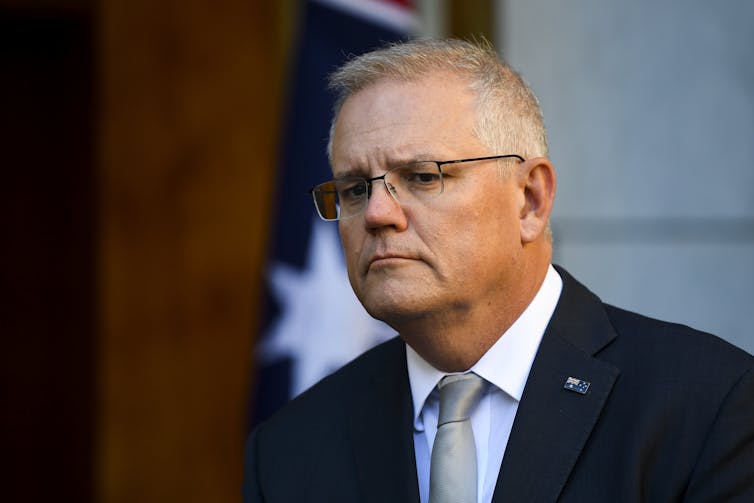 On Thursday, Prime Minister Scott Morrison told reporters national cabinet had agreed to temporarily reduce the number of travellers arriving from India.
Lucas Coch/AAP
On Thursday, Prime Minister Scott Morrison told reporters national cabinet had agreed to temporarily reduce the number of travellers arriving from India.
Lucas Coch/AAP
But from a humanitarian perspective, I feel uneasy. One could argue those wishing to return from India need us to look after them more than ever right now. With transmission uncontrolled and lives at risk due to infection and a lack of hospital resources, we shouldn’t abandon people in India or any other country facing a similar situation.
As hard as it is to make a decision like this, it’s not without precedent. Limiting or preventing travel from high-risk countries to reduce the risk of importing disease has been a mainstay of the pandemic response in Australia and elsewhere. This policy of reducing traveller numbers from high-risk areas looks similar to the UK’s “red list”, which bans people travelling from certain countries (unless they’re British or Irish citizens, who can enter but have to quarantine at their own cost and test negative).
It does raise the question, however, of how we will define “high-risk” from now on. Expecting a rigid definition is probably unreasonable, given how many variables need to be considered, including which variants of the virus are circulating in other countries.
But despite this, I think it will be important for the government to communicate as much as it can about how these determinations will be made.
The more transparency and clarity we have on these decisions, the more confidence we can have in their fairness. If we understand the basis for these decisions, it may help us understand when and why a country is added to the list, and of course when and why it should come off again.
The response to this crisis in India speaks yet again to the complexity of public health decision-making. Although one has to listen to the science, the science cannot tell you what what your policy settings should be. In setting policy, one has to factor in fairness, consider the human perspective, and at the same time balance what’s acceptable to the wider community.
We’ve seen the challenge of balancing these various, and often competing, considerations in other difficult decisions that have been taken during the pandemic. This is just the latest example.
The federal government has probably landed on a pretty reasonable and pragmatic response to protect Australians by not closing the border to India completely, but instead reducing the risk of importing COVID by restricting the number of arrivals. Like many, however, I’m deeply concerned by the situation in India. The unfolding crisis highlights that until we bring virus transmission under control in all countries, we still have a long way to go for this pandemic to be behind us.
Read more: 3 ways to vaccinate the world and make sure everyone benefits, rich and poor
Authors: Hassan Vally, Associate Professor, La Trobe University

















