

why mobility as a service needs a proper platform
- Written by S. Travis Waller, Professor and Head of the School of Civil and Environmental Engineering, UNSW
Uber, Ola, Car Next Door, GoGet, Urbi and Shareabike have transformed the mobility experience for millions of people, but are just the tip of the looming iceberg of changes in transport. Globally, 93 million travellers use the Uber app on a monthly basis. More Australians use Uber (22.9%) than taxis (21.8%).
The public clearly has an appetite for mobility as a service (MaaS). People want to plan, book and pay for various forms of transport via a digital platform.
Read more: For Mobility as a Service (MaaS) to solve our transport woes, some things need to change
However, mobility service providers are actors in search of a stage. As with software, computing and entertainment, only when a properly designed and managed platform underpins all the services will the real transformation be unlocked.
The 3 pillars of the platform
MaaS is part of a broader evolution as novel technologies have driven the rapid transformation of products and offerings into collections of services. Smartphone applications rely on digital distribution platforms such as Google Play Store, Apple Store, Microsoft Store and Amazon Cloud. Similarly, the evolving technologies and mechanisms of mobility systems require a platform for distribution.
Read more: We subscribe to movies and music, why not transport?
The platform concept should include at least three key elements:
integrated ticketing and payment: user payments are managed in a uniform and adaptable manner across all providers
accessible, standardised regulations with open data: regulations and data are managed to be accessible/plug-n-play, secure and equitable
reputation management: reputations of providers and users are managed in a scalable, fair and efficient way.
If the platform is designed poorly, markets will be distorted, privacy will be violated, and escalating infrastructure costs will continue to burden taxpayers.
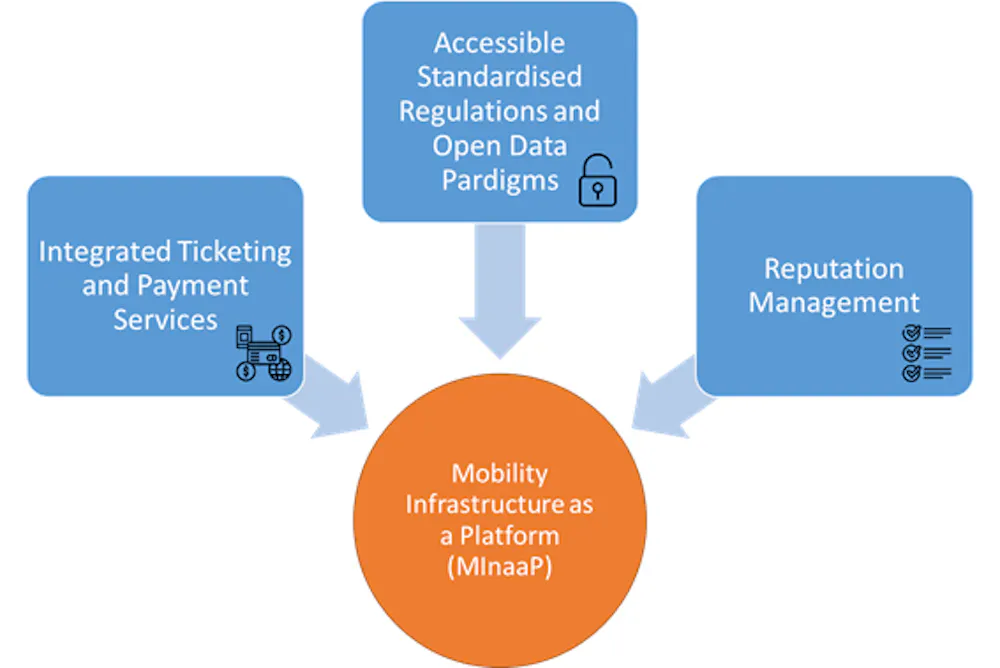 The critical elements of mobility infrastructure as a platform.
Author provided
The critical elements of mobility infrastructure as a platform.
Author provided
Moving towards integrated payment
Historically, the transport platform has simply been the physical networks – roads, walking paths, cycle paths, rail and so on – and the ancillary infrastructure such as stations, airports, ports, vehicle storage and parking. Governments must reimagine existing physical infrastructure as part of the mobility services platform.
Recent innovations have focused not only on infrastructure development – autonomous vehicle systems, for example – but also on managing existing infrastructure. For example, cities around the world have moved towards rail automation and smart ticketing for public transport (Opal, Oyster, Octopus and Myki cards). The smart cards market for public transport in the US alone was valued at US$57.2 billion (A$73.9bn) in 2018.
Setting up seamless payment across services is the first pillar of the platform needed to support mobility as a service. It removes a major barrier to entry for service providers and users.
 Smart cards were an essential step towards an integrated system of ticketing, payments and patronage data.
Wikimedia Commons
Smart cards were an essential step towards an integrated system of ticketing, payments and patronage data.
Wikimedia Commons
Significant efforts to integrate payments are ongoing. The other two essential pillars of a MaaS platform require much more attention.
Mobility as a service is seen as a solution to various transport problems, particularly by reducing private vehicle use. Customers are being promised efficient door-to-door multi-modal travel through a single holistic application. In reality, the infrastructure to achieve this is not yet present.
Research has raised questions about its benefits, social impacts and governance. For instance, emphasising smaller-scale, more flexible mobility services in unideal environments can increase congestion and undermine urban planning goals.
Why regulation is essential
The value and risks the platform creates for mobility providers, users, disadvantaged groups and society must all be kept in mind. The aim should be to create a fair marketplace that enables participation, innovation, equity and quality service.
Read more: Billions are pouring into mobility technology – will the transport revolution live up to the hype?
The second pillar, accessible, standardised regulations with open data paradigms, will enable service providers to participate in a market that delivers societal benefits. Innovations by providers must conform to a common “plug-n-play” approach that meets the mobility needs of the community as efficiently as possible. Crowd-sourced data (such as from Google or TomTom), user demand data from travel cards and traffic volume data should be available in the one platform for all service providers.
This is a complex undertaking, and data privacy must be a core component. It calls for strong professional leadership.
A big part of the challenge is that civil infrastructure cannot be unified in the same way as IT infrastructure or cloud computing. Civil infrastructure, especially transport infrastructure, is also expensive to build and maintain over its long lifespan, so the MaaS platform must be able to help optimise existing infrastructure to meet public mobility needs.
Regulation based on the protection and service of society is the only way to achieve this. The regulatory framework must be standardised, fair and accessible. This means any service providers adhering to the standards can join (and leave) the market without “insider” barriers.
Balancing profit with public benefits
Though it is a difficult task, we should apply the “everything as a service” concept with clear standardisation and regulation to deliver equitable and sustainable transport services.
This also offers a way to integrate profit maximisation and social welfare within transport but also involving adjacent services such as parking.
In the rail industry, standardisation has enabled more commoditised heavy and light rail systems and vehicles. Commoditisation is a process that creates reliable nearly identical products – rail services in this case – in the eyes of consumers. They can choose between these competing products based on cost and which best suits their needs at the time. This process has improved the economics, safety, accessibility and technology of rail services.
Over the past decade, the European Commission has implemented laws and policies to create a Single European Railway Area. The goal is to revitalise the sector by creating a single market for interoperable rail services that are more innovative and competitive.
 The Single European Railway Area is a long-term project that is starting to show the benefits of integration.
Heinrich-Böll-Stiftung/European Union, CC BY
The Single European Railway Area is a long-term project that is starting to show the benefits of integration.
Heinrich-Böll-Stiftung/European Union, CC BY
Managing reviews and reputations
Finally, reputation management is essential for a mobility infrastructure platform. Reviews and reputation management have been a driving force for Uber, Amazon, eBay, iTunes, Airbnb etc.
A user-driven reputational management system must be trustworthy, scalable and resistant to tampering and malignant reviews. Blockchain technologies could help build the required trust.
Mobility will increasingly be delivered as a service to travellers. New technologies combined with social awareness and strong professional leadership will all be needed to develop the platform.
This article was co-authored by Victor Prados-Valerio, a Senior Associate at the advisory firm TSA Management, who has been a project manager and senior rolling stock engineer on train, light rail and depot procurement projects in Australia and overseas.
Authors: S. Travis Waller, Professor and Head of the School of Civil and Environmental Engineering, UNSW


















