

Would Australians support mandates for the COVID-19 vaccine? Our research suggests most would
- Written by David Smith, Associate Professor in American Politics and Foreign Policy, US Studies Centre, University of Sydney
Australia’s vaccine rollout is moving far more slowly than the government had hoped, and there is evidence of vaccine hesitancy in a significant part of the population.
Some governments and media outlets are already considering whether mandates will be needed to reach sufficient vaccine coverage.
Last year, Prime Minister Scott Morrison briefly suggested a vaccine would be mandatory before walking it back hours later.
Supply and rollout problems must clearly be solved first. But if mandates do come back on the table in the face of vaccine hesitancy, our research sheds light on how widely supported they would be.
Last year, with our research partner Pureprofile, we surveyed 1,200 Australians about whether they would take a COVID-19 vaccine when it became available. We also asked if they thought the government should make the vaccine a requirement for work, travel and study.
Our sample included 898 respondents we had previously surveyed in 2017. Back then, we asked their opinions about the safety and necessity of vaccines and whether they supported the federal government’s “No Jab, No Pay” policy, which takes away financial entitlements from vaccine refusers.
Read more: Should a COVID-19 vaccine be compulsory — and what would this mean for anti-vaxxers?
Of those who participated in both the 2017 and 2020 surveys, 88% agreed in 2017 with the statement that “vaccines are safe, necessary and effective”. Yet 30% gave a hesitant response (“maybe” or “no”) when asked in 2020 if they would take the coronavirus vaccine.
We asked all hesitant respondents why they were hesitant. Just 8% of them were “against vaccines”. Another 16% indicated they weren’t personally concerned about the coronavirus. But an overwhelming 70% had safety concerns about the vaccine because of how quickly it was being developed.
 New research has found widespread support among Australians for mandating COVID-19 vaccination.
David Caird/AAP
New research has found widespread support among Australians for mandating COVID-19 vaccination.
David Caird/AAP
This level of vaccine hesitancy is very high by Australian standards, but it is unfortunately normal for COVID-19. Other local and international studies have also found much higher than normal hesitancy about COVID-19 vaccines, driven by a variety of factors. Despite this higher-than-usual hesitancy, a comfortable majority of Australians still want the vaccine.
Moreover, large majorities of Australians are in favour of government mandates for COVID-19 vaccines. Surprisingly, more respondents in our survey said they favoured the government making the vaccine a requirement (73%) than said they would definitely take it themselves (66%).
This is the opposite of what vaccination mandate studies usually find in the US, where there is less support for government mandates than there is for personally taking vaccines. However, it is in line with what other researchers have found about Australians during the pandemic. We have generally been highly accepting of strict government measures to control it, even if we don’t agree with them. This may also be evidence of a broader culture of rule-following.
Another crucial difference between Australians and Americans is in the political makeup of support for COVID-19 vaccines. While vaccine hesitancy in the US previously didn’t map onto party-political affiliation, it has very much done so for COVID-19.
Donald Trump’s opposition to other measures to fight the pandemic, his scepticism about the pandemic itself, and perhaps even his earlier statements about childhood vaccines seem to have caused widespread rejection of the COVID-19 vaccine among Republicans. This is in spite of the Trump administration’s significant support of vaccine development, and Trump’s own claim that he is the “father of the vaccine”.
Making vaccinations mandatory is even less popular with Republicans, and threatens to become a significant culture war issue.
Read more: Can the government, or my employer, force me to get a COVID-19 vaccine under the law?
However, in Australia, the COVID-19 vaccine and the prospect of government requirements are popular. Supporters of both the Coalition parties and Labor, which between them form every state and federal government in the country, embrace both: 72% of these major party voters say they would definitely take the vaccine, while 79% of them support requirements for it. There is no statistically significant difference between supporters of the different parties.
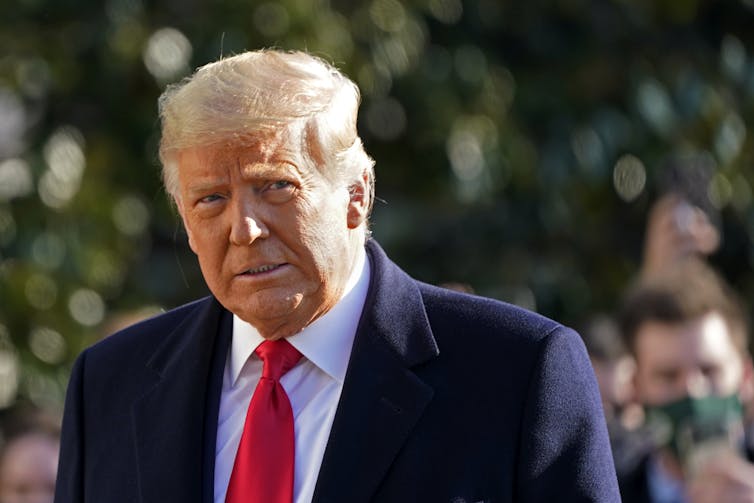 Donald Trump has recently declared himself the ‘father’ of the vaccine, despite being publicly sceptical at first about the seriousness of the virus.
Gerald Herbert/AP/AAP
Donald Trump has recently declared himself the ‘father’ of the vaccine, despite being publicly sceptical at first about the seriousness of the virus.
Gerald Herbert/AP/AAP
On the other hand, voters whose first preference would go to another party or independent were more hesitant about the vaccine and requiring it. Only 56% of them said they would definitely take the vaccine, while 61% said they would support a mandate.
Politicians from the Coalition and Labor have led Australia’s response to COVID-19, appearing alongside each other in a sometimes fractious but generally co-operative national cabinet. So perhaps it isn’t surprising that supporters of these parties also support vaccination in large numbers.
The biggest pockets of opposition are found in supporters of parties that usually don’t form government, and which challenge the major party consensus from both the left and right. It is important to emphasise that even a majority of these minor party voters would definitely take the vaccine, and would also support government requirements to do so. But we must keep in mind that vaccine hesitancy may well have an “anti-establishment” character in Australia, found among those who are less satisfied with the major parties.
We conducted our survey before any vaccine had been developed, let alone rolled out. Now that Australians have seen both the spectacular successes and rare but worrying adverse events following some brands of vaccination, should we expect them to have different views?
The market research company Ipsos undertook the only other national study we know of on attitudes to making COVID-19 vaccinations mandatory. In January, Ipsos asked whether this should be the case for those over 18, and found 54% of Australians said yes, 35% said no and 10% were unsure.
The stronger language of “mandates” and less clarity about what mandatory means in practice may have prompted less support than in our study. Comparisons to 13 other countries put Australians somewhere in the middle in terms of acceptance of mandates. The Ipsos survey, like ours, was conducted prior to the recent pivot away from AstraZeneca vaccination for under 50s.
However, a recent survey of Western Australians found much higher support when respondents were asked about a specific requirement. Some 86% of respondents said they would favour making a vaccine mandatory for anyone who wanted to travel overseas.
The authors of this piece are neither anti- nor pro- vaccine mandates. We believe in certain circumstances it is appropriate for governments to require people to be vaccinated, and we prefer this to leaving vaccine mandates to the private sector. The development of any mandatory vaccination policies should involve robust and transparent engagement with the public.
However, we believe mandates should be a policy of last resort. Well-funded and targeted public communications, easy access and incentives should come first. We are still waiting for our own eligibility to be vaccinated, so there is a long way to go.
Authors: David Smith, Associate Professor in American Politics and Foreign Policy, US Studies Centre, University of Sydney

















