

A bigger budget for mental health services won't necessarily improve Australia's mental health
- Written by Anthony Jorm, Professor emeritus, The University of Melbourne
The federal budget’s allocation of A$2.3 billion in mental health and suicide prevention funding will be welcome news for the mental health services sector and for people who have struggled to find adequate support.
The recent Productivity Commission and Victorian Royal Commission reports into mental health have emphasised the major effect of mental ill health on Australian society, as well as the public’s concerns about the inadequacies of existing service provision.
The big expenditure items announced in the budget for mental health largely involve increasing treatment services, including:
A$487 million to establish a national network of adult mental health centres
A$278 million for the expansion of Headspace youth services
A$288 million for repetitive transcranial magnetic stimulation (rTMS), a treatment for depression
more than A$100 million each for digital mental health services and group therapy, supporting the participation of family and carers.
Although in time these pledges are likely to make it easier for many people to access mental health services, it’s important to understand this won’t necessarily translate to improved mental health in Australia.
Read more: Cuts, spending, debt: what you need to know about the budget at a glance
Will more services mean better mental health?
It’s a logical assumption that greater expenditure on mental health treatment services will improve mental health. But it’s an uncomfortable truth that neither Australia, nor any other comparable country, has managed to improve the mental health of its population by increasing the provision of mental health services.
Australia has seen significant increases in mental health services over the past 20 years, with many more people receiving GP, psychological and allied health services funded through Medicare. We have also had a major expansion of youth services through Headspace.
However, over this period, the Australian Bureau of Statistics has been tracking our national mental health — and it hasn’t improved at all. For young people, if anything there’s been a worsening in recent years. Further, the suicide rate has been trending up.
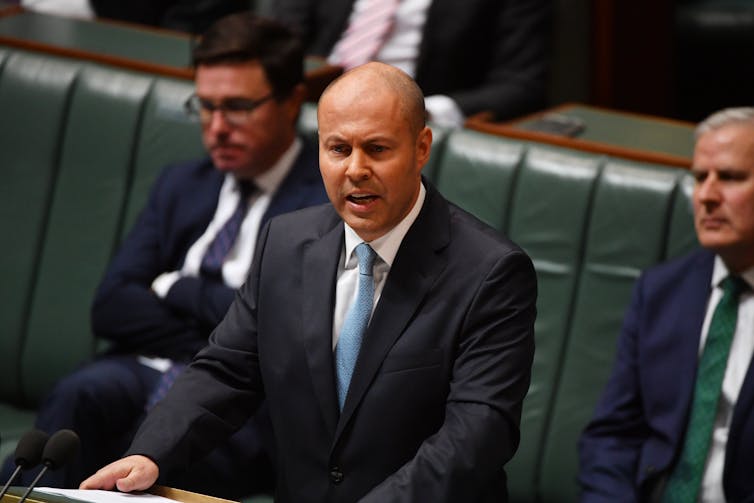 Treasurer Josh Frydenberg has handed down the 2021-2022 federal budget, and it includes A$2.3 billion for mental health.
Mick Tsikas/AAP
Treasurer Josh Frydenberg has handed down the 2021-2022 federal budget, and it includes A$2.3 billion for mental health.
Mick Tsikas/AAP
Not necessarily the right services for the right people
There is plenty of evidence from randomised controlled trials showing treatments can work. For example, a range of psychological treatments can be effective for depression and anxiety disorders. Also, antidepressants can be helpful for people with more severe depression or anxiety.
However, what people get in practice is not necessarily what’s evaluated in trials, nor is it generally consistent with the standards experts set in clinical practice guidelines.
For example, people typically receive far fewer sessions of psychological therapy than recommended despite the increasing availability of services. Similarly, GPs often prescribe antidepressant medications for people with milder problems who are unlikely to benefit from this type of treatment.
We need greater quality of services
In the past, we’ve seen that increasing services leads to progressively more people receiving services that are too thinly spread or poorly targeted to make a real difference. What we need is to improve the quality of services for people with more severe problems and increase the availability of self-help options for people with milder problems as an alternative to specialist mental health services.
We don’t know whether the additional services funded in the budget will make a difference. It’s important we focus on the longer-term benefits of these services to mental health rather than on the immediate increases in services the money will buy.
Pleasingly, the budget does allocate A$117 million to establish a national database on service delivery, performance and outcomes across the mental health system. This will help pave the way to a greater focus on whether the services are making a difference to national mental health.
Read more: Youth anxiety and depression are at record levels. Mental health hubs could be the answer
Some much-needed attention to prevention
Another reason past government expenditure has not improved national mental health is that prevention has been neglected.
This budget takes some small steps in the right direction in this regard, with some focus on childhood, where mental health problems often begin. There’s A$46 million allocated to parenting education and support, and A$54 million to establish child mental health and well-being hubs.
 Establishing child mental health and well-being hubs is a positive step in terms of preventing mental ill-health.
Shutterstock
Establishing child mental health and well-being hubs is a positive step in terms of preventing mental ill-health.
Shutterstock
There is also expenditure in other areas that will reduce risk factors for mental health problems, including sexual abuse, family violence, homelessness and unemployment. However, the balance of mental health spending is still very much on treatment rather than prevention.
The long haul: fulfilling the Productivity Commission’s vision
The Productivity Commission’s final report on mental health, released in November last year, set out a grand vision for major reform. It recognised that improving mental health required action across many areas of government, not just treatment services.
The danger was always that the Commission’s recommendations would be cherry picked in budgets and election promises, and the grand vision lost. While this latest federal budget has some promising offerings for mental health, the grand vision remains to be fulfilled.
Read more: We can't ignore mental illness prevention in a COVID-19 world
Authors: Anthony Jorm, Professor emeritus, The University of Melbourne

















