

How China has been transforming international education to become a leading host of students
- Written by Jing Qi, Lecturer, School of Global, Urban and Social Sciences, RMIT University
When Australians think of international education and China, they typically consider the country as a source of international students — Australia’s largest. But China is now one of the leading host countries of international students in the world.
China’s level of international education policymaking over the past decade, backed up by strategic priorities, has been unprecedented.
My recently published research shows Chinese universities are learning to reconcile the different forces of local, national and global demands. They aim to:
calibrate to the Chinese government’s grand scheme of national rejuvenation
expand their global reach and market influence
enhance their professional impact and managerial efficiency
respond to the community repercussions of growing numbers of international students.
A top study destination in the making
China was on the way to becoming a top destination for studying abroad well before the COVID-19 pandemic.
By 2018, 492,185 international students from 196 countries studied in mainland China. They were enrolled in 1,004 higher education institutions.
International student numbers had doubled since 2009, when 238,184 were enrolled. Back in 1978 the total was a mere 1,236.
Read more: The rise of China: a threat or opportunity for Australian universities?
The Study in China Initiative, Liuxue zhongguo jihua, first appeared in 2010 in the National Outline for Mid- and Long-Term Education Planning and Development.
The growth of the initiative over the past decade echoes across China’s laws, five-year plans, guidelines and action plans, and government decisions, opinions, regulations, notices and explanations.
2010 was a turning point
Between 2007 and 2009, the Chinese Ministry of Education had signalled against reckless pursuit of international student enrolments at the expense of quality education. This was a fleeting period of slight uncertainty for the sector.
In 2010, state policymaking re-endorsed mass international education in China. Study in China was to be built into a global education brand.
The plan specified annual enrolment targets, culminating in 500,000 students in 2020. This included 150,000 degree-seeking students. Yearly targets were set to develop exemplary sites, programs and courses for international education.
The overall goal was to make China the largest study abroad destination in Asia by the end of the decade. This was achieved in 2017-2018.
Subsequent state policies focused on legal, financial and administrative improvements. Increasing funding was made available through national, local, government and corporate scholarships and stipends for international students.
Education’s place in a broader global strategy
The mid-2010s defined the orientation of international education in China. The Study in China Initiative was subsumed under the new global strategy, the Belt and Road Initiative (BRI). It is a “road map” for China’s higher education to step onto the world stage.
Read more: Why is there so much furore over China's Belt and Road Initiative?
Study in China is part of the core political discourse of national rejuvenation.
We can see this in the official 2019 Study in China Guide. The guide depicts the BRI as a core strength and essential knowledge about China. It powerfully demonstrates China’s market aspirations and appeal to international students.
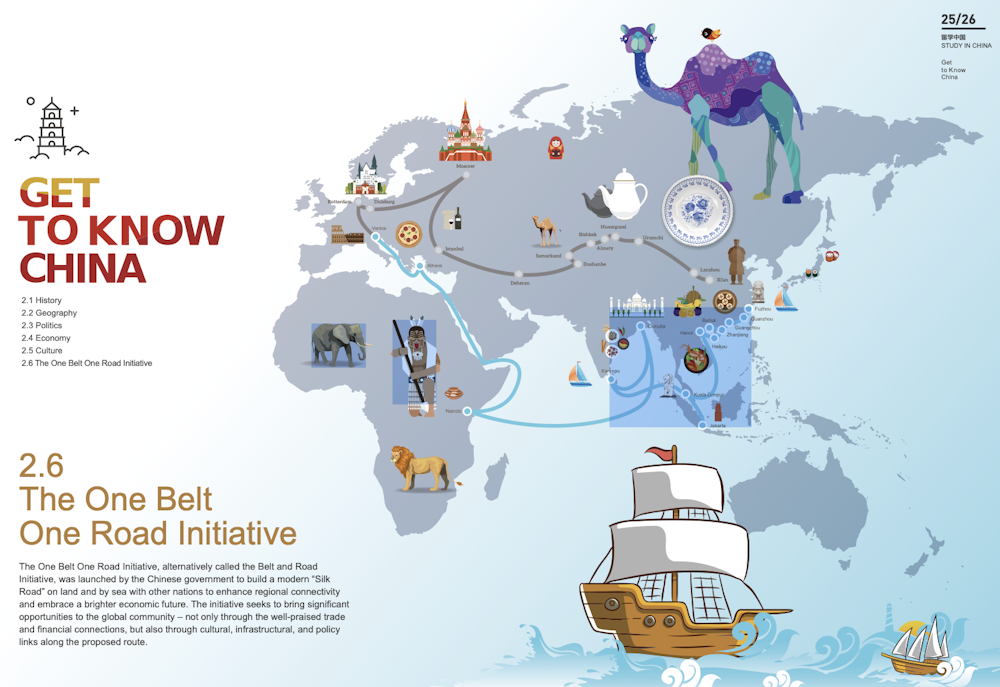 The official Study in China Guide makes it clear international education is part of the Belt and Road Initiative.
Study in China Guide
The official Study in China Guide makes it clear international education is part of the Belt and Road Initiative.
Study in China Guide
The Chinese government’s Silk Road Scholarship Program sponsors 10,000 new international students a year from countries participating in the Belt and Road Initiative. Universities can apply for state funding to run a BRI talent development site for large cohorts of these students.
Research grant schemes fund studies that improve the quality of international education, while supporting BRI work in infrastructure, trade, culture and diplomacy.
The Belt and Road Initiative is central to China’s rapid shift from major importer to rising exporter of international education. In 2017, 317,200 international students came from BRI countries, 64.85% of the total.
Focus shifts to quality assurance
Quality improvement was not new in the policy discourse on Study in China. However, substantive progress has been made since 2017.
Compared to its 2000 version, the 2017 Administrative Measures for the Enrolment and Development of International Students by Universities and Schools (Order 42) emphasised systematic quality enhancement in four areas:
development of relevant university regulations
rigorous assessments for admissions and scholarships
systematic planning of teaching and staff development
development of quality control mechanisms.
The 2018 Quality Assurance Standards for Higher Education of International Students is the first of its kind in China. The 2019 Quality Accreditation Rules for International Higher Education established China’s first external qualification accreditation and assurance system for international education.
One quality indicator concerns the composition of international students. Degree-seeking students became the majority (52.44%) of international students in China for the first time in 2018. Their numbers had increased by more than 350% from 36,387 in 2006 to 178,271 in 2018. They include bachelor, master and doctoral students who study abroad for at least one year.
 International students enrolled for degrees in China increased in number by more than 350% from 2006 to 2018.
Shutterstock
International students enrolled for degrees in China increased in number by more than 350% from 2006 to 2018.
Shutterstock
A balancing act for Chinese universities
Chinese universities have benefited from the escalating scale and influence of the Study in China Initiative.
However, my research shows they are under the stress of having to respond to multiple, often competing pressures.
An example of this is academic language and associated ideological tension. English is the dominant language in the academic world and in global trade. Most international students in Chinese universities study in English-taught programs.
But shifting political and community perceptions of the English language have stepped up internal pressures on Chinese universities. The legitimacy of English as the lingua nullius of global knowledge production is under challenge.
Another clear policy shift encourages convergent management of domestic and international students. There is pressure to integrate international students into the regular operations of Chinese universities. The rise in international student numbers has created a need to increase managerial efficiency.
This shift is also a response to community perception. International students benefit from more flexible testing arrangements and greater access to elite universities and scholarships, compared to domestic students. International students are spared the gruelling competition of Gaokao, the national college entrance examination.
In addition, breaches of rules and regulations by international students have often gone unaddressed.
Chinese universities are having to weigh up competing considerations of state aspiration, market appeal, corporate consolidation, professional enhancement and community pressures.
Authors: Jing Qi, Lecturer, School of Global, Urban and Social Sciences, RMIT University

















