why do we yawn and why is it contagious?
- Written by: Mark Schier, Senior Lecturer in Physiology, Swinburne University of Technology
Consider the scenario. You’re driving on a long, straight stretch of country highway at about 2pm on a sunny afternoon, and you’re desperately keen to reach your destination. You’re trying to stay alert and attentive, but sleep pressure is building up.
In response you yawn, sit up straighter in your seat, possibly fidget around a little and engage in other mannerisms that may increase your level of arousal.
Is this the purpose of yawning? Yawning is generally triggered by several things, including tiredness, fever, stress, drugs, social and other psychological cues. These are generally well documented and vary between individuals.
The question of why we yawn evokes a surprising amount of controversy for what is a relatively minor field of study. We don’t have evidence that can point us to the exact purpose of yawning.
But there are several theories about the purpose of yawning. These include increasing alertness, cooling the brain, and the evolutionary theory of alerting others in your group that you’re too tired to keep watch, and someone else should take over.
1. Helps us wake up
Yawning is known to increase with drowsiness. This has led to the arousal hypothesis of yawning. Associated with the yawning are increased movement and stretching behaviour. The increased fidgeting behaviour may help maintain vigilance as sleep pressure builds.
Read more: Health Check: how can I make it easier to wake up in the morning?
Also, specific muscles in the ear (the tensor tympani muscles) are activated during yawning. This leads to a resetting of the range of movement and sensitivity of the eardrum and hearing, which increases our ability to monitor the world around us after we may have tuned out before the yawn.
 Yawning is usually accompanied by stretching behaviour.
from shutterstock.com
Yawning is usually accompanied by stretching behaviour.
from shutterstock.com
Additionally, the opening and flushing of the eyes will probably lead to an increase in visual alertness.
2. Cools the brain
Another theory for why we yawn is the thermoregulatory hypothesis. This suggests that yawning cools the brain. Yawning causes a deep inhalation that draws cool air into the mouth, which then cools the blood going to the brain.
Proponents of this theory claim a rise in brain temperature is observed prior to yawning, with a decrease in temperature seen after the yawn.
But the research report that gave rise to this theory only shows excessive yawning may occur during an increase in brain and body temperature. It doesn’t suggest this has a cooling purpose.
Increased yawning rates are seen when fevers have been experimentally induced, which does suggest a correlation between body warming and yawning. But there is no clear evidence it leads to body cooling – just that body warming seems to be a trigger for yawning.
3. Sentry duty
Yawning-like behaviour has been observed in almost all vertebrates, suggesting that the reflex is ancient. The evolutionary based behavioural hypothesis draws on humans being social animals. When we are vulnerable to an attack from another species, a function of the group is to protect each other.
Part of our group contract has included sharing sentry duties, and there is evidence from other social animals of yawning or stretching signals when individuals are becoming lower in arousal or vigilance. This is important for changing activities to prevent the watch from slipping, or to indicate the need for another sentry.
Neuroscience explanations
The yawning reflex involves many structures in the brain.
One study that scanned the brains of those who were prone to contagious yawning found activation in the ventromedial prefrontal cortex of the brain. This brain region is associated with decision-making. Damage to this region is also associated with loss of empathy.
Read more: Understanding others' feelings: what is empathy and why do we need it?
Stimulation of a particular region of the hypothalamus, which contains neurons with oxytocin, causes yawning behaviour in rodents. Oxytocin is a hormone associated with social bonding and mental health.
Injecting oxytocin into various regions of the brain stem causes yawning, too. These include the hippocampus (associated with learning and memory), ventral tegmental area (associated with the release of dopamine, the happy hormone) and the amygdala (associated with stress and emotions). Blocking the oxytocin receptors here prevents that effect.
Patients with Parkinson’s disease don’t yawn as frequently as others, which may be related to low dopamine levels. Dopamine replacement has been documented to increase yawning.
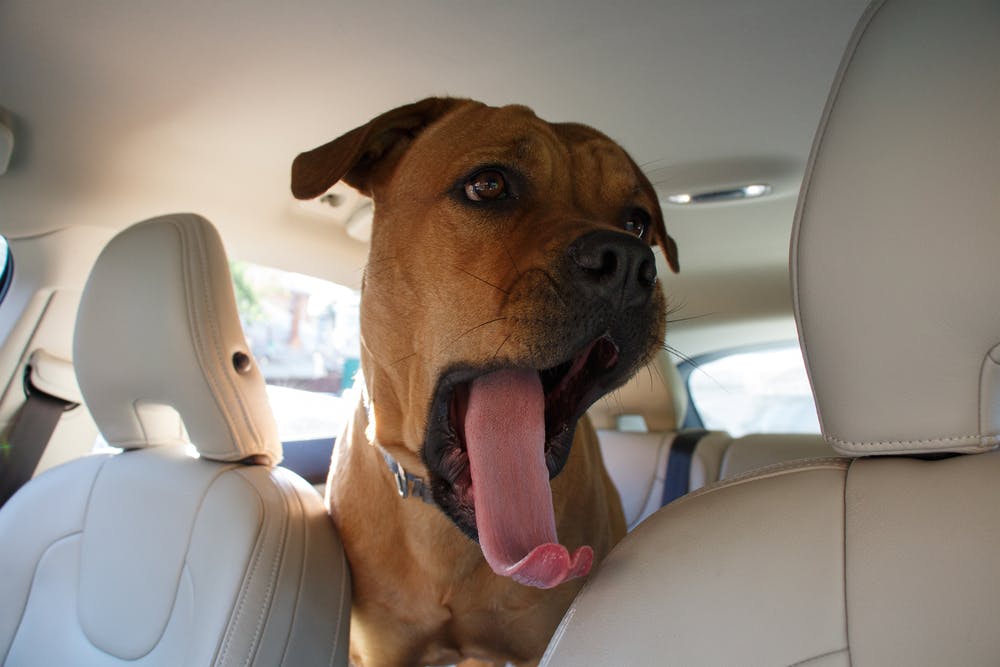 Your dog could be yawning on long car trips because it is stressed.
from shutterstock.com
Your dog could be yawning on long car trips because it is stressed.
from shutterstock.com
Similarly, cortisol, the hormone that increases with stress, is known to trigger yawning, while removal of the adrenal gland (which releases cortisol) prevents yawing behaviour. This suggests that stress might play a role in triggering yawning, which could be why your dog may yawn so much on long car trips.
So, it seems yawning is somehow related to empathy, stress and dopamine release.
Why is it contagious?
Chances are you’ve yawned at least once while reading this article. Yawning is a contagious behaviour and seeing someone yawn often causes us to yawn as well. But the only theory that’s been suggested here is that susceptibility to contagious yawning is correlated with someone’s level of empathy.
It is interesting to note, then, that there is decreased contagious yawning among people on the autism spectrum, and people who have high psychopathic tendency. And dogs, considered to be highly empathetic animals, can catch human yawns too.
Read more: Contagious yawns show social ties in humans and bonobos
Overall, neuroscientists have developed a clear idea of a wide range of triggers for yawning, and we have a very detailed picture of the mechanism underlying yawning behaviour. But the functional purpose of yawning remains elusive.
Back to our road trip, the yawning may be a physiological cue as the competition between vigilance and sleep pressure begins to favour drowsiness. But the overwhelming message is that sleep is winning and encouraging the driver to pull over for a break, and it shouldn’t be ignored.
Authors: Mark Schier, Senior Lecturer in Physiology, Swinburne University of Technology
Read more http://theconversation.com/health-check-why-do-we-yawn-and-why-is-it-contagious-94732