West Papua is on the verge of another bloody crackdown
- Written by: Jim Elmslie, Honorary Fellow, University of Wollongong
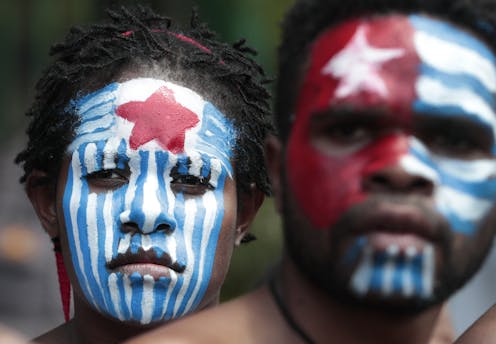
“Destroy them first. We will discuss human rights matters later.” These are the reported words of Bambang Soesatyo, chairman of the People’s Consultative Assembly to the Indonesian military (TNI), last month.
He was talking about the Indigenous people of the contested territory of West Papua, who are seeking independence from Indonesia. This has sparked concerns West Papua may again be on the brink of a violent crackdown — or worse — executed by Indonesia’s elite security forces, including the notorious Kopassus.
These have occurred before, for example, the well-documented massacres in the Baliem Valley in 1977-78 and on Biak Island in 1998.
The world said nothing about these events when they were happening — they were conducted out of public sight. If violence is committed again, the world cannot in clear conscience turn away.
Months of building tensions
The immediate catalyst for this latest military intervention was the fatal shooting of Brigadier General Gusti Putu Danny Karya Nugraha, head of Indonesian intelligence in Papua, on April 25. The act was claimed by members of the West Papua National Liberation Army, the TPN-PB.
Danny had been in the highlands region investigating the killing of two school teachers and a youth, who were accused by the TPN-PB of being Indonesian spies.
After the killing, President Joko “Jokowi” Widodo ordered state security forces “to chase and arrest” all armed militants and Bambang issued his threat to “crush” the rebels.
Read more: Riots in West Papua: why Indonesia needs to answer for its broken promises
We know, from recent accounts, what such revenge can look like.
In February, an Indonesian soldier was shot and killed by separatist fighters in the central highlands of Papua, and security forces went on the hunt for his killer. During their interrogation of residents of a village, they shot a young man, Janius Bagau, in the arm, shattering his bone.
His brothers accompanied him to a health clinic to seek medical attention. While there, the three men were allegedly tortured and killed, according to Janius’s wife, who was interviewed by Reuters.
The military claimed the men were members of TPN-PB — the armed wing of the broader separatist group called the Free Papua Movement (OPM) — and had tried to take the soldiers’ weapons and escape. However, a spokesman for the group said none of the men were members.
The killing of Danny, the head of Indonesian intelligence in Papua, is certain to result in similar retribution. In the wake of the shooting, the government formally declared Papuan separatists “terrorists”, which human rights groups warned could lead to more abuses.
The military also deployed 400 elite soldiers known as “Satan’s forces” to the region, who had previously taken part in operations in Timor-Leste and Aceh.
And a leading independence figure, Victor Yeimo, was arrested for alleged treason, sparking widespread protests across the restive region. At least two cities have been without internet service for weeks.
Displacement in the guise of development
In 1971, Papuans comprised over 96% of the population in the two provinces of Papua and West Papua, on the western side of the island they share with Papua New Guinea. Now, Papuans in urban centres and coastal regions make up less than half the population due to the inward migration of non-Papuan settlers in recent years.
Many Papuans believe they are facing a slow-motion genocide as they are progressively marginalised and their lands are forcibly expropriated for military-backed logging, oil palm and mining operations.
One major reason for the escalation of the conflict in recent years has been the policies pursued by Jokowi. He believes economic development will trump Papuan nationalism and has pushed accelerated development as a cure for the conflict.
Read more: Papua: how Indonesian president Jokowi is trying – and failing – to win hearts and minds
Chief among these projects is the construction of a highway through the highlands region to the coast that will “open up” the interior of Papua. These are the very regions where Papuans remain in the majority and retain some degree of control over their lives.
Where Jokowi sees economic development flowing from the road, the Papuans see more soldiers, logging and mining companies, and more Indonesian settlers. Three years ago, TPN-PB forces killed at least 24 Indonesian road workers whom they claimed to be Indonesian army spies in a bid to stop the construction of the road.
The area has been heavily occupied by the military ever since, resulting in the expulsion of some 45,000 people from their homes.
The Papuan fighters see the conflict as a legitimate war of national liberation against foreign invaders. The TPN-PB has reportedly signalled it may start targeting non-Papuan settlers if Papuan civilians are killed or injured in the military crackdown, which seems highly likely.
This opens up the horrifying possibility of inter-ethnic conflict between settlers and Papuans, which to date has been largely avoided.
Read more: Fight for freedom: new research to map violence in the forgotten conflict in West Papua
Indonesia successfully, albeit with great difficulty, resolved the other two armed conflicts that had troubled the nation for decades: Aceh (which remains as part of Indonesia) and Timor-Leste (which became independent). Through dialogue and foreign involvement, however, peace was finally achieved.
There has been no substantial dialogue between leaders in Jakarta and independence advocates in West Papua to date. The UN has been ineffectual in resolving the conflict, and the world, with the exception of some of the Pacific nations, has turned a blind eye.
While global attention has been riveted on Palestine, Myanmar and the plight of the Uyghurs in China in recent months, it is time to speak out against the atrocities unfolding on Australia’s door step.
Ronny Kareni, a West Papua Project expert advisor at the University of Wollongong, contributed to this report.
Authors: Jim Elmslie, Honorary Fellow, University of Wollongong
Read more https://theconversation.com/west-papua-is-on-the-verge-of-another-bloody-crackdown-161272