

Doctors have been blamed for the rise in black fungus in India, but the COVID treatment guidelines could be contributing
- Written by: Rajib Dasgupta, Chairperson, Centre of Social Medicine and Community Health, Jawaharlal Nehru University
One of the more recent and worrying consequences of COVID-19 in India is the emergence of mucormycosis and other fungal co-infections.
Media reports use black, white and yellow fungus to refer to mucormycosis, aspergillosis, candidiasis and cryptococcosis. Together, they are referred to as invasive fungal infections, and they usually infect people with an impaired immune system, or with damaged tissue.
Some 12,000 cases of mucormycosis have been reported across the country in recent months.
These are said to have been caused by misuse of steroids and antibiotics (which impair our ability to fight these fungal infections) in COVID treatments, and high numbers of patients with poorly controlled diabetes where tissue is damaged.
Mucormycosis most commonly manifests in the nose and sinuses, but from there can spread to the eyes, lungs and brain. It also affects other organs including the skin.
Wide-scale shortages of Amphotericin B, the mainstay therapy for mucormycosis, are being reported. Citizens have had to turn to social media and courts to procure the medicine.
The central government has granted approval to five companies to produce the drug, in addition to the six that already do so.
Could the situation have been averted? Perhaps, if the government had considered recent evidence and issued clear guidelines on using steroids and antiobiotics in treating COVID-19.
Read more: What is mucormycosis, the fungal infection affecting COVID patients in India?
What we knew before the second wave
Over the last year, COVID-19-associated invasive fungal infections have been reported from across several countries. In India, they were reported as early as April last year, during the first wave.
These infections have also been reported during previous epidemics such as SARS in 2003.
The infection is often fatal. Deaths due to the fungal infection in previous coronavirus outbreaks such as SARS ranged from 25% to 73%.
Read more: After early success, India's daily COVID infections have surpassed the US and Brazil. Why?
Antibiotic guidelines in India
The two most recent versions of COVID treatment guidelines in India (June 27, 2020 and May 24, 2021) rightly state antibiotics should not be prescribed routinely.
Instead, they urge doctors to consider “empiric” antibiotic therapy as per a “local antibiogram” when COVID patients have moderate secondary infections. Empiric antibiotic therapy implies making a diagnosis based on what the literature says is the most likely pathogen (or bug) causing the infection. Antibiograms are sent out to hospitals periodically and they describe the current infections circulating in the area and which antiobiotics work against them.
For severe secondary infections, the guidelines suggest conducting blood cultures to check which antibiotic might work, ideally before the medication is started.
An empirical approach can work effectively only if a majority of COVID facilities treating moderate cases have access to local antibiograms. If they don’t, doctors will usually end up prescribing broad-spectrum antibiotics. Broad-spectrum antiobiotics kill a range of bugs, rather than a specific one, which is risky because they can also kill the good bugs we use to fight off things like fungal infections.
A study of ten Indian hospitals found 74% of patients with secondary infections during the first wave were given antibiotics the World Health Organization has said should be used sparingly, and another 9% received antibiotics that were not recommended.
The guidelines should advise the same procedure for moderate and severe cases, that is, to conduct blood cultures before starting patients on antimicrobial therapy to ensure the antibiotics will work, and that they won’t lead to a secondary fungal infection.
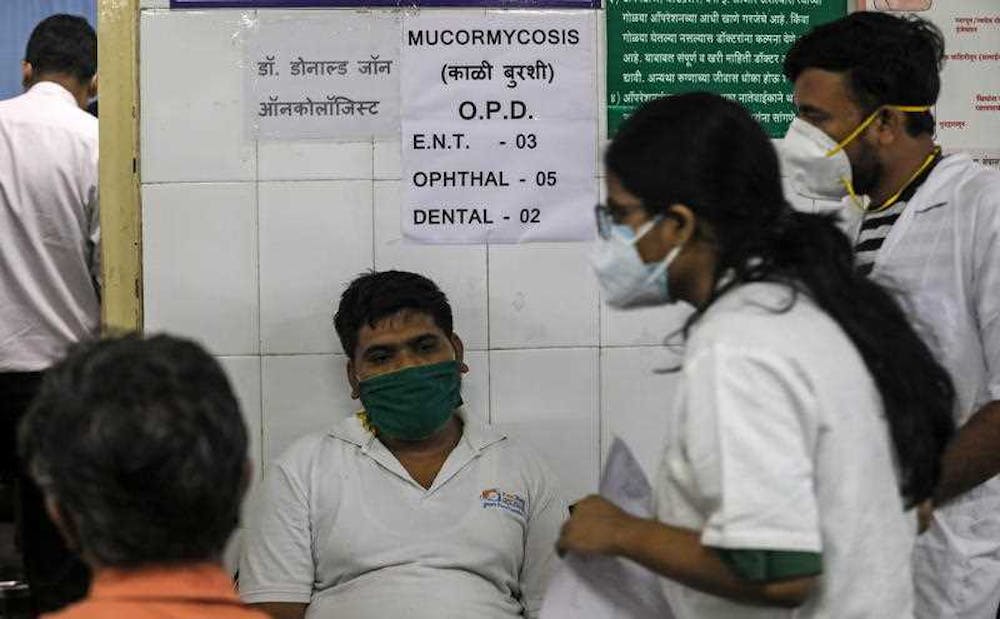 A suspected mucormycosis patient waits to be examined.
DIVYAKANT SOLANKI/EPA
A suspected mucormycosis patient waits to be examined.
DIVYAKANT SOLANKI/EPA
Steroid dosage too high
One of the recommended COVID treatments of the National Institute of Health in the US is 32mg a day of the steroid methylprednisolone.
In March 2020, Indian guidelines for treatment recommended 1-2mg methyprednisolone per kilo of body weight for patients with severe symptoms (so 70-140mg for a 70kg person).
This was updated in June 2020 with a lower dose of methylprednisolone (35–70mg per day for a 70kg person) for three days for moderate cases and the original recommended dose (70–140mg per day for a 70kg person) for five to seven days for severe cases.
The most recent guideline of April 2021 does not alter the dosage per day but recommended an increased duration of therapy, five to ten days, for both moderate and severe cases.
Despite that, the Indian recommendation still works out to a wide range across moderate and severe categories — from a low of about 35 mg to a high of 140 mg (for a 70kg person). This is in sharp contrast to the 32mg (total daily dose) recommendation in the US.
Indian government spokespersons have attributed the rise in fungal infections to the fact doctors in the country may have irrationally used steroids.
But given the government’s own guidelines for steroid use are so much higher than in other countries, there should be analysis into whether this may be contributing to the significant rise in fungal infections.
Those findings would have profound implications on India’s pandemic management.
Authors: Rajib Dasgupta, Chairperson, Centre of Social Medicine and Community Health, Jawaharlal Nehru University


















