

Why is everyone so obsessed with going to Mars? Here are some other worlds ripe for exploration
- Written by: Gail Iles, Senior Lecturer in Physics, RMIT University
Last month, China successfully landed and deployed the ‘Zhurong’ rover on Mars, becoming the second country ever to set wheels on the surface of red planet.
Last year the United States, the United Arab Emirates and China all launched missions to Mars, taking advantage of the relatively short journey time offered by the two planets’ unusually close proximity.
Why are planetary scientists so obsessed with Mars? Why spend so much time and money on this one planet when there are at least seven others in our solar system, more than 200 moons, countless asteroids, and much more besides?
Fortunately, we are going to other worlds, and there are lots of missions to very exciting places in our solar system — worlds bursting with exotic features such as ice volcanoes, rings of icy debris, and huge magnetic fields.
There are currently 26 active spacecraft dotted around our solar system. Some are orbiting other planets and moons, some have landed on the surfaces of other worlds, and some have performed fly-bys to beam back images. Only half of them are visiting Mars.
Included in those 26 spacecraft are long-term missions like Voyager 1 and 2 - which are still operational after over 40 years and have now left the Solar system and ventured into interstellar space. And it also includes some less famous, but no less weird and wonderful, spacecraft.
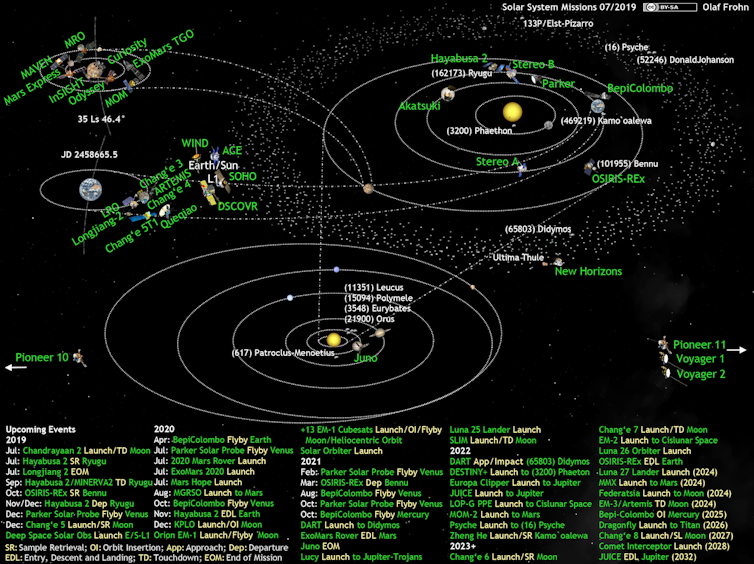 Active space probes in the Solar System.
By Olaf Frohn - http://www.planetary.org/multimedia/space-images/charts/whats-up-in-the-solar-system-frohn.html (image link), CC BY-SA 3.0, https://commons.wikimedia.org/w/index.php?curid=80963751
Active space probes in the Solar System.
By Olaf Frohn - http://www.planetary.org/multimedia/space-images/charts/whats-up-in-the-solar-system-frohn.html (image link), CC BY-SA 3.0, https://commons.wikimedia.org/w/index.php?curid=80963751
Take the Juno spacecraft in orbit around Jupiter, for example. Launched in 2011, it arrived in orbit around Jupiter almost five years later. It is now measuring various properties of the giant planet, including its magnetic field, atmospheric conditions, and determining how much water is in Jupiter’s atmosphere. This will help theorists work out which planet formation theory is correct (or if new theories are needed). Juno has already surpassed its planned seven-year mission duration, and has been extended to at least 2025.
Rocky ride
One of the most complex feats of astrodynamics was completed late last year when the Japanese Space Agency (JAXA) not only landed a spacecraft on an asteroid, but in a spectacular slingshot manoeuvre, returned a sample to Earth.
Hayabusa2, named after the Japanese term for a peregrine falcon, completed a rendezvous with asteroid 162173 Ryugu in 2018, surveying the surface and taking samples.
Departing in 2019, Hayabusa2 used its ion engines to change orbit and return to Earth. On December 5, 2020, a sample-return capsule about the size of a hatbox and weighing 16 kilograms was dropped through Earth’s atmosphere, landing unscathed at the Woomera Test Range in Australia.
As JAXA begins analysing the rocks and dust collected on the Ryugu asteroid, Hayabusa2 is off on its travels once more - this time to meet up with a second asteroid, 1998 KY_(26), some time in 2031.
Well of knowledge
Not included in the list of planetary missions earlier, are those spacecraft trapped in “gravitational wells” within our Solar system.
There are special locations in orbits called “Lagrangian points”, which are gravitationally balanced spots between two bodies.
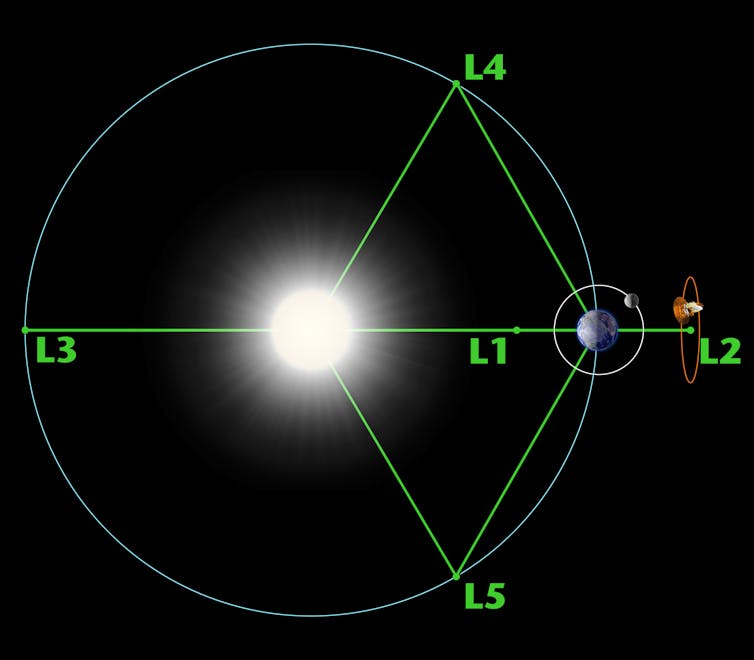 ‘Lagrange Points’ are positions in space where the gravitational forces of a two body system like the Sun and the Earth produce enhanced regions of attraction and repulsion. These can be used by spacecraft to reduce fuel consumption needed to remain in position.
NASA/WMAP Science Team
‘Lagrange Points’ are positions in space where the gravitational forces of a two body system like the Sun and the Earth produce enhanced regions of attraction and repulsion. These can be used by spacecraft to reduce fuel consumption needed to remain in position.
NASA/WMAP Science Team
The Solar and Heliospheric Observatory (SOHO) is one of four spacecraft close to the Lagrangian point between the Earth and the Sun, roughly 1.5 million kilometres from Earth (about four times further away than the Moon).
It makes observations of the Sun’s outer layer and the solar wind, sending early warning back to Earth of potentially disastrous space weather. Geomagnetic storms from the Sun are powerful enough to hit the Earth with electromagnetic blasts so strong they have been known to take out country-wide power grids.

Another hostile location is our nearest planetary neighbour, Venus. Despite the searing temperatures and crushing pressures on the surface, NASA recently approved funding for two big missions to explore the origins of Venus and its atmosphere. The discovery of phosphine gas in the upper atmosphere led life scientists to believe life may exist at the more habitable and cooler temperatures of higher altitudes.
Hot on the heels of the successful flight of the Ingenuity helicopter on Mars — the first flight of any powered aircraft on another world — NASA’s Dragonfly mission will fly a drone through the atmosphere of Saturn’s icy moon, Titan. Launching in 2026 and arriving in 2034, the rotorcraft will fly to dozens of promising locations on Titan looking for any chemical precursors or life similar to those on Earth.
So how much does all this cost?
Governments tend to allocate relatively small amounts of their budgets to science and space exploration. Countries typically spend less than 1% of their budget on space missions — far less than social services or military defence.
Deciding what space missions will receive that money is very often driven by public interest. But trying to decide definitively which probe or spacecraft offers the most bang for buck is almost impossible.
When humans first set foot on the Moon, 25% of the world’s population watched the video with bated breath, inspiring several generations of space explorers for decades afterwards. You can’t put a price on that.
Authors: Gail Iles, Senior Lecturer in Physics, RMIT University


















