

What if I can't get in for my second Pfizer dose and the gap is longer than 3 weeks?
- Written by: Nathan Bartlett, Associate Professor, School of Biomedical Sciences and Pharmacy, University of Newcastle
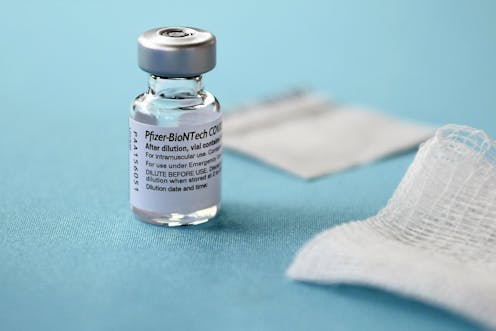
Bookings for the first dose of the Pfizer vaccine have been halted in Victoria this week, amid shortages of the vaccine.
Some Victorians who’ve had their first Pfizer dose already will need to wait six weeks to get their second.
Some people are wondering if it’s OK to get their second Pfizer shot beyond the recommended three week gap between their first and second dose.
And yesterday, the federal government recommended the Pfizer vaccine as the preferred vaccine for people under 60. Previously, it was only recommended for people below 50. This will place even more pressure on our currently limited supply of Pfizer vaccine, and could lead to wait times being longer than three weeks for some.
Read more: What are the side effects of the Pfizer vaccine? An expert explains
The good news is, you can wait up to 12 weeks between your first and second dose of the Pfizer vaccine. In fact, some preliminary evidence suggests you might get even stronger immunity with a longer wait time.
The only downside is you’re at risk from the virus the longer you wait for your second dose.
So the improved immunity conferred from waiting longer must be weighed against the risk of contracting COVID in the meantime.
You can wait longer than three weeks
The Australian Technical Advisory Group on Immunisation (ATAGI) recommends a minimum of three weeks between the first and second Pfizer dose. However it says this gap can be extended to up to six weeks.
The minimum time to establish immune memory following first exposure to a new vaccine is roughly three weeks. This is the minimum time, but waiting longer between the first and second jab is absolutely fine in terms of efficacy.
This makes sense based on what immunology experts understand about our immune response to vaccines.
By about two weeks after vaccination, adaptive immunity has kicked in. This involves immune cells called T and B cells working together to produce antibodies that target the SARS-CoV-2 spike protein, and are able to block infection.
At this stage, some of these become “memory” immune cells, and by about the third week they have established immune memory. This means these virus-recognising cells are on hand to rapidly respond if we are exposed again.
If that exposure is via a second immunisation, this will boost the immune response to the vaccine and increase immune memory, which in turn enhances protection against the virus.
Read more: How long do COVID vaccines take to start working?
The secondary immune response is faster and bigger because you have a pool of memory immune cells primed and ready to jump into action. The memory response is also faster, so by two weeks after the second jab, protection has significantly increased.
You’re not fully protected against COVID until about seven to 14 days after the second Pfizer dose.
Waiting longer might be even better
Many vaccines confer improved protection with longer gaps between doses, and preliminary data suggests this seems to be the case with Pfizer too.
One pre-print study, yet to be peer reviewed, suggests waiting 11-12 weeks for the second Pfizer dose actually produces an even more potent antibody response in people over 80.
The levels of antibodies in people who waited 12 weeks for their second dose were 3.5 times higher than those whose gap was three weeks.
What are the risks of waiting?
We must remember the level of protection isn’t the only consideration. The time it takes to get there is also important. Delaying the second dose increases the time it takes for you to achieve a high level of immunity, and therefore increases your susceptibility to infection, and risk of COVID.
One dose does provide some protection from severe COVID, but not enough, which means you can still become infected and transmit the virus to others. Preliminary data suggests one Pfizer dose provides only 33% protection against the Delta variant, while two doses confers 88% protection.
However, this risk must be weighed against the risk of contracting COVID in Australia currently. Community outbreaks are relatively contained, so the risk in between doses is not as high as it is during periods of rampant transmission.
In saying that, as we’ve seen from Victoria’s recent lockdown and new cases in Sydney this week, COVID transmission is still smouldering in Australia and we must not let our guard down yet. In this context it’s important everyone who can get vaccinated does, and as soon as possible.
Authors: Nathan Bartlett, Associate Professor, School of Biomedical Sciences and Pharmacy, University of Newcastle


















