

Victoria's wild storms show how easily disasters can threaten our water supply
- Written by: Ian Wright, Senior Lecturer in Environmental Science, Western Sydney University
The wild storms that recently raged across eastern Victoria caused major property and environmental damage, and loss of lives. They’ve also triggered serious water contamination incidents.
Yarra Valley Water issued an urgent health warning to not to drink tap water — not even if it’s boiled — in three affected suburbs: Kalista, Sherbrooke and The Patch.
So what caused this incident? Yarra Valley Water says the severe weather led to an equipment failure, with potentially unsafe water entering the drinking water system.
I spoke to the water authority about the nature of the contamination, and they did not provide any more detail. But based on my three decades of experience in the water industry, I can offer some insight into how disasters create contamination crises, and Australia’s vulnerabilities.
Does boiling water help?
Despite recent health warnings, it’s worth pointing out that Australia’s water supply is generally safe and reliable, with few exceptions. Still, this is hardly the first time disasters have disrupted water supply, whether from droughts, storms and floods, or bushfires.
For example, the Black Summer bushfires damaged water supply infrastructure for many communities, such as in Eden and Boydtown on the south coast of New South Wales. The Bega Valley Shire Council issued a boil water notice, as the loss of electricity stopped chlorinating the water supply, which is needed to maintain safe disinfection levels.
Boil water alerts indicate harmful pathogens may be present in the water, and you should boil water for at least one minute to kill them.
Read more: Better boil ya billy: when Australian water goes bad
In inland and remote communities, drinking water contamination can be more common and very difficult to resolve.
For example, many remote Western Australian towns have chronic water quality problems, with drinking water often failing to meet Australian standards. And in 2015, the WA Auditor General reported the water in many Indigenous communities contains harmful contaminants, such as uranium and nitrates.
The source of this contamination is often naturally occurring chemical compounds in the local geology of ground water supplies.
One of the biggest contamination incidents in Australia occurred in August and September in 1998. A series of extreme wet weather events after a long drought triggered the contamination of Sydney’s drinking water with high levels of protozoan parasites, which can cause serious diseases such as gastroenteritis or cryptosporidiosis. It resulted in boil water alerts across much of the Sydney metropolitan area.
 A damaged house in Kalorama, Melbourne, after wild storms raged across Victoria.
AAP Image/Daniel Pockett
A damaged house in Kalorama, Melbourne, after wild storms raged across Victoria.
AAP Image/Daniel Pockett
But what makes this latest incident in Victoria so concerning is that authorities have warned even boiling will not reduce contamination. This suggests contamination may be due to the presence of a harmful chemical, or high levels of sediment particles.
Sediment in water — measured as “turbidity” — can be hazardous because these particles can hold other contaminants, or even shield pathogens from disinfection.
Yarra Valley Water’s advice for the affected suburbs is to avoid using water in any cooking, making ice, brushing teeth or mixing baby formula, and for people to take care not to ingest water in the shower or bath. Emergency drinking water is being supplied by Yarra Valley Water in some locations.
So why do disasters threaten our drinking water?
This latest incident is another reminder that our drinking water is vulnerable to disruption from extreme weather.
This is almost certain to continue, and worsen, as the the Bureau of Meterology’s State of the Climate 2020 report predicts more extreme weather — including drought, heatwaves, bushfires, storms, and floods — in Australia’s future.
As these disasters become more frequent and extreme under climate change, impacts on water supplies across Australia are likely to become more destructive.
A good example of how this can unfold was the impact on Canberra’s water supply after the destructive 2003 bushfires.
Fire burned most of the region’s Cotter River catchments, which hold three dams. After fires went out, massive storms eroded the weakened ground, and washed ash, soil and organic debris into the storage reservoirs. It took years for the water supply system to fully recover.
Physical damage to water infrastructure is also a big risk, as modern water supplies are large and complex. For example, a fallen tree could break open the roof of a sealed water storage tank, exposing water to the elements.
Interruptions of electrical supplies after extreme weather are also common, leading to failures of water supply technology. This, for instance, could stop a water pump from operating, or break down the telemetry system which helps control operations.
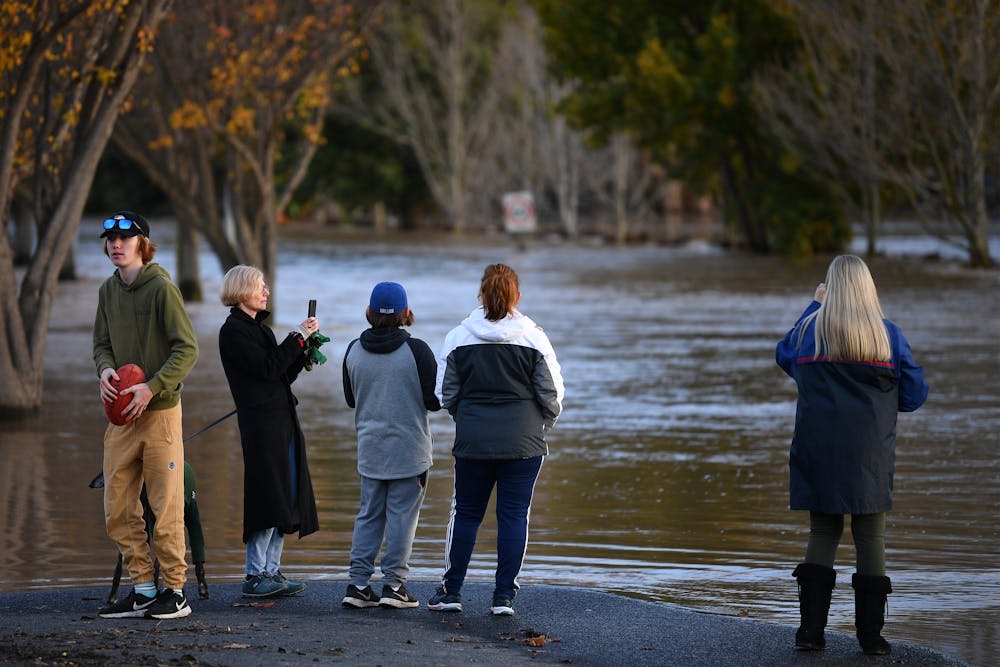 Storms can wash debris and sediment into water supplies.
AAP Image/James Ross
Storms can wash debris and sediment into water supplies.
AAP Image/James Ross
As difficult as these hits to Australia’s water security are, and will be in future, it’s even more problematic in the developing world, which may not have the resources to recover.
How can we withstand these challenges?
To maintain optimal water quality, we must protect the integrity of water catchments — areas where water is collected by the natural landscape.
For example, damaging logging operations along steep slopes in Melbourne’s biggest water catchment threatens to pollute the city’s drinking water because it increases the risk of erosion during storms.
Read more: Logging must stop in Melbourne's biggest water supply catchment
There’s also merit in Australian cities investing in advanced treatment of wastewater for reuse, rather than build infrequently used desalination plants for when there’s drought.
Australia could follow the US state of California which has ambitious targets to reuse more than 60% of its sewage effluent.
And it’s completely safe — Australia has developed guidelines to ensure recycled water is treated and managed to operate reliably and protect public health.
Read more: Why does some tap water taste weird?
If you’re concerned about water quality from the tap and haven’t received any alerts, you might just not like its taste. If in doubt, contact you local water supplier.
This story is part of a series The Conversation is running on the nexus between disaster, disadvantage and resilience. It is supported by a philanthropic grant from the Paul Ramsay foundation. You can read the rest of the stories here.
Authors: Ian Wright, Senior Lecturer in Environmental Science, Western Sydney University


















