

New Zealand approves Pfizer vaccine for young people from 12 to 15, but they'll have to wait their turn
- Written by: Michael Plank, Professor in Applied Mathematics, University of Canterbury
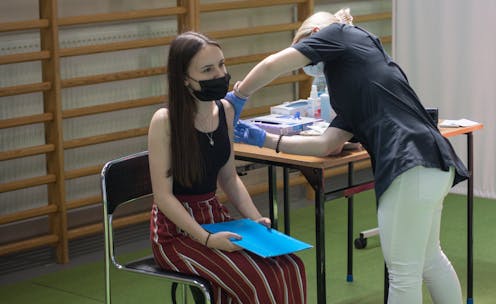
New Zealand’s medicines regulator Medsafe has granted provisional approval of the Pfizer vaccine for youth aged 12 to 15, and Prime Minister Jacinda Ardern expects cabinet approval to follow next week.
Once cabinet approves, 12-15-year-olds will become eligible for vaccination towards the end of the year, after older groups have had their turn.
Although children are at lower risk of serious illness or death from COVID-19 than older people, it is still essential to vaccinate them for two reasons.
First, if children catch the virus they can spread it to other people, including higher-risk groups or people who can’t be vaccinated for medical reasons. Several countries have seen outbreaks start in young people and spread into older age groups, causing significant hospitalisations and deaths.
Second, although the risk of death is very small, children can still suffer significant long-term health complications as a result of COVID-19, often known as long COVID. This has been shown to affect a significant proportion of people, even in younger age groups.
Read more: Long COVID in children: what parents and teachers need to know
The Medsafe approval is based on solid data showing the vaccine is safe and highly effective for this age group. It follows similar moves in Europe, the US and Canada.
Vaccinating teenagers reduces their risk of getting sick and of passing the virus to others. By getting vaccinated, we are protecting not only ourselves, but also those around us.
How children fit into New Zealand’s rollout plan
In New Zealand, 265,000 children are in the 12-15 age group, accounting for just over 5% of the population. Add that to the 80% who are older than 16, and the Pfizer vaccine now has Medsafe approval for use in 85% of the population. This is good news because we will need really high vaccination rates to have a chance of reaching population immunity (sometime called herd immunity).
The vaccine is not mandatory and it’s likely not everyone will want to take it. This means we might need to vaccinate some children in younger age groups. Trials are currently underway to assess if the vaccine is appropriate for children aged six to 11. Director General of Health Ashley Bloomfield said Medsafe would consider the trial results once available.
There is a strong relationship between age and risk of severe COVID-19. It makes sense for the general rollout to start with older people and gradually work through the age groups, as Ardern announced last week. There may be exceptions — teenagers living with border workers or who have underlying health conditions could be offered the vaccine earlier in the rollout.
There are also other risk factors. We know that as a result of longstanding systemic racism in the healthcare system, Māori and Pacific people are at higher risk of needing hospital treatment for COVID-19. Therefore, an equitable rollout should ensure Māori and Pacific communities are prioritised for early access to the vaccine.
Read more: Research shows Māori are more likely to die from COVID-19 than other New Zealanders
Moving towards collective immunity
At the moment, New Zealand’s population is like a pile of dry kindling: sparks of COVID-19 from countries around the world are constantly threatening to set it ablaze. Vaccinating our population is like dousing that kindling pile with a hose.
To begin with, the wood is still dry enough that a spark landing in the wrong place could set it alight. But eventually, once the wood is wet enough, there might be a bit of smouldering here and there, but the fire won’t be able to take off.
The government has laid out its side of the bargain: the plan is to offer the vaccine to everyone by the end of the year. Ardern said New Zealand’s pre-purchase orders of the Pfizer vaccine will deliver enough doses during the rest of the year to offer two doses to 12-15-years-olds without anyone else missing out.
Now it’s up to all of us to do our bit and get vaccinated when our turn comes. Everyone who gets vaccinated is making a contribution to our collective immunity against the virus.
The higher we can get our collective immunity, the better protected we will be as a community, and the more options we’ll have for safely allowing international travel to resume. Vaccinating young people will be an important part of this effort and this latest announcement marks a significant step on the long journey towards the end of the COVID-19 pandemic.
Authors: Michael Plank, Professor in Applied Mathematics, University of Canterbury


















