

What's Australia's first local Pfizer-style COVID vaccine? And when might it be in our arms? An mRNA expert explains
- Written by: Archa Fox, Associate Professor and ARC Future Fellow, The University of Western Australia
Australia has struggled to get enough Pfizer doses to meet Australians’ growing demand for COVID-19 vaccinations.
Australia has been producing doses of AstraZeneca since March, but this vaccine is no longer recommended for those aged under 60 because of the small but serious risk of clotting.
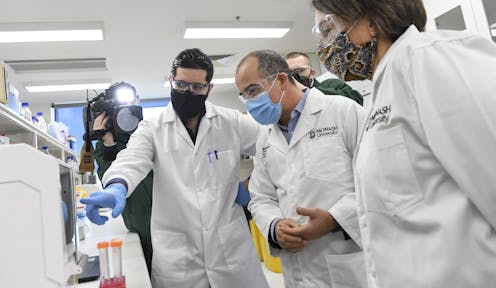
Now a research team at Monash University, led by Professor of Pharmaceutical Biology Colin Pouton, hopes to develop a new mRNA vaccine, which works by the same principles as the Pfizer vaccine, and could be manufactured locally.
So how would the vaccine work? What hurdles do the researchers need to overcome to make it a reality? And when could it become available?
It’s based on existing technology
Before COVID, the researchers were developing mRNA vaccines against a variety of viruses and diseases, and testing the technology in mice. After the pandemic hit, they pivoted their skills and technology and started work on an mRNA vaccine against COVID-19.
The vaccine is an mRNA vaccine, like the ones by Pfizer and Moderna. These vaccines prompt your body to produce the virus’ spike protein, to which your immune system makes antibodies against.
But the Monash mRNA vaccine is a little bit different, as it directs our cells to only make a small part of the spike protein, the “receptor binding domain”, which is the most important part allowing the virus to enter our cells.
The receptor binding domain, or tip of the spike protein, is also the part that’s quickly mutating to form the different variants of concern. Directly targeting this part makes sense to get the most variant-specific response.
How do mRNA vaccines work again?
MRNA vaccines work as instructions, telling our cells to make certain proteins. If these proteins are foreign to our bodies, our immune system will recognise them and mount an immune response. Over time, immune memory is developed, meaning when we encounter the virus, our immune system will clear it.
The researchers began modelling the vaccine off the original strain of the virus, first discovered in Wuhan. But they’ve since adjusted their sequence to model the shot off the Beta variant, first discovered in South Africa. This adjustment was made partly because the neutralising antibodies from patients infected with the Wuhan strain are least effective against the Beta variant.
Our current crop of approved COVID vaccines protect well against the Alpha variant, first found in the United Kingdom, and the Delta variant, first discovered in India. But because the Beta variant is good at evading immunity from vaccines, it’s more likely than most other variants to surge when vaccine protection begins to wane.
For these reasons, there’s a stronger clinical need for Beta variant vaccines.
This quick adjustment of the sequence demonstrates how flexible the mRNA technology is. It’s easy to change the sequence of the vaccine to adapt to new variants of the virus that have emerged, and might emerge in future. This ability to quickly change the sequence is similar for DNA vaccines like AstraZeneca, but harder for traditional and protein-based vaccines.
As with all other mRNA vaccines, the RNA will be broken down in the body over the course of a day or so. The vaccine doesn’t stay in your body over the long term. You gain immunity as your immune system learns how to respond to the short burst of proteins your body makes. When you get the second dose of mRNA vaccine, the immune memory is reinforced.
The group has tested this vaccine in mice, and says its results are really promising.
Based on these pre-clinical results, the Victorian government has given the project A$5 million. The money has come out of a A$50 million research fund earmarked to support local mRNA vaccine development.
The A$5 million will help pay for a manufacturer in Europe to make a sufficient amount of the mRNA for the phase 1 trials. This material will then be shipped via ultra-cold storage to Australia, and a local company is going to package the RNA into “lipid nanoparticles” which allows the mRNA to get into human cells.
What are the next steps?
Phase 1 trials to check the vaccine is safe in humans will begin in October or November this year, and will initially include 150 volunteers.
If the vaccine passes this trial, it will move to phase 2 and 3 trials which require tens of thousands of participants. The primary aim of these later stage trials will be to see if the vaccine can reduce the severity of COVID-19 disease, while also checking it’s still safe.
These later stage trials are quicker to complete if conducted in areas with (unfortunately) high community transmission. One reason we saw Pfizer and Moderna’s vaccines approved so quickly was because trials took place in countries where the virus was rampant. If and when this vaccine goes to phase 2 and 3 trials, Australia will hopefully not be in a situation with widespread transmission. So the team may need to involve international partners and recruit participants overseas.
Read more: What if I can't get in for my second Pfizer dose and the gap is longer than 3 weeks?
However, there may also be alternative metrics to measure how well a vaccine is working. Researchers can look at study volunteers’ blood to see how many, and the type of, antibodies they’re producing. This could work as a proxy for measuring efficacy. But it’s not clear if Australia’s drug regulator, the Therapeutic Goods Administration, would approve the vaccine without the traditional exposure model.
The team will also compare their mRNA vaccine directly with Pfizer, in a side-by-side comparison, to see how stable it is and how well it elicits antibodies against the virus.
So when can we get it into our arms? It’s uncertain how long the full suite of trials will take, but probably not for a couple of years. It’s possible the vaccine will not make it past phase 1 or 2 trials, although with the similarity in methodology to the Pfizer and Moderna vaccines, both of which are safe, this is less likely.
Why we need Australian-made vaccines
This is an important step in developing Australia’s sovereign capacity for mRNA vaccine production, and for the newly developing Australian RNA biotechnology sector as a whole. It’s likely we’ll need booster shots for some years to come, so we need to develop local manufacturing capability.
I sincerely hope it’s successful, but even if it’s not, it’s creating a pipeline for onshore mRNA vaccine development.
What’s more, mRNA vaccines are the new gold standard and the next generation vaccine technology. It’s likely we’ll see more pandemics and novel viruses in future, so that adds to the argument for having local mRNA vaccine capacity.
We don’t know how much the federal government paid for the Pfizer and Moderna vaccines, but it’s likely to have been much more costly than making it here. If we can make it ourselves more cheaply, we’re at a real advantage.
Authors: Archa Fox, Associate Professor and ARC Future Fellow, The University of Western Australia


















