

Self-collected cervical screening is a great way to prevent cervical cancer. How can we get more people doing it?
- Written by: Nicola Creagh, Research Assistant in Evaluation and Implementation Science, Centre for Health Policy, Melbourne School of Population and Global Health, The University of Melbourne
Cervical cancer is a preventable cancer — most cases are caused by long-term infection with high-risk types of human papillomavirus (HPV).
Screening aims to detect types of HPV associated with cervical abnormalities and cancer. Early detection allows preventative treatment, so cancer doesn’t develop.
Cervical screening is a reasonably invasive procedure, which requires a doctor or nurse to do a pelvic examination and insert a speculum, a medical tool used to help examine the cervix.
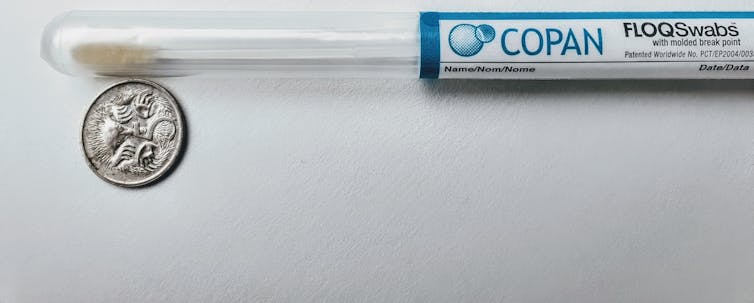
Since 2017, many Australian women have had access to “self-collection”, whereby they can collect their own vaginal sample using a small, soft swab (similar to the ones used to collect a COVID test). But many women who are eligible don’t know it’s an option.
Read more: Never had a Pap smear? Now there's a DIY option for you
Our new study, published today in the Medical Journal of Australia, found many women prefer this option, and doctors and nurses like having it available.
However, it’s significantly underused in Australia. Between 2017 and 2019, only 6,000 of these tests were conducted, out of an estimated one million women eligible.
To prevent as many cases of cervical cancer as possible, we need to find out why this option is being used so rarely, and how can we increase access.
Wait, what’s cervical screening again?
In 2020, the World Health Organization (WHO) called on countries to progress towards the elimination of cervical cancer as a public health problem.
Australia is considered a global leader in preventing cervical cancer. We have an effective HPV vaccination program delivered through schools, and a longstanding cervical screening program.
 Only 6,000 of one million eligible women used self-collection in cervical screening in 2017-2019.
VCS Foundation, Author provided
Only 6,000 of one million eligible women used self-collection in cervical screening in 2017-2019.
VCS Foundation, Author provided
Having HPV won’t necessarily cause cancer. There are more than 100 types of HPV, and only 14 are associated with it. Having HPV at some point in your life is quite normal. We just need to make sure we pick up any types of HPV associated with cervical cancer.
In Australia, women (and people with a cervix) aged 25-74 are invited to have a cervical screening test every five years. This more accurate test replaced the “Pap” test in December 2017, which used to be recommended every two years.
We know women find the test uncomfortable. For many, other barriers — such as past trauma or cultural sensitivity — prevent them having the test.
In Australia, 72% of cervical cancer cases occur in women who are overdue for screening, or who have never been screened. This is concerning, considering only 55% of 35-year-old women have been screened at least once with an HPV test. This is below the WHO’s elimination target of 70% by 2030.
How does self-collection work?
In December 2017, Australia introduced a new screening option where women could take their own samples. This option is only available to women who:
are over 30 years old
are more than two years overdue (so four or more years since their last Pap test)
or who have never been screened
and decline a traditional test.
A self-collected test still requires a consultation with a doctor or nurse. But in this supported environment, a woman can collect her own sample.
Self-collection is as accurate as the sample collected by a doctor or nurse. Australian modelling studies suggest self-collection can save lives.
About 6% of people who test positive for some types of HPV need to return to their doctor or nurse for a traditional test to look for cell changes. So the main downside is a small percentage of people who’ve done self-collection will also need to return for a traditional test. Another roughly 2% of women will require referral to a specialist for further assessment.
Both women and health-care providers support self-collection
Data from overseas suggest self-collection is an effective way to screen women who traditionally haven’t been screened enough (or at all).
One Australian study demonstrated 85% of under-screened women who were offered self-collection opted to screen.
Our work with Victorian Aboriginal women indicates self-collection is key to improving the accessibility and acceptability of cervical screening. A review assessing progress towards elimination of cervical cancer for Indigenous people in high-income countries highlighted the critical role that self-collection is likely to play in increasing participation in cervical screening.
Read more: Five myths about the new cervical screening program that refuse to die
Our new study was done in collaboration with cervical cancer prevention organisation the VCS Foundation and the Victorian government. It provides the first insight into what women and doctors and nurses thought about their experience of using self-collection.
Women appreciated the availability of an alternative option — one that addressed many of their barriers. Doctors and nurses regarded self-collection as a “progressive” change, and thought self-collection was effective at re-engaging those who decline a traditional test.
Why is self-collection being used so rarely?
Our study also identified barriers making it difficult for doctors and nurses to use or offer the option of self-collection.
Doctors and nurses found it difficult and time-consuming to determine whether women fit the eligibility criteria. They said it took too long for them to work out who was eligible.
Some doctors and nurses were uncertain about the process. For example, many were unclear whether women could take the test home to complete (they can). This reduced some doctors’ and nurses’ confidence in offering self-collection.
This lack of confidence is consistent with another Australian study, which found only 59% of doctors and nurses were confident in discussing self-collection and only 36% believed the test was reliable.
4 ways to increase access
It’s important we increase access to self-collection. This can be achieved through addressing four main points.
First, we need to remove the restrictive eligibility criteria. We’re encouraged the Medical Services Advisory Council recently recommended giving all women the choice of collecting their own sample. We eagerly await the federal government’s decision regarding this recommendation.
Second, we need more education for doctors and nurses to increase their confidence in offering self-collection. This should include clearer guidelines for them.
Third, more HPV tests need to be approved for use with self-collection samples, enabling more pathology labs to process them.
Fourth, we need the National Cervical Screening Program, general practitioners, and nurses and community health organisations to more widely communicate and promote the self-collection option. Women who are hesitant to be screened should know there’s another option.
Increasing access to self-collection is critical to increasing equity in Australia’s screening program. We have the tools to create equity and eliminate cervical cancer as a public health problem in Australia. We need to use them.
Authors: Nicola Creagh, Research Assistant in Evaluation and Implementation Science, Centre for Health Policy, Melbourne School of Population and Global Health, The University of Melbourne


















