

Australia's China policy can't be based on paranoia or corporate interests — there is a better way
- Written by: David Brophy, Senior Lecturer in Modern Chinese History, University of Sydney
This is an edited extract from China Panic: Australia’s Alternative to Paranoia and Pandering, by David Brophy
Things could always be worse in Australia–China relations, but on both sides, analysts see a rift too deep to be mended anytime soon.
Leaders of the two countries have not held prearranged talks since 2016, ministers since 2018. Chinese officials now impose informal sanctions and bans on Australian exports on a regular basis, plunging some industries into crisis and spooking many of the rest.
Ostensibly, it was Australia’s call for China to admit an international investigation into the origins of COVID-19 that triggered China’s ongoing trade retaliation. But the truth is China is responding to a range of measures that represent a wholesale shift in the way Australia views it. Security laws, foreign investment decisions, raids on Chinese journalists – the list is long.
The combined effect of all these measures has been to cultivate an image of China as a uniquely dangerous country, with which business as usual cannot go on. China has got that message and is now taking its business elsewhere.
We’ve got ourselves into a position where serious debate as to the rationale for, and wisdom of, Australia’s foreign and domestic policies involving China is becoming hard to have. We need to get ourselves out of it.
Read more: Why the Australia-China relationship is unravelling faster than we could have imagined
Security agencies and backbencher ‘wolverines’
Historians will eventually have a more precise picture of how Australia entered onto this path, but we can say with some confidence that security agencies have led the way.
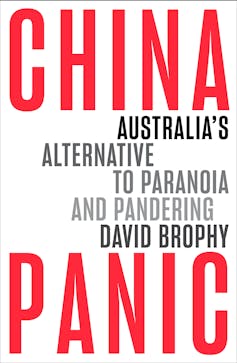 China Panic, Black Inc. Books.
An inter-agency inquiry chaired by prime ministerial adviser John Garnaut has been widely cited as the catalyst for Malcolm Turnbull’s policy shift. ASIO has itself taken on an increasingly public role, issuing warnings from 2017 onwards that foreign interference was occurring at “an unprecedented scale” in Australia.
The Australian Strategic Policy Institute (ASPI) has likewise been assiduous in talking up risks from China. Headed by Peter Jennings, who advised John Howard on intelligence leading up to the Iraq War, ASPI has often been the brains behind Australia’s interventionist policies in the Pacific and the Middle East, and now serves as a clearing house for “get tough” strategies towards China.
Backbenchers from the right wings of both major parties have openly embraced the new mood, adopting the “Wolverines” moniker from the 1980s film Red Dawn.
While that image calls to mind plucky young Cold Warriors putting up a last-ditch defence, the definition of “security” that Australia’s hawks work with often extends well beyond the Australian continent and its maritime frontiers, making the line between defensive and offensive measures a blurry one.
Paul Monk, one-time director of China analysis for the Defence Intelligence Organisation, recently outlined a five-step plan to push back against Beijing. He advises Australia to configure its “information warfare capabilities” for offence, which will include “talking up the attractive prospects for a more open and tractable China”.
The definition of “tractable”, of course, is “easy to control or influence”. It’s notable that those most exercised by foreign influence are often the most interested in exercising it.
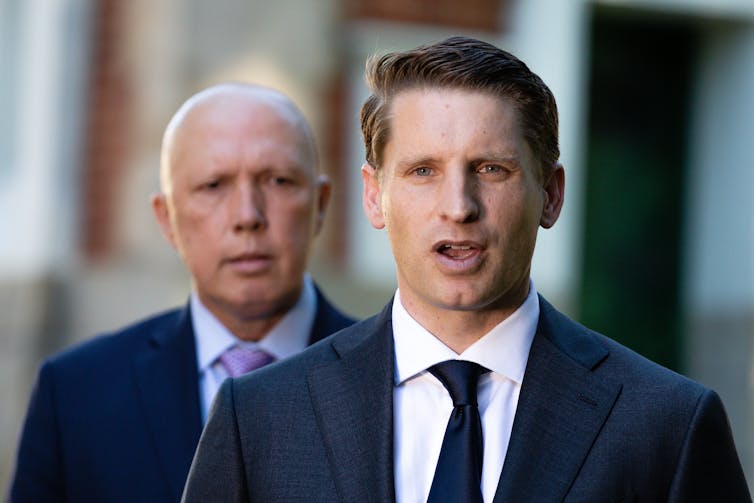 MP Andrew Hastie has called on the west to wage its own ‘hybrid and political warfare’ against its adversaries.
Richard Wainwright/AAP
MP Andrew Hastie has called on the west to wage its own ‘hybrid and political warfare’ against its adversaries.
Richard Wainwright/AAP
‘Selling out for the national interest’
In the economic sphere, meanwhile, those who first guided Australia’s liberalisation and turn to Asia remain bullish on China and champion trade multilateralism as the alternative to what they see as America’s turn to protectionist nationalism.
What of capital itself? Are Australia’s captains of industry tilting towards China, as many imagine?
Some have certainly been sending signals. At the height of the COVID-19 pandemic, it was hard not to be struck by the scene of Andrew “Twiggy” Forrest bypassing the government to engage his “Chinese friends” in the medical equipment industry, and then ambushing health minister Greg Hunt by inviting a Chinese consul to the press conference announcing his purchase.
Some in the immediate firing line of China’s trade shutdown have been more forthright in their views. When wine shipments were held up last November, one angry vigneron complained: “It’s no one else’s fault, it’s the Australian government’s fault.”
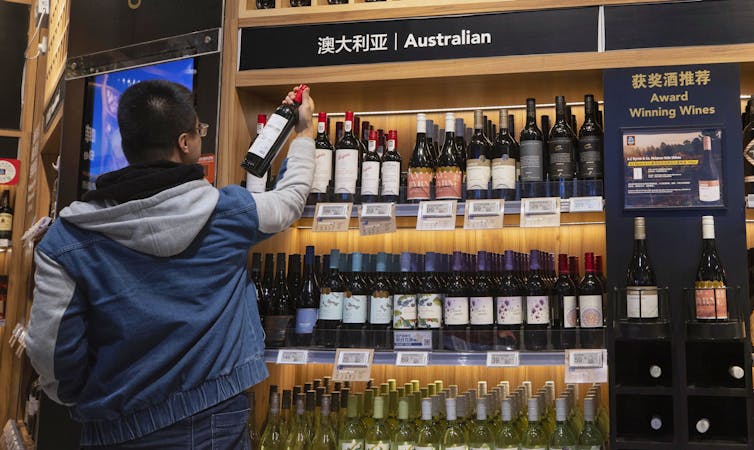 China introduced interim tariffs of up to 200% last year, then confirmed they would be locked in for five years.
ALEX PLAVEVSKI/EPA
China introduced interim tariffs of up to 200% last year, then confirmed they would be locked in for five years.
ALEX PLAVEVSKI/EPA
Many who do business with China probably feel the same way, but there can be a cost for speaking up. So effective has been the suspicion cast on corporate ties to China, that even the mildest critics from that milieu can find themselves pilloried for selling out the national interest.
My book is written, though, with an understanding that foreign policy is not so much a field of competing ideas as a field of competing interests. As much as Australia’s major parties are resolute in their loyalties to the US alliance, they also remain deeply beholden to corporate interests.
Read more: Morrison's dilemma: Australia needs a dual strategy for its trade relationship with China
In a field of foreign policy dominated by these two outsized influences, it can often feel as if our options are constrained.
China hawks don’t so much challenge the corporate influence on Australian policy as use it as a foil: if we don’t side with the United States, they ask, then what’s to stop Australia dropping its criticism of China for the sake of a buck?
I take this question seriously. Certainly, nobody wants corporate lobbyists writing Australia’s China policy. Even if that’s not on the cards, certain truths have been exposed about the nature of Australia’s transactional relationship with China, and about China itself, that naturally make people hesitant to endorse any return to “business as usual”.
The standard critique of “engagement” – that the West learned to live with a repressive party-state so as to advance its own political and economic interests – has much truth to it.
Compromises that were made to preserve and cultivate “the relationship”; a revolving door between politics and the corporate world; the blurry line between political lobbying and more dubious forms of influence-peddling: all of these issues and more have come into view.
Where does Australia go from here?
The solution seems obvious. What we need is a position not beholden to the paranoid vision of the security agencies or to the priorities of trade, but one that lives up to its profession of universal values.
This, of course, is where the structural constraints of foreign policy get in the way. To reorient Australia’s China politics in a more progressive direction, one capable of both defusing the brewing cold-war conflict and extending solidarity to people in China, there’s no getting around the fact that those constraints will need to be broken down. A wider range of voices and interests need to be represented in the making of Australian foreign policy.
Read more: Australians fear China-US military conflict but want to stay neutral: Lowy 2021 Poll
I sometimes talk about what “Australia” should do, but most of the time I’m really talking about what Australians should do. I’m sceptical that the Australian state, as it exists today, can be a principled humanitarian actor on the world stage – it’s simply not built for that purpose.
Similarly, with occasional exceptions, I avoid referring to a national “we”. The lesson to draw from today’s conflict over China policy is not that Australia is having trouble identifying its national interest, but that there’s really no such thing as a single national interest.
Global rivalries for economic and political dominance serve elite interests, but for the rest of us, they deplete public resources and endanger political freedoms.
To get out of the rut into which Australia’s China debate has settled, we need to recentre it on the interests that ordinary people in Australia and across Asia share in both combating oppression and resisting warmongering.
The array of questions that China raises for Australia today is daunting, far too diverse for anyone to claim expertise in them all. I’ve written my book not because these questions require a specialist, but because they’re too important to leave to the specialists.
Authors: David Brophy, Senior Lecturer in Modern Chinese History, University of Sydney


















