

how the IPCC reaches scientific consensus on climate change
- Written by: Rebecca Harris, Senior Lecturer in Climatology, Director, Climate Futures Program, University of Tasmania
 CC BY-ND
Climate Explained is a collaboration between The Conversation, Stuff and the New Zealand Science Media Centre to answer your questions about climate change.
If you have a question you’d like an expert to answer, please send it to climate.change@stuff.co.nz
When we say there’s a scientific consensus that human-produced greenhouse gases are causing climate change, what does that mean? What is the Intergovernmental Panel on Climate Change and what do they do?
The Intergovernmental Panel on Climate Change (IPCC) provides the world’s most authoritative scientific assessments on climate change. It provides policymakers with regular assessments of the scientific basis of climate change, its impacts and risks, and options for cutting emissions and adapting to impacts we can no longer avoid.
The IPCC has already released five assessment reports and is currently completing its Sixth Assessment (AR6), with the release of the first part of the report, on the physical science of climate change, expected on August 9.
Each assessment cycle brings together scientists from around the world and many disciplines. The current cycle involves 721 scientists from 90 countries, in three working groups covering the physical science basis (WGI), impacts, adaptation and vulnerability (WGII) and mitigation of climate change (WGIII).
CC BY-ND
Climate Explained is a collaboration between The Conversation, Stuff and the New Zealand Science Media Centre to answer your questions about climate change.
If you have a question you’d like an expert to answer, please send it to climate.change@stuff.co.nz
When we say there’s a scientific consensus that human-produced greenhouse gases are causing climate change, what does that mean? What is the Intergovernmental Panel on Climate Change and what do they do?
The Intergovernmental Panel on Climate Change (IPCC) provides the world’s most authoritative scientific assessments on climate change. It provides policymakers with regular assessments of the scientific basis of climate change, its impacts and risks, and options for cutting emissions and adapting to impacts we can no longer avoid.
The IPCC has already released five assessment reports and is currently completing its Sixth Assessment (AR6), with the release of the first part of the report, on the physical science of climate change, expected on August 9.
Each assessment cycle brings together scientists from around the world and many disciplines. The current cycle involves 721 scientists from 90 countries, in three working groups covering the physical science basis (WGI), impacts, adaptation and vulnerability (WGII) and mitigation of climate change (WGIII).
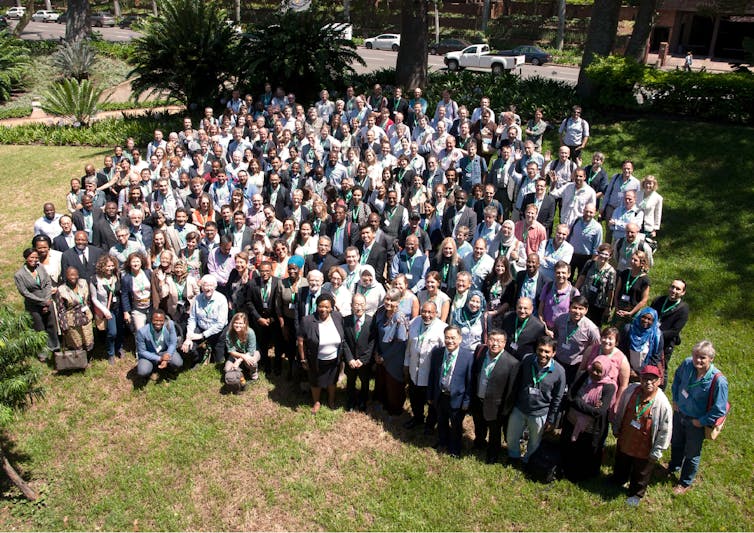 People contributing to IPCC reports come from 90 countries and different backgrounds. This image shows the Working Group II team.
Author provided
In each assessment round, the IPCC identifies where the scientific community agrees, where there are differences of opinion and where further research is needed.
IPCC reports are timed to inform international policy developments such as the UN Framework Convention on Climate Change (UNFCCC) (First Assessment, 1990), the Kyoto Protocol (Second Assessment, 1995) and the Paris Agreement (Fifth Assessment, 2013-2014). The first AR6 report (WGI) will be released in August this year, and its approval meeting is set to take place virtually, for the first time in the IPCC’s 30-year history.
This will be followed by WGII and WGIII reports in February and March 2022, and the Synthesis Report in September 2022 — in time for the first UNFCCC Global Stocktake when countries will review progress towards the goal of the Paris Agreement to keep warming below 2℃.
During the AR6 cycle, the IPCC also published three special reports:
People contributing to IPCC reports come from 90 countries and different backgrounds. This image shows the Working Group II team.
Author provided
In each assessment round, the IPCC identifies where the scientific community agrees, where there are differences of opinion and where further research is needed.
IPCC reports are timed to inform international policy developments such as the UN Framework Convention on Climate Change (UNFCCC) (First Assessment, 1990), the Kyoto Protocol (Second Assessment, 1995) and the Paris Agreement (Fifth Assessment, 2013-2014). The first AR6 report (WGI) will be released in August this year, and its approval meeting is set to take place virtually, for the first time in the IPCC’s 30-year history.
This will be followed by WGII and WGIII reports in February and March 2022, and the Synthesis Report in September 2022 — in time for the first UNFCCC Global Stocktake when countries will review progress towards the goal of the Paris Agreement to keep warming below 2℃.
During the AR6 cycle, the IPCC also published three special reports:
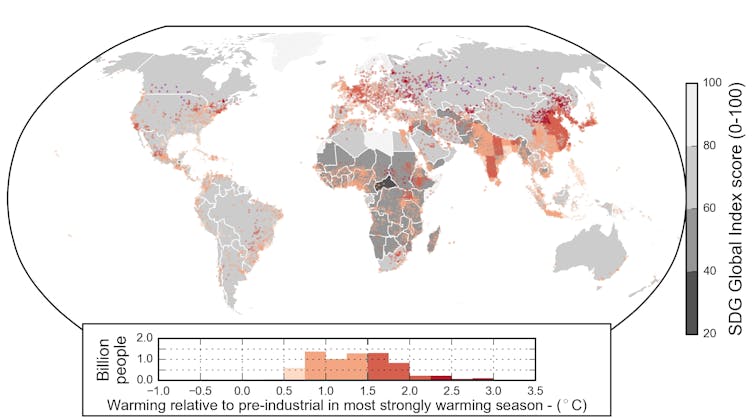 The IPCC’s special report on global warming at 1.5 showed present-day warming across the globe.
IPCC, CC BY-ND
How the IPCC reaches consensus
IPCC authors come from academia, industry, government and non-governmental organisations. All authors go through a rigorous selection process — they must be leading experts in their fields, with a strong publishing record and international reputation.
Author teams usually meet in person four times throughout the writing cycle. This is essential to enable (sometimes heated) discussion and exchange across cultures to build a truly global perspective. During the AR6 assessment cycle, lead author meetings (LAMs) for Working Group 1 were not disrupted by COVID-19, but the final WGII and WGIII meetings were held remotely, bringing challenges of different time zones, patchy internet access and more difficult communication.
Read more:
Top climate scientist: I put myself through hell as an IPCC convening lead author, but it was worth it
The IPCC’s reports go through an extensive peer review process. Each chapter undergoes two rounds of scientific review and revision, first by expert reviewers and then by government representatives and experts.
This review process is among the most exhaustive for any scientific document — AR6 WGI alone generated 74,849 review comments from hundreds of reviewers, representing a range of disciplines and scientific perspectives. For comparison, a paper published in a peer-reviewed journal is reviewed by only two or three experts.
The role of governments
The term intergovernmental reflects the fact that IPCC reports are created on behalf of the 193 governments in the United Nations. The processes around the review and the agreement of the wording of the Summary for Policymakers (SPM) make it difficult for governments to dismiss a report they have helped shape and approved during political negotiations.
Importantly, the involvement of governments happens at the review stage, so they are not able to dictate what goes into the reports. But they participate in the line-by-line review and revision of the SPM at a plenary session where every piece of text must be agreed on, word for word.
Acceptance in this context means that governments agree the documents are a comprehensive and balanced scientific review of the subject matter, not whether they like the content.
Read more:
IPCC 1.5℃ report: here's what the climate science says
The role of government delegates in the plenary is to ensure their respective governments are satisfied with the assessment, and that the assessment is policy relevant without being policy prescriptive. Government representatives can try to influence the SPM wording to support their negotiating positions, but the other government representatives and experts in the session ensure the language adheres to the evidence.
Climate deniers claim IPCC reports are politically motivated and one-sided. But given the many stages at which experts from across the political and scientific spectrum are involved, this is difficult to defend. Authors are required to record all scientifically or technically valid perspectives, even if they cannot be reconciled with a consensus view, to represent each aspect of the scientific debate.
The role of the IPCC is pivotal in bringing the international science community together to assess the science, weighing up whether it is good science and should be considered as part of the body of evidence.
The IPCC’s special report on global warming at 1.5 showed present-day warming across the globe.
IPCC, CC BY-ND
How the IPCC reaches consensus
IPCC authors come from academia, industry, government and non-governmental organisations. All authors go through a rigorous selection process — they must be leading experts in their fields, with a strong publishing record and international reputation.
Author teams usually meet in person four times throughout the writing cycle. This is essential to enable (sometimes heated) discussion and exchange across cultures to build a truly global perspective. During the AR6 assessment cycle, lead author meetings (LAMs) for Working Group 1 were not disrupted by COVID-19, but the final WGII and WGIII meetings were held remotely, bringing challenges of different time zones, patchy internet access and more difficult communication.
Read more:
Top climate scientist: I put myself through hell as an IPCC convening lead author, but it was worth it
The IPCC’s reports go through an extensive peer review process. Each chapter undergoes two rounds of scientific review and revision, first by expert reviewers and then by government representatives and experts.
This review process is among the most exhaustive for any scientific document — AR6 WGI alone generated 74,849 review comments from hundreds of reviewers, representing a range of disciplines and scientific perspectives. For comparison, a paper published in a peer-reviewed journal is reviewed by only two or three experts.
The role of governments
The term intergovernmental reflects the fact that IPCC reports are created on behalf of the 193 governments in the United Nations. The processes around the review and the agreement of the wording of the Summary for Policymakers (SPM) make it difficult for governments to dismiss a report they have helped shape and approved during political negotiations.
Importantly, the involvement of governments happens at the review stage, so they are not able to dictate what goes into the reports. But they participate in the line-by-line review and revision of the SPM at a plenary session where every piece of text must be agreed on, word for word.
Acceptance in this context means that governments agree the documents are a comprehensive and balanced scientific review of the subject matter, not whether they like the content.
Read more:
IPCC 1.5℃ report: here's what the climate science says
The role of government delegates in the plenary is to ensure their respective governments are satisfied with the assessment, and that the assessment is policy relevant without being policy prescriptive. Government representatives can try to influence the SPM wording to support their negotiating positions, but the other government representatives and experts in the session ensure the language adheres to the evidence.
Climate deniers claim IPCC reports are politically motivated and one-sided. But given the many stages at which experts from across the political and scientific spectrum are involved, this is difficult to defend. Authors are required to record all scientifically or technically valid perspectives, even if they cannot be reconciled with a consensus view, to represent each aspect of the scientific debate.
The role of the IPCC is pivotal in bringing the international science community together to assess the science, weighing up whether it is good science and should be considered as part of the body of evidence.
Authors: Rebecca Harris, Senior Lecturer in Climatology, Director, Climate Futures Program, University of Tasmania


















