

Aggressive marketing has driven the rise of the double-cab ute on New Zealand streets — time to hit the brakes?
- Written by: Kirsty Wild, Senior Research Fellow, Public Health, University of Auckland
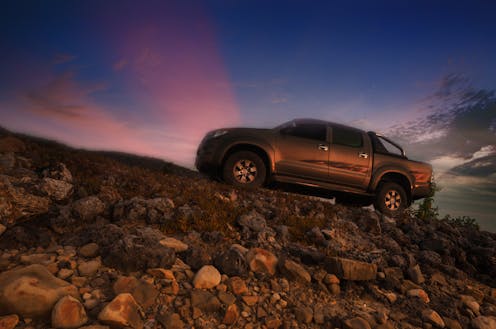
“Explore your inner beast.” That was the slogan used last year to sell the Ford Ranger. At 2.4 tonnes, that’s a lot of “light” truck, but the stakes are rising. This year, the 3.5 tonne Ram 1500 “eats utes for breakfast”.
Super-sized light trucks have landed in Aotearoa New Zealand. Eight out of the ten top-selling passenger vehicles are now utes or SUVs, with two-thirds registered for personal use.
According to the Household Travel Survey, many journeys previously made using much smaller cars (such as shopping trips) are now made in these vehicles.
And despite the recent protests from farmers and tradies about the so-called “ute tax”, the double-cab light truck has become very much an urban vehicle.
When we looked at the marketing videos for these vehicles in New Zealand, utes or pickups enjoyed the most “masculine” marketing strategies. Themes of dominance and violence are strong: vehicles have names like “Raptor” and “Gladiator”, and are referred to as “muscular” and “beasts”.
Much of the advertising involves images of aggressive driving — skidding and jumping, with the vehicle generally shot from below, travelling fast at the camera. SUV marketing is slightly more unisex and emphasises safety, luxury and envy.
Trucks versus cars
But here’s the problem: climate change is also super-sizing, as the recent extreme heat wave in the Pacific Northwest of the US and Canada and severe floods in Europe and elsewhere have reminded us.
Light trucks on city streets are bad for the climate in two ways. Due to their weight and size, they emit more CO₂ than other vehicles: in a year’s typical driving, 100 Ford Rangers would emit 90 tonnes more CO₂ than the same number of Toyota Corollas.
And large vehicles affect the urgent shift to low-carbon modes of transport, by obstructing footpaths because they’ve outgrown car parking, making cycling and walking more difficult and dangerous.
Cyclists and pedestrians struck by one of these vehicles are roughly twice as likely to die or be seriously injured compared with a crash involving a small car.
Nature as marketing tool
Ironically (but deliberately), nature and the ability to connect with the countryside are an enduring marketing theme for selling large four-wheel-drive vehicles to urban dwellers.
As cultural historian William Rollins has pointed out, SUV marketing has exploited and twisted a “developing environmental consciousness” into demand for high-emission vehicles. In the process, time needed to develop cleaner vehicles was lost.
Read more: Nature is a public good. A plan to save it using private markets doesn't pass muster
In New Zealand, the shift to larger SUVs and utes has largely wiped out the fuel efficiency gains made over the past ten years. Globally, the SUV market was the only industry sector last year where CO₂ emissions continued to rise despite the pandemic.
The growth in SUV sales has been identified as the second-most-important reason why CO₂ is continuing to rise.
Not a new story
But this isn’t a new story. Detroit auto journalist Keith Bradsher’s 2002 book, High and Mighty: SUVs – the world’s most dangerous vehicles and how they got that way, documents the now familiar risks: high emissions, deadly to other drivers and pedestrians, and prone to fatal “rollovers”.
He also provides an extraordinary ethnography of the advertising strategy that formed around these vehicles — some of which now rival the size of a WWII tank.
Marketed at our “reptilian” instincts for safety, dominance and connection to the natural world, it had a strong Hobbesian flavour. Life – particularly city life – is nasty, brutish and short. One must dominate or be dominated, even on that trek to the supermarket in search of cat food.
Bradsher’s interviews with marketing executives revealed a deliberate strategy to market these vehicles to consumers with higher levels of egotism, insecurity and status anxiety. New Zealand research with SUV drivers has also shown they were more likely to agree with the statement that “most people would like a vehicle like mine”.
Auto industry goldmine
New Zealand has been a dream market for urban light trucks. With weak emission standards and vehicle safety ratings that prioritise drivers over other road users, the regulatory frameworks have created an environment ripe for vehicle super-sizing.
This, too, is a familiar story. The American pickup famously came about as a result of a trade war with Europe that locked foreign competitors out of the US market. The all-American pickup truck came to enjoy a range of exemptions from environmental and safety regulations.
Read more: How the Ford F-150 became king of cars
Since then they’ve been a gold mine, with profits on SUVs and utes much higher than on cars, and the auto marketing machine swinging in heavily behind these vehicles.
Around 85% of Ford’s ad spend is now devoted to SUVs and utes. The US$35 billion global auto marketing industry is now largely focused on selling them, including into emerging markets in India and Brazil.
Change is coming
Big-budget marketing campaigns for these high-emission vehicles are now becoming a flashpoint over the role of the advertising sector in climate change.
UK organisation Badvertising, which has called for an ad ban on the dirtiest third of these vehicles, argues advertising should be “named and shamed” like other industries that indirectly contribute to climate change (such as banking and investment).
But the advertising industry itself may be part of the solution. Creatives working with governments on ambitious decarbonisation targets are speaking up about the “tide of misinformation” they face from corporate advertising.
Read more: Mass-market electric pickup trucks and SUVs are on the way
While marketing spends may still be weighted heavily in favour of the auto industry, there are ways of promoting smaller, cleaner, safer vehicles:
make planetary health warnings compulsory in all advertising of high-emission products
ban the marketing of the dirtiest third of those vehicles
bring forward New Zealand’s import ban on those same vehicles from 2035 to 2025
establish low-emission zones in cities
ban marketing of diesel vehicles that don’t meet latest European emission standards.
And finally, a big one: adopt new advertising codes of ethics to end the promotion of high-carbon lifestyles and products.
Mia Wisniewski, Master of Public Health candidate at the University of Auckland, contributed to the research for this article. Analysis of SUV/ute advertising themes in New Zealand was undertaken as part of her MPH thesis.
Authors: Kirsty Wild, Senior Research Fellow, Public Health, University of Auckland


















